Fencing is a sport for people with strong forearms and a stronger intellect. Or as Rene Enrique Castellanos-Brandon, a spry 73-year-old foil and epée coach, told me when I arrived at class: “Fencing is for smart people. You’re doing physics.”
As I watched the regulars show up early to work on conditioning exercises like jump-squats across the pistes (those strips on the floor where matches take place), he continued: “We have a lot of engineers, chess players — people who take good care of their minds and bodies.”
“Got it, no beers after class,” I joked, feeling out of my element.
“That’s what we call a carbohydrate — fine in moderation,” Castellanos-Brandon quipped back, as if to say that everyone is welcome.
It was my first time fencing, but my dad dabbled when he was younger, and I had always been curious about the caliber of workout. When I noticed fencing gained more visibility during the 2024 Paris Olympics, I had to try it. Fortunately, the Fencing Center of Chicago warmly welcomed me, along with one other novice in the group. So I put on a chest protector and suited up for a mentally and physically exerting experience.
How to Hold a Sword
For my beginner class, I used an epée, a French sword with a larger guard compared to other swords. Castellanos-Brandon explained that the guard acts as a shield. I held the epée in my right hand using a French grip. Each sword has a handle beneath the guard, where you place your dominant thumb on top and index finger underneath. Below this, there’s also a place for your remaining three fingers, but I was instructed that the thumb and index fingers do most of the work, whereas the other three fingers provide support.
As is often the case in recreational fencing, there was a plug next to the handle for a cord that ran through my jacket sleeve and down my back like a tail. (Castellanos-Brandon kindly tied it for me before I tripped.) One end of the cord would later be plugged into a scoring machine, and the other into the sword to keep score of a “match” I would have later.
Holding the sword was challenging in itself because it required a particular kind of muscle control from the forearm, while allowing other muscles in the arm to remain flexible. Like a lot of newbies, I had to be reminded by Castellanos-Brandon to relax my arm several times before noting, “fencing uses core and arm muscles you didn’t know you had.”
Footwork Is Everything
Growing up, Castellanos-Brandon had to master footwork before he was allowed to pick up a sword. “Back then, people were still having duels,” he said. According to the r/fencing subreddit, a lot of fencing aficionados talk about the old days in these terms. Duels historically refer to real combat that would draw blood, but fencing is a safe sport derived from the tradition. Now the stakes are lower, and fencing footwork is taken almost as seriously today.
The footwork portion reminded me a lot of ballet, and not just because I was bad at it. However, the first position in fencing is slightly different, where you place your ankles together at a 90-degree angle with your dominant side facing forward. From there, we shifted into the “en garde” stance by lunging forward about a foot and a half, then bending both knees. From there, we ran drills shuffling forward and backward as Castellanos-Brandon shouted out commands. Finally, we picked up swords — not to fight, but to practice shuffling back and forth with a blade pressed against our opponents.
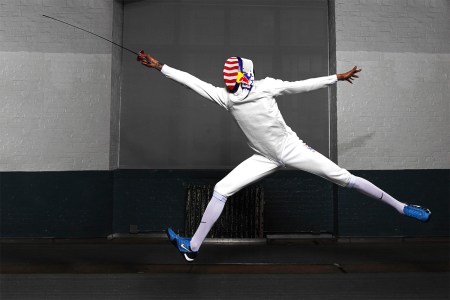
How a World Champion Fencer Is Preparing for the Paris Games
Miles Chamley-Watson on advice he got from Kobe Bryant, working out with Lewis Hamilton and his Olympic routineHow to Even Out Your Sides
After a few more basic and offensive moves, my fellow newbie and I had what was generously referred to as a match. It was hard to catch my breath under the mask while laughing so hard at myself, but I managed to get a few points on the board. When I took a water break, I noticed that although the cardio I was getting was great, my arm workout was one-sided.
Castellanos-Brandon pointed me to the weights in the corner and walked me through several forearm exercises to even things out. He also informed that serious fencers tend to train with a weapon on both sides, even if they’re not ambidextrous, for the same reason. It was far from a marketing ploy, but I did think about coming back for my left side the following week.
It’s Not Just a Physical Exercise
I can say with my full chest plate that fencing is a great workout — and not just on the physical side. Having to listen to instructions and use my body in a different way left me mentally exhausted the next day, and perhaps slightly smarter. At least I now know the French word for sword.
And if you’ve never even considered the activity before, keep an open mind. Case in point, I struck up a conversation with a guy who had been fencing for six months. He told me how he grew up playing soccer his whole life and wanted to go pro, but got so many concussions that his doctor told him he could never play sports again.
“Until he found fencing!” Castellanos-Brandon chimed in before pointing out how soccer made him a natural at footwork. Outside of the sport itself, the kid’s outlook impressed me. When you have so much of your identity wrapped up in one thing and are suddenly not able to do that, figuring out what’s next can be debilitating for a lot of adults. And the fact that he mastered this with a sword was cool to see.
As much as I would come back to fencing class just for a fun workout, what I loved most about fencing was how it made me use my brain in a different way. That’s why I would recommend it to anyone who wants to get smart (and a little jacked) at the same time.
More Like This
Twice a week, you'll find guinea pig features, personal essays and expert interviews on living better — for however long you’re here. Subscribe to Champ now.