
Landon Donovan Is an Open Book
Ahead of the release of his new memoir, the soccer legend opens up about the struggles under the surface of his hall-of-fame career
The Gist
Landon Donovan's forthcoming memoir candidly reveals the profound mental health crisis he endured during a 2013 Cambodian retreat, a period publicly misread as a mere sabbatical, and chronicles his lifelong struggle with immense pressure, self-discovery and eventual peace.
Key Takeaways
- Donovan's 2013 trip to Cambodia, widely perceived as a break, included a severe hallucinogenic episode that nearly led him to suicide.
- He credits breathwork and therapy with his therapist Juliet for guiding him through mental health challenges and fostering self-forgiveness.
- The memoir details the intense pressure placed on him by U.S. Soccer from age 16 and his eventual reconciliation with his estranged father.
In early 2013, Landon Donovan traveled 8,000 miles from Los Angeles to an island resort off the coast of Cambodia. He took two planes, a three-hour car ride along lunar roads and a boat to reach his final destination, Song Saa, which looks like this. Ogygia with bungalows.
The idea was to go somewhere where no one could possibly know who he was. Donovan brought his book to the beach, watched sunsets from his pool deck, got scuba certified and had staring contests with seahorses. As the days inched by, he made friends with the staff and played pick-up soccer with local kids on nearby Koh Rong. When he returned to the United States, he rolled the trip into another 100 days of rest. Sports media had lots to say about his time away.
ESPN asked the then-31-year-old to define his time off as a “sabbatical, self-imposed exile or leave of absence.” The New York Times noted the public divide on whether Donovan’s trip was “necessary, appropriate [or] worthwhile.” Alexi Lalas, the face of the U.S. men’s national team before Donovan came along — and later his teammate and general manager in Major League Soccer — told the Times: “There is an element, when it comes to Landon, where you just want to slap him in the face and say, hey, snap out of it.”
The USMNT universe largely felt that Donovan, the program’s all-time leader in goals and assists, should’ve been focusing on the upcoming World Cup. He’d just won the MLS Championship with David Beckham, after finishing first in the league in assists. He’d completed another successful loan to Everton, then a top-10 side in the English Premier League. Why waylay all that momentum with an inexplicable solo vacation?
What people didn’t know at the time is Donovan almost didn’t survive that trip to Cambodia.
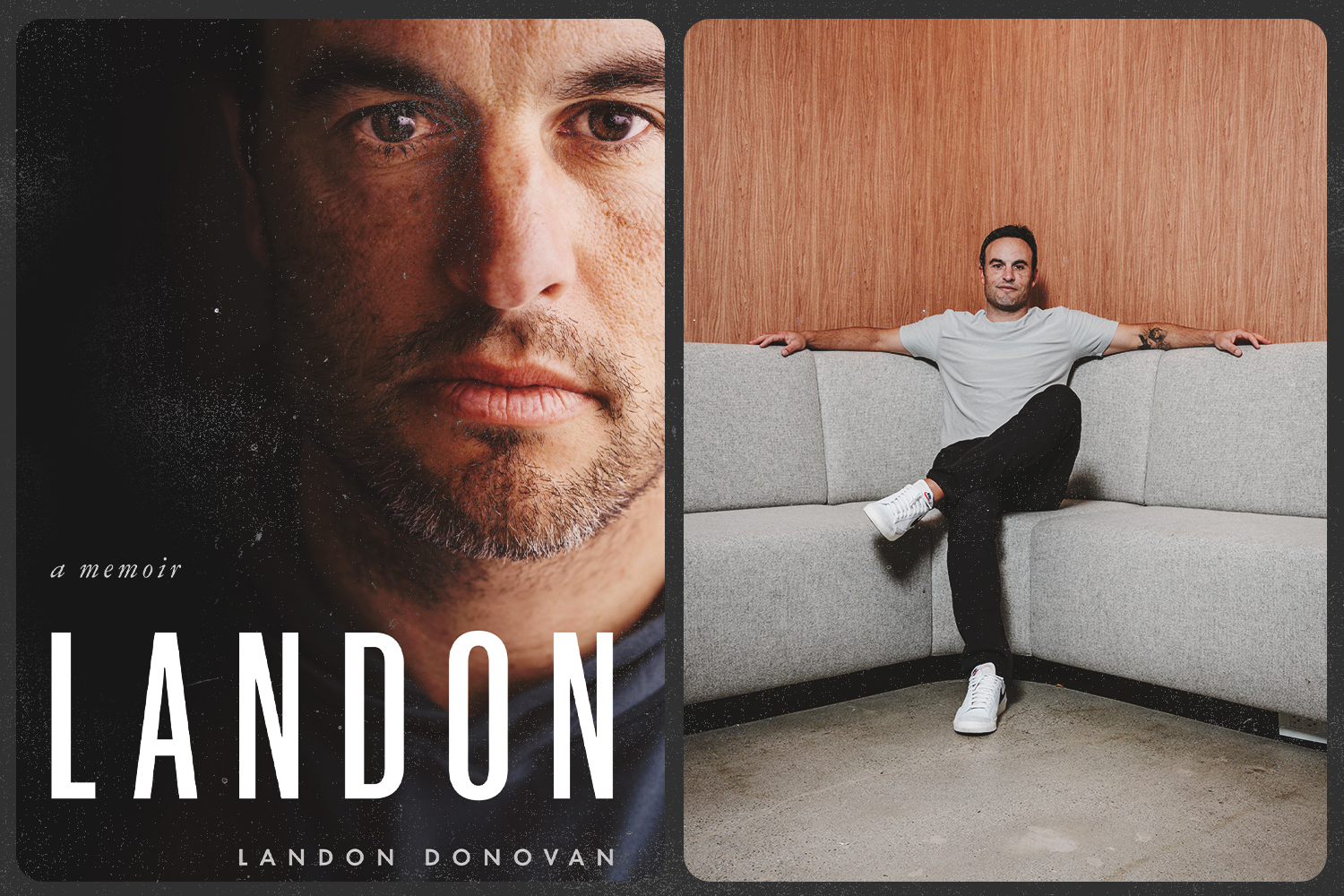
In his new memoir Landon, which releases on March 24, the long-retired, 44-year-old star recounts how close he came to taking his own life on that trip. After smoking a joint with a duo he met on the island, he reported feeling zero effects and prepared for a restful night of sleep. Instead, he suffered through a nightmarish, night-long hallucinogenic episode, completely alone. There were worms in his sink. Frogs all over the floor. And a voice in his head, urging him to throw himself into the ocean.
“Breathwork saved my life,” Donovan told me last week. “I’m not being hyperbolic, it literally saved my life. I was in this space where if I opened my eyes, I would go crazy and I would see shit. And if I closed my eyes, my body was saying: Just go jump off the cliff. Just end it. Just go get it over with. I was stuck in this in-between. Finally, by some miracle, I just said, ‘Let’s go back to the breath,’ because that’s what meditation is. You see stuff going by, and you go, ‘Okay, let’s go back to the breath. Let’s go back.’ You just do it over and over. And that got me through it.”
The next day, exhausted and terrified, Donovan finally managed to get on the phone with his therapist, Juliet. He wanted to get on the first plane out of Cambodia. She convinced him to stay put — to recuperate, to eat lots of food, to lean on anyone available to help him. “Do not get on a plane,” Juliet told him, as he writes in the book. “That’s the worst thing you can do. What’s going on is biochemical…the day you come back, I want to see you. If there’s a need for medication, we’ll cross that bridge.”
Donovan spent the last 72 hours of his trip in a dark depression. “I lie on the beach and try to stay near people,” he writes. “I feel physically unable to do anything. I can barely get myself up off the sand…I feel like a failure.”
U.S. Soccer Anoints Its Savior
Half his life earlier, Donovan was a skinny 16-year-old sitting in the front row of a U.S. Soccer press conference. In the team’s final friendly before the 1998 World Cup, the USMNT had failed to score against Scotland, a beatable side. A gallery of reporters wanted answers from Coach Steve Sampson. He waffled, then used Donovan as a life raft, pointing him out and telling the journalists they’d be writing about this kid one day.
“It was the first time I felt that boulder of pressure laid on my back by the federation or had a glimpse of just how big the mountain was that U.S. Soccer wanted us to shoulder,” Donovan writes in his memoir.
By “us,” he specifically means the ’82s. In youth soccer, players are typically arranged by their birth year, and the 1982 cohort included Donovan, as well as running mates DaMarcus Beasley and Oguchi Onyewu. Theirs was the first U.S. Soccer cohort to train and live together from their teenage years. (They had a residency at IMG Academy, the behemoth sports development institution in Bradenton, Florida, which today claims alumni like Maria Sharapova, Joe Mauer and J.J. McCarthy.)
The goal was for the Americans to win the World Cup in 2010, and even 12 years away, there wasn’t a moment to waste. (U.S. Soccer would finish dead last in the 1998 World Cup; the team was officially knocked out by Yugoslavia, then in the midst of a brutal civil war.)
In the new millennium, Donovan would be the answer to any journalist’s annoying question. The wunderkind from Joan Didion’s California, who grew up “American poor” with a twin sister, a mom who taught special education and an estranged father who slowly stopped showing up for the twins’ handoffs at the McDonald’s on Fourth and Cucamonga — that Landon Donovan would need to keep his head screwed on tight if his 5-foot-8 frame was going to carry the weight of a nation’s ambitions and embarrassments.
“I was always under a microscope. From the time I was 16, my whole life was dictated for me,” Donovan told me. “This is when you train, this is when you have the day off, this is when you play, this is when you travel, this is where you stay. I was supposed to live life a certain way — you can’t make mistakes and you can’t be a kid ’cause now you’re a professional. Now you’re a man.”
Donovan wrote Landon with Ryan Bergman, an entrepreneur and corporate keynote speaker. The duo took inspiration from Andre Agassi’s Open, which is considered one of the best sports memoirs ever written.
“That was the template for me because he was so open and so vulnerable,” Donovan said. “In the first few pages, he’s like, ‘I hated tennis.’ What? This guy who was one of the best ever hated tennis? There were times that I was ready to quit soccer in my early twenties. When I was just like, I’m done. I’m not doing this because it’s not worth the pain.”
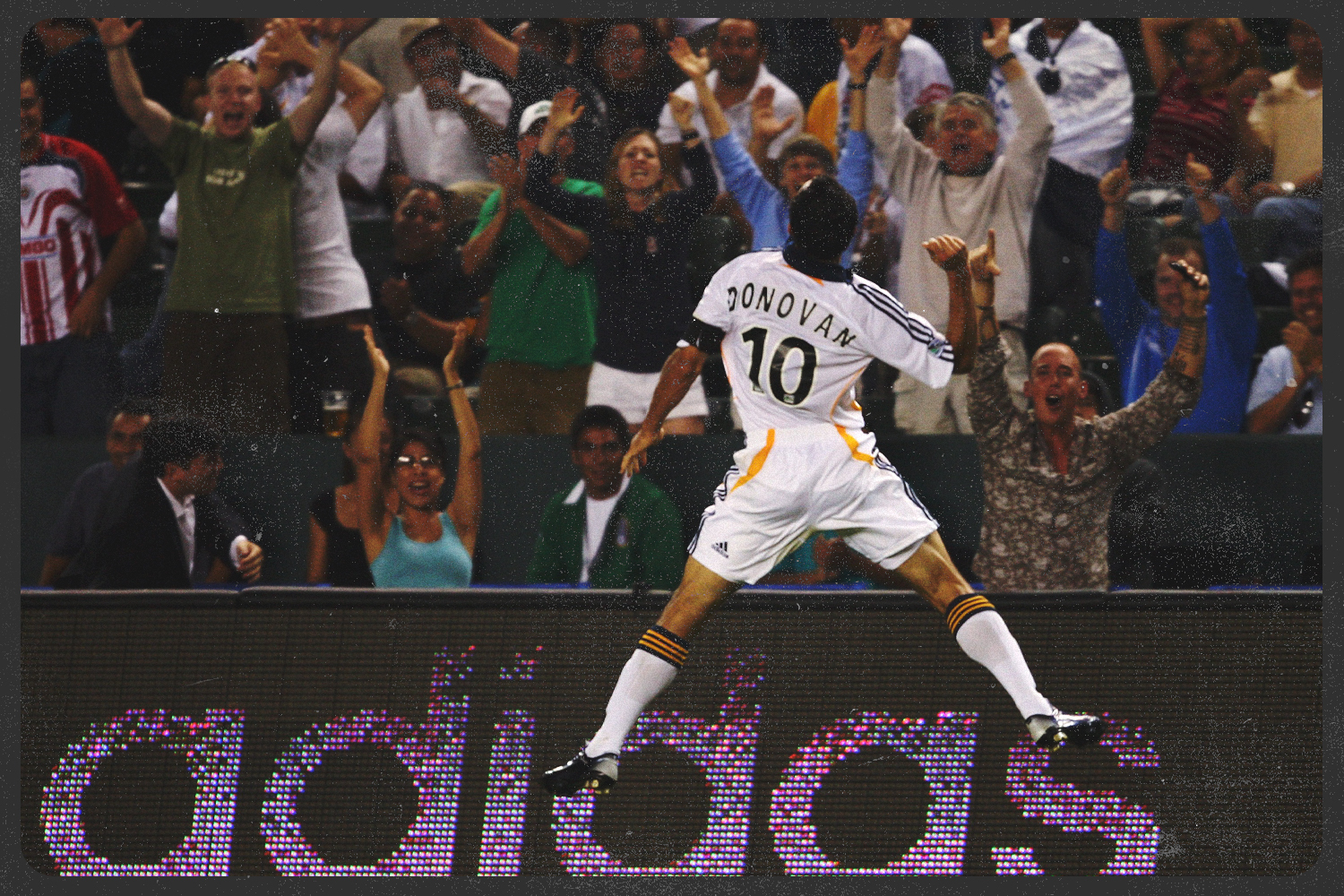
Surprising admissions like that mirror the near-surreal experience of reading this book. It’s hard to imagine Landon Donovan retired at 25. It’s unfathomable to imagine him dead at 31. But they’re a reminder that the whole time we were growing up or growing old — watching #10 drag the MLS from a fringe league with broken faucets to a $20 billion enterprise; watching him score that glittering goal against Algeria; watching him establish Dos a Cero — Landon Donovan was never a superhero.
He was the older version of a boy who once raced through his homework so he could run outside to scrape his knees on San Bernardino cement. Who loved soccer so much he’d gotten too good at it. Who watched the sport morph from a joy to a job quicker than he could process the pieces of his young life.
On the Other Side of Forgiveness
There was the misery of his loan to Bayer Leverkusen. Sitting alone in a German apartment at age 17, eating bland food, a Southern California kid under gunmetal skies, trying to learn the language, make friends and see the pitch.
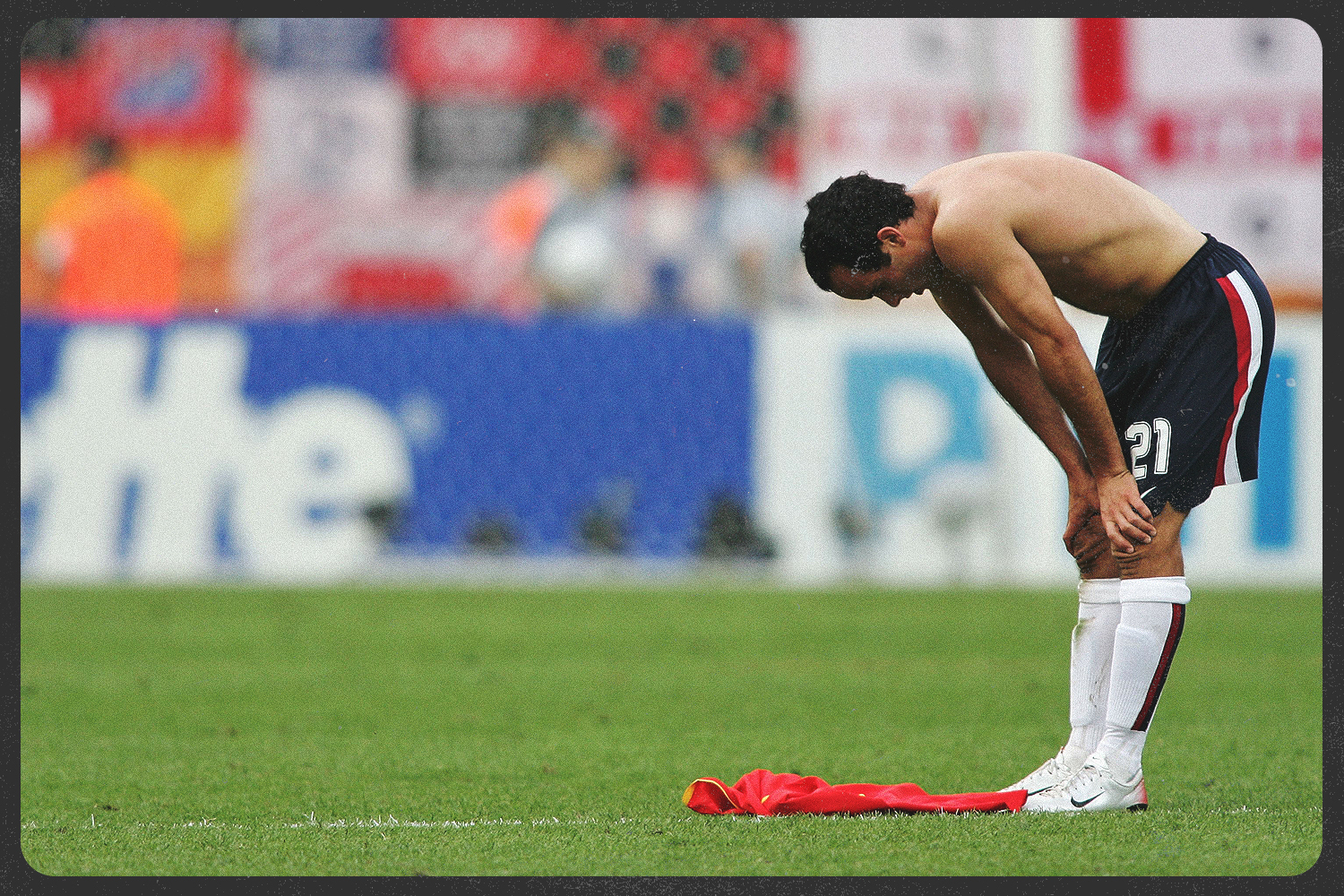
There was the early exit from the 2006 World Cup, the year the Americans were supposed to announce themselves but only managed one lousy goal. Afterwards, some pundits didn’t even bother calling it a disappointment: “The United States wasn’t all that good to begin with.”
There was his protracted breakup and eventual divorce from the actress Bianca Kajlich, whom he’d started dating at the age of 21.
Each instance of situational depression threatened to swallow Donovan whole. Each bout buried the chest containing the great questions of his childhood deeper into the ocean, where it lay barnacled, beating and shut tight — too heavy to drag to shore, even if he tried.
But he found a way forward. He held tight enough to his lifelines, those people in his life who encouraged him to lead with empathy, to trust that progress isn’t linear, to seek help. His mother Donna Kenney-Cash, his sister Tris and his agent Richard Motzkin were among them. And it was Kajlich who took him to a meditation class with Juliet, a few years before she became his therapist.
Still, given the era Donovan played in — and the entrenched stigma around masculinity and mental health at the pinnacle of sport — it was a miracle he found his way to therapy.
We’ve come so far since the aughts. In recent years, elite athletes like Michael Phelps, Simone Biles, Kevin Love, Jarren Duran and Naomi Osaka have spoken openly about depression, anxiety and even suicidal ideation. Professional leagues and clubs now provide access to sports psychologists, psychiatrists and peer mentor programs. They grant leaves of absence and are more thoughtful about protecting players from the media. But at Donovan’s peak, such public support or understanding was rare.
The biggest revelation was how much my identity had become ‘Landon Donovan’ — that I’d lost everything about who I really am at my core.
– Landon Donovan
Donovan’s first breakthrough with Juliet came on his very first day in her office, after she interrupted what he remembers as a “20-minute diatribe.” He recalled her saying: “‘I don’t want you to be a storyteller in here. That’s not how this is going to work. I want to actually get to something much deeper.’ And the biggest revelation was how much my identity had become ‘Landon Donovan’ — that I’d lost everything about who I really am at my core. That was the biggest aha moment.”
She encouraged him to dive into his memories, to pinpoint where “Little Boy Landon” had officially disappeared. She taught him the meditation routine that would one day save his life. “In through the nose, out through the nose,” he illustrated for me, closing his eyes. “When thoughts come, you recognize them. You don’t judge yourself for having them. You go back to the breath.” She maintained that true peace could only be found on the other side of forgiveness.
In fits and starts, Donovan brought amends and accountability into his life. He had a heart-to-heart with Beckham, realizing he’d made the English supernova’s transition to MLS harder than it needed to be. He had a magical spell with Everton, where he played with a raw presence and joy he hadn’t known since childhood. He forced himself to confront the cracks in his relationship with Kajlich and the role he’d played in its ultimate fracture.
He started creating off-the-field rituals with teammates that would’ve seemed unthinkable during his years of “monk-like training.” In 2011, he and a trio of teammates had a shot of Louis XIII cognac after each game. “For the first time in my career, not only did I feel like a reliable teammate,” he writes. “I felt like a reliable friend.”
Someone Else’s Story
This is one of my favorite lines in Landon: “If you took the time to learn someone else’s story, you’d have compassion for anyone.”
Donovan’s dad, Tim Donovan, was the oldest of five siblings. When his parents divorced, they sent the kids to relatives all across Canada. Eventually they got back together and recalled the kids one by one, except for Donovan’s dad. He stayed in Nova Scotia, abandoned at the age of 11.
Over the years, the Donovans’ father-son relationship had taken deep gashes from a poisoned blade. At one point, the elder Donovan tried to elbow his way into a manager role for his phenom son; later, after a fight in Kansas City, the younger Donovan cut off their relationship with an epithet-laden email. Even when his dad got nasal cancer, Donovan stayed away. He was still the hurt boy — waiting in vain on the hard plastic at McDonald’s.
Therapy spurred action. Donovan reached out to his dad, fulfilling the dearest wish of his sister Tris, who’d maintained her own relationship, however imperfect, with her father all those years. Tim Donovan was now living in Nashville, cancer-free. Father and son met a few times, and prompted by Landon, started talking about where their relationship had blown off course. One day, they played. Tim was now in a roller-hockey league (a lifetime ago, he’d played semi-pro ice hockey). Landon put on pads and blades and played a full game with Tim, then got beers with the team after. It’s a deeply moving part of the book, and when I mentioned it to Donovan, he pointed proudly to a photo of that day on the shelf behind his desk.
“Dad says he’ll never forget that day,” Donovan writes. “Neither will I. I’ve had some great days on the soccer field, achieved some amazing things. But if I’m ranking the top five moments of my life, you can put playing hockey with my dad right at the top.”
The Three Ms
Song Saa was supposed to be Donovan’s Alaska. Years earlier, he’d sat in a dark movie theater in Manhattan Beach and cried as Eddie Vedder’s gravelly voice spelled the end of Into the Wild. The movie leveled him.
When he took his controversial sabbatical from professional soccer in 2013, the goal was to finally have his Christopher McCandless moment. “In the movie, it’s very different circumstances,” Donovan said, “but he feels the same way. He feels like he’s supposed to go to law school and then graduate and be a lawyer. There’s a path he’s supposed to take. But he’s like, ‘That’s not me. That’s not the real me. I just want to be free and find out who I am at my core.'”
In the end, Donovan did get to experience a fundamental lesson of that movie. As his boat sped away from the Cambodian island, he reflected on the final words a dying McCandless scratched in his journal: HAPPINESS ONLY REAL WHEN SHARED. Donovan’s progress hadn’t been linear; there was still so far to go. But he knew he was ready to let others in, to haul the barnacled chest out of the ocean and pry the thing open once and for all.
Breathwork saved my life. I’m not being hyperbolic, it literally saved my life.
– Landon Donovan
Donovan married Hannah Bartell in 2015. Eleven years later, they have three kids together and live on a lemon grove in San Diego. I asked Donovan if he would have felt prepared for fatherhood if he hadn’t reconnected with his own father.
“I certainly wouldn’t have been as prepared because there’s a version of parenting where you do what your parents did, and it’s unconscious and not always healthy,” he said. “But there’s a version, too, where you do the opposite of what your parents did because you don’t want your kids to ever go through what you went through. I don’t want to do what my dad did, but I also don’t want to go the opposite and become what I see so often now, where people have this obsession with their children and they can do no wrong and it’s always everyone else’s fault and the teacher’s wrong.”
Tim Donovan passed away this past December. “My kids had a real connection because they saw how much I loved him,” Landon told me. “I was able to forgive him in a meaningful way, in a real way, and I think that just allowed me also to share him with my kids in a real way. They saw me crying in December when he passed and how much it meant to me, and I think that really helps them.”
Donovan’s capacity to process his father’s death helped heal tangential wounds, too — his sister took his father’s death really hard. “I was able to empathize and take it hard too,” he said. “If I didn’t have the forgiveness and the reconciliation, I wouldn’t have felt the same way she was feeling. I know a lot of people whose parents aren’t around. When they die, they don’t even cry. It’s just like, ‘All right, well.'”
All the work he’s done also protected him from slipping into another bout of situational depression. “When dad passed, I realized I’m way better equipped to understand my feelings. I was depressed during that time, but managing it in an appropriate way — and knowing that it’s all going to be okay, it’s going to pass.”
Donovan specifically relies on what he calls his “three Ms”: medication, meditation and his mother. “I have this incredible mom who went through so much shit with us and never complained, ever. She’s just a rock.”
Landon, Now
It’s tempting to picture one’s quest for peace like a lifelong X axis, a straight drive into a sunset highway. But peace isn’t defined by space or time. It’s something that comes and goes, like the people we love. We’re born with it, and as adults, we can find it again if we dare close our eyes and breathe. Peace is in silence, in reflection, in tomorrow. It’s blinking then gone, a firefly. That capturing it takes effort is what makes it worthwhile.
Donovan has reclaimed pockets of peace from writing this book. The process took him back to the dusty cul-de-sacs of Ontario, California, where his peace was playing into dusk. He’s reflected on early, peaceful decisions that he maybe didn’t give himself enough credit for, like staying in MLS, close to home, back when Americans were clamoring for him to test his talent against Europe’s best. “My mom used to say: if you’re not enjoying it, don’t do it,” he recalled.
Donovan told me he’s enjoyed “humanizing himself,” and that he hopes this memoir will help a lot of people. It’s his contribution to others’ journeys, while he stays on his own wayward axis. Peace remains at the forefront of his mind and routine. “There are things I try to do to bring myself peace every day,” he said. Simple stuff: he swims, plays hockey and walks the dog. He likes to get on the Peloton and “blow up” his lungs. He goes on adventures with his family. He still practices meditation.
I was curious how he feels about the upcoming World Cup, after bearing U.S. Soccer’s dreams for so many years. This year, the tournament will take place on North American soil for the first time since 1994.
“Back then, I was 12 years old and I went to the Rose Bowl to see Romania play Argentina in a knockout game. I was like, ‘Oh my God. This is what this can be with 100,000 people here.’ I was hooked,” he said. “My hope for this summer is that millions of girls and boys have the same experience. I hope [Team U.S.A.] make a deep run into the tournament because the eyeballs and the attention will get exponentially bigger every step you go. I hope they have a few really iconic moments that just grab the nation.”
He looked down at his arm and smiled. “I just can’t believe it. I get goosebumps saying it.”
I couldn’t tell what had moved him — whether the memories were flooding back, or he was filled with hope about whatever lies ahead.

More Like This



Twice a week, you'll find guinea pig features, personal essays and expert interviews on living better — for however long you’re here. Subscribe to Champ now.