“Do you remember the Triwizard Tournament?” Jack asks.
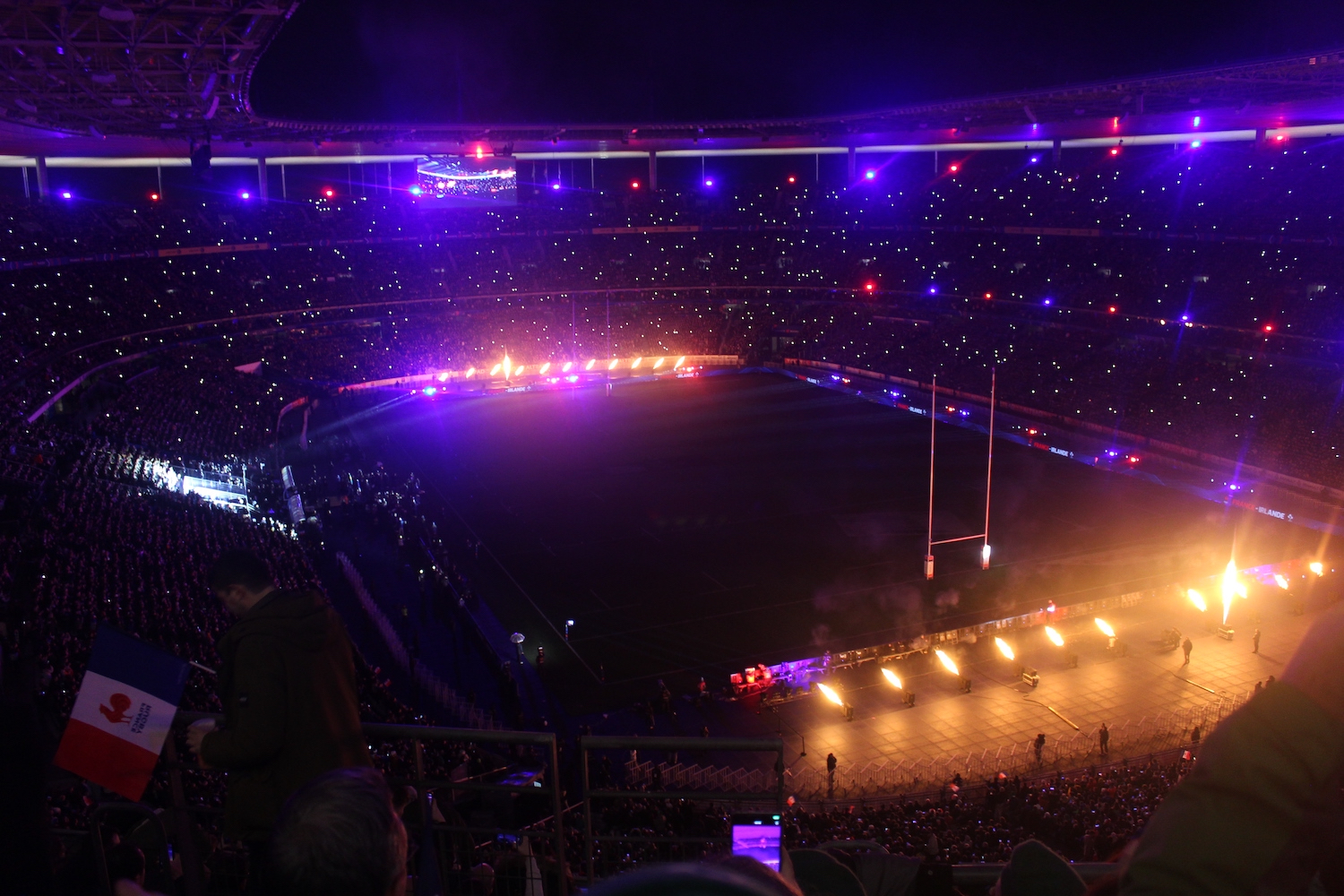
The lights dim and the stadium rumbles with anticipation. Then, the show begins: shades of blue and red, white and green dart and flash across the field and into the stands. Fireballs shoot from each end zone in time and rhythm to a bouncing bass. From our seats we can see the players lined up in the tunnel at the 50-meter line. Each member of the starting 15 runs out to a royal welcome.
“Antoine!” the announcer yells. “DUPONT!” respond 80,000 French fans.
Each team lines up facing the stands, arm in arm, for their national anthem. A line of green behemoths on the left. A line of blue on the right. Quiet for the Irish national anthem. And then comes the roar of the French.
Jack is right. There’s a magical energy in the air for the opening match of the 2026 Six Nations Rugby Tournament, held in a sold-out Stade de France just north of Paris.
He’s the reason we’re in Paris at all. Jack Iscaro is a longtime friend and former rugby teammate from our days at UC Berkeley. He’s currently part of our men’s national team, USA Rugby, also known as the Eagles.
But Jack dropped everything when an opportunity arose to play overseas. Within four days, he was in Paris for medical tests. Now, he’s on a two-year deal to play prop for Stade Francais in France’s top professional league. He is one of only a handful of Americans who have ever managed to play overseas at this level. His achievement is roughly equivalent to an American soccer player cracking a top Premier League team.
Brutal and Beautiful
Rugby has been called the sport of hooligans played by gentlemen. Its foothold in the U.S. is relatively small, but the sport is played widely around the world, boasting an estimated 10 million global players.
The game takes the best parts of football and mixes it with those of soccer. A match is 15 to a side (though a popular variant uses sevens), and is hosted on a pitch slightly larger than a football field. A score, known as a “try,” is worth five points; the conversion afterwards, a kick similar to a field goal, is worth two; and a penalty kick three. The ball must be passed backwards but can be kicked forwards. The 80-minute game is divided into two halves, and, like soccer, stoppages come from scores, infractions or when the ball (or a player with the ball) goes out of bounds.
What truly separates rugby from other sports is the coexistence of utter brutality alongside the almost musical rhythm of a match well played. Good rugby is both fluid and physical, a dance and a joust. It’s a sport for all body types, all manner of athlete, showcasing pure athleticism alongside coordination, toughness, intelligence and creativity. There is very little as satisfying as watching a player run onto a perfectly weighted pass and through a gap to the try zone.
And there are few things as fun as sharing pints with a bunch of rugby players. As I said, hooligans.
Are the Enhanced Games the Future of Sport or a Steroid “Clown Show”? We’re About to Find Out.
The pro-doping athletic spectacle is descending on Vegas this May, spurred on by ex-Olympians and MAGA backersSix Nations: Europe on the Line
While the quadrennial Rugby World Cup is the ultimate test of rugby supremacy, not far behind is the Six Nations. The competition brings together the top six European nations — Ireland, England, Scotland, Wales, France and Italy — to play for the pride of the continent. It first officially convened in 1883 and has run 130 times since.
The championship has weathered both world wars, civil war and unrest in Ireland, and a British retreat from the E.U. And it represents far more than just rugby — it’s a vibrant, violent manifestation of centuries of European rivalry. Teams carry the pride and pressure of entire nations on their backs, especially in France.
French captain Antoine Dupont’s face covers billboards all over the country. In central Paris, at one of the city’s busiest subway stations, is a replica exhibit of the national team’s locker room. Even after just a few months in Paris, my friend Jack is being recognized around town.
Along with fielding consistently strong teams, France Rugby is known (and reviled) for its brutality. But meanness is a requirement if you expect to make it through a professional season. The premier French league, Top 14, the league Jack has just joined, runs from September to June and consists of up to 36 matches in a marathon season. The Six Nations games are played during the professional season with built-in bye weeks to accommodate player representation on national team sides.
Adding additional weight to the tournament is the impact that placement has on World Rugby’s rankings, as nations jockey for position in the upcoming 2027 World Cup. After back-to-back Six Nations championships for Ireland in 2023 and 2024, France narrowly secured the trophy in 2025, their seventh all-time.
Les Bleus in Flight
The French came into their opening match this year ranked fifth in the world, primed to play fourth-ranked Ireland. As the opening kickoff dropped, my friend appeared carrying a cardboard purse of beer, rows of frosty golden pints of Heineken, which he’d purchased from one of the mobile keg-carrying vendors that roamed the stands in Stade de France.
Les Bleus of France started off hot, opening the match with a blistering, fleet-footed try from their star wing, Louis Bielle-Biarrey. Another quick try followed and the French 15 spent the rest of the half shredding the Ireland defense, closing the half at 22-0.
One of the most striking aspects of the game was the backline’s clinical kicking. The backs — roughly the equivalent of wide receivers and defensive backs in football — are tasked with stretching the defense through precise ball movement and exploiting gaps in the opponent’s line. Increasingly, data shows that the team that kicks more tends to win more; as a result, the modern style emphasizes pinpoint kicking for field position and during open play. This match was no exception: two French tries came from balls kicked high and accurately into space, bouncing perfectly into the hands of attacking players.
Coming into the last third of the match, Ireland mounted a comeback cutting a 29-0 lead to 29-14. But the momentum was short lived and France scored again in the final minutes to close the game out at 36-14, making an exceedingly strong statement to start the season.
Get in the Game
While this particular game was not the barnburner that one might’ve expected from a match between two of the world’s best, it was an incredible display of rugby and the culture within European sports. The Six Nations runs through March 14, and will close with what is likely to be the match of the year.
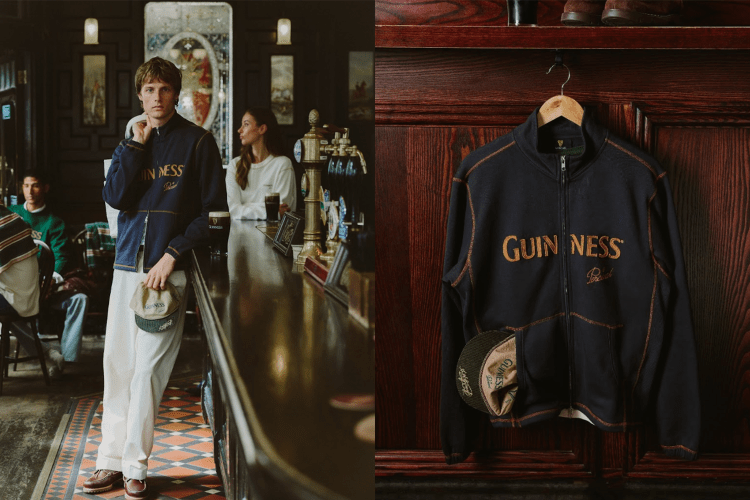
Consider the Six Nations the perfect remedy for the football-shaped hole in your heart. There’s no better excuse to enjoy a Saturday-morning Guinness than watching a match from a dark wooden bar with a friend, screaming at the television as one pint turns into three.

More Like This



Twice a week, you'll find guinea pig features, personal essays and expert interviews on living better — for however long you’re here. Subscribe to Champ now.