
Something unholy is coming to the Nevada desert. A short walk off the Las Vegas Strip, experiments are set to take place — experiments that fly in the face of decades of perceived wisdom, calling into question concepts like decency, fairness and even morality. Locals may be largely unaware of what is happening right under their noses, but these inquiries have unleashed the wrath of a powerful organization watching from a thousand miles away.
“While those behind the Enhanced Games might be looking to make a quick buck, that profit would come at the expense of kids across the world thinking they need to dope to chase their dreams,” said Travis Tygart, CEO of the U.S. Anti-Doping Agency (USADA), headquartered in Colorado Springs.
“These things aren’t just banned because they’re effective at making athletes stronger or faster, many are banned because they’ve been proven to be dangerous for athletes, with some harmful side effects being potentially irreversible,” added Dr. Matt Fedoruk, USADA’s chief science officer.
The Enhanced Games is an upcoming Olympic-style athletic competition in which participants are encouraged to take performance-enhancing drugs. To its detractors, the idea of purposefully (and visibly) doping to increase athletic prowess is the antithesis of sportsmanship. Not only does it nuke the idea of a fair playing field, but it turns athletes into, at best, walking guinea pigs. At worst, the Enhanced Games will catalyze society-wide moral decay, especially for young children who tune in.
That said, as evidenced by the creation of this event, there are those have a different perspective. Some believe that in finally setting athletes free from the shackles of restrictions like those imposed by USADA, we’re about to finally see what the human body can really do. In short, they say, we’re about to see real-life superheroes, unleashed in the flesh.
Hitting the Jackpot
The inaugural Enhanced Games is set to take place at Resorts World Las Vegas on Memorial Day weekend this May. Ahead of this first experimental outing, interest in the event is at an all-time high. In November, it was announced that the competition’s parent company would go public, merging with Hong Kong-based SPAC A Paradise Acquisition. Together, their combined valuation was estimated at $1.2 billion, with plans to list Enhanced Group stock on the Nasdaq exchange, pending regulatory approval. It’s a big bet that the doping-friendly games are here to stay, and will lead to big business. But it wasn’t so long ago that all of this was a pipe dream.
The Enhanced Games’ journey from flight of fancy to reality is a weird one, involving the late Hulk Hogan and accusations of an “anti-science police force.” Hogan came into the story through his 2013 lawsuit against the American blog Gawker, which had leaked a Hogan sex tape, and as a result was sued into non-existence. Hogan’s suit was backed by Peter Thiel (the billionaire co-founder of PayPal and the first investor in Facebook), who had his own contentious history with Gawker. Litigating on Thiel’s behalf was a young Australian named Aron D’Souza.
D’Souza, who also runs a company providing technological infrastructure for pensions across Australia, New Zealand and Hong Kong, had perhaps absorbed some of Thiel’s libertarian leanings during their time together. Noticing that people who were working out next to him at an Equinox in Miami were clearly using steroids, he decided to set up the Enhanced Games in 2022. During his promotional blitz for his endeavor, he’s called the World Anti-Doping Agency an “anti-science police force for the IOC [International Olympic Committee].”
In D’Souza’s view, bureaucratic concerns about health and safety have been crushing athletes’ rights to push themselves, and to take their sport to the limit. “Athletes are adults…and they have a right to do with their body what they wish — my body, my choice; your body, your choice,” he told the Australian Associated Press. “And no government, no paternalistic sports federation, should be making those decisions for athletes — particularly around products that are FDA regulated and approved.”
I’ll juice to the gills and I’ll break [the record] in six months.
Swimmer James Magnussen on Competing in the 50m Freestyle
The Enhanced Games would not only give agency to the athletes, in D’Souza’s opinion, but by offering significant prize money, it could provide a potentially life-changing payday for those who’ve sacrificed everything in a single-minded pursuit of sporting excellence — only to find themselves at the other end of it with next to nothing in the bank.
Investors soon came onboard, with Thiel and Saudi prince Khaled bin Alwaleed Al Saud sinking money into the project. Donald Trump Jr. called the Enhanced Games “real competition, real freedom, and real records being smashed,” adding that “[t]his is about…American dominance on the world stage — something the MAGA movement is all about.” 1789 Capital, the investment fund in which Trump Jr. is a partner, co-lead “a multi-million dollar investment round” for the organization.
Four years after it was first dreamed up, the Enhanced Games now has the backing, the venue and the motivation to change the face of sports. But what about the athletes? Is this a build-it-and-they-will-come call to arms? Or, having lived a life ruled by vigorous anti-doping laws, will today’s best athletes be reluctant to dip their toes in the water?
Meet the Athletes
Performance-enhancing drugs (PEDs) come in a range of flavors, each with its own effects. Anabolic steroids increase the concentration of nitrogen in the muscle, which in turn helps preserve muscle mass. Dopaminergic stimulants improve reaction times and decrease fatigue. Human growth hormone helps increase lean muscle mass while cutting fat. Blood boosters enhance the body’s ability to supply oxygen to muscles. The list goes on, and there are very few instances in which any of these are legal in professional sport.
The Enhanced Games isn’t aiming to change this. It isn’t campaigning for athletes to be allowed to take drugs in all competitive spheres, at least not yet. What it wants to do is to test an environment where athletes are unleashed, so to speak, to see how the relaxed rules impact performance. (Competing athletes aren’t required to take PEDs, by the way, just encouraged to do so.) Forget a level playing field, this is a purposeful demolition of the entire park.
“If you want to destroy any concept of fair play and fair competition in sport, this would be a good way to do it,” warned the International Olympic Committee (IOC) in a statement.
For many prospective competitors, that’s the entire appeal. Well, that and the money. Across three sports — swimming, track and field, and weightlifting — the Enhanced Games will offer $500,000 per individual event, with special $1 million bonuses to competitors who break world records in the 100-meter sprint (track) and 50-meter freestyle (swimming).
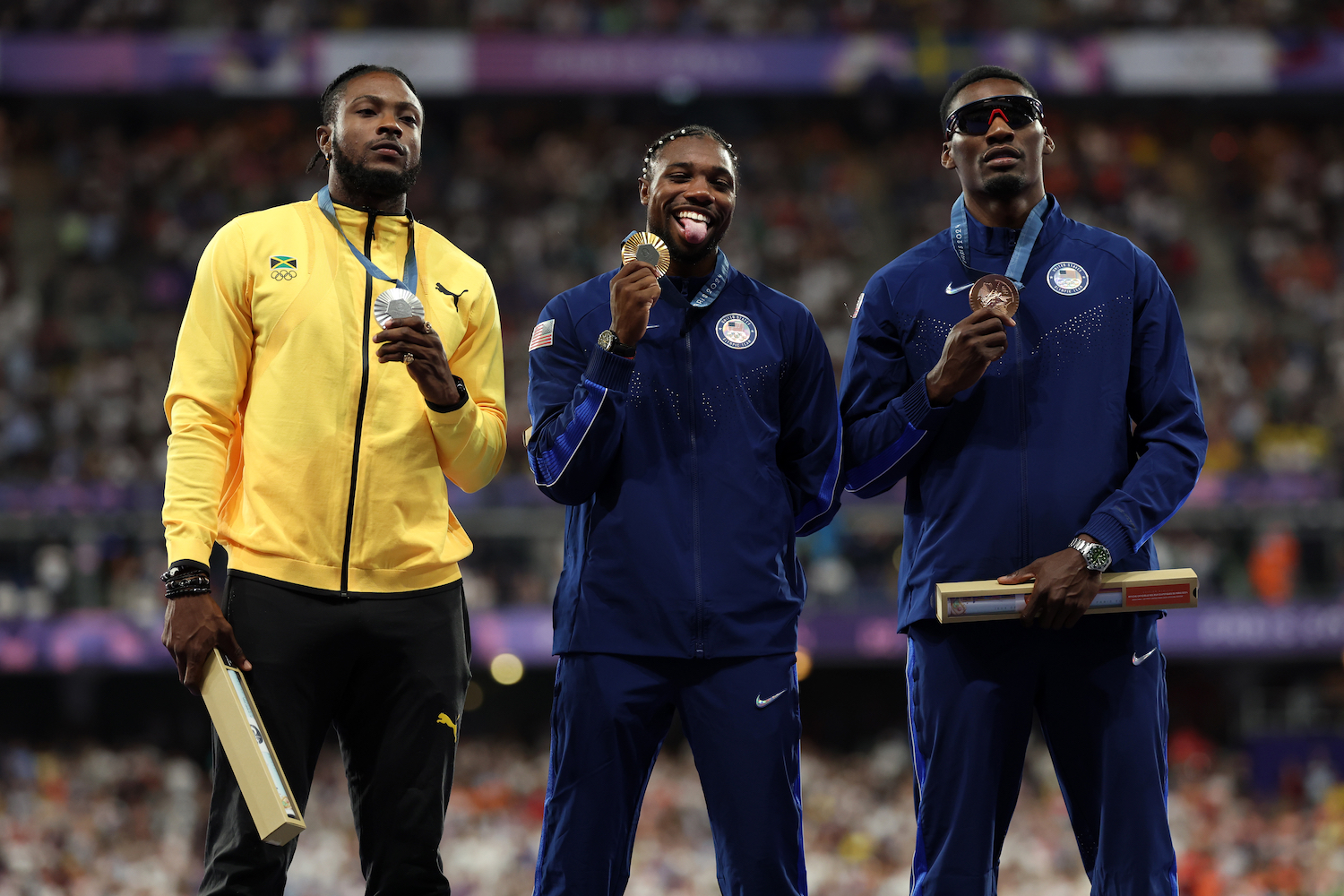
Fred Kerley, a Texas-born sprinter, was the first American athlete to join the Enhanced Games, announcing his intention in September. With an Olympic silver medal to his name from 2020, Kerley arguably has nothing left to prove. But at 30 years old, and with silver slipping to bronze at the 2024 Olympics, the Enhanced Games represent a final chance to get paid. As an extra wrinkle, the Monaco-based Athletics Integrity Unit issued Kerley a provisional suspension in August, due to “whereabouts failures” under anti-doping rules. Kerley plans to contest the suspension, but could face a two-year ban from the sport.
“I’m looking forward to this new chapter and competing at the Enhanced Games,” Kerley said in a statement, indicating that he sees any speed records established in the Enhanced Games as legitimate. “The world record has always been the ultimate goal of my career. This now gives me the opportunity to dedicate all my energy to pushing my limits and becoming the fastest human to ever live.”
The Olympics doesn’t have any competition, so it might be a good thing because the Olympics doesn’t pay athletes.
Mark Foster, former british olympian
For Australian swimmer James Magnussen, himself the recipient of three Olympic medals, one silver and two bronze, this competition is a chance to return from retirement and attempt to break the 50m freestyle world record. He hasn’t been shy about embracing the performance-enhancing aspect of it all, either. “I’ll juice to the gills and I’ll break [the record] in six months,” he claimed. D’Souza said Magnussen has “the potential to show us what the human body, improved through science, is truly capable of.”
That’s all well and good, but in an age where sports officials get themselves in a tizzy over carbon-plated running shoes, there’s next to no chance of any new records set by Enhanced athletes being officially recognized.
Given some of its backers, it’s natural to see the Enhanced Games as an all-boys club. But the inaugural event has added a few female athletes to the roster, including swimmer Megan Romano. Born in Florida, Romano is currently part of the American record women’s 4x100m freestyle team. She called the Enhanced Games “an opportunity to push the boundaries of human performance in a transparent and scientifically-backed environment, and to compete on a stage where female athletes are valued and compensated fairly, equally.” She added that she considers the Enhanced Games “the future of sport.”
Running the Numbers
As a sort of laboratory to test human limits, the Enhanced Games is a provocative idea. Richard Godfrey, former chief physiologist with the British Olympic Association, and current senior lecturer in coaching and performance at Brunel University of London, acknowledges that studying data from the Enhanced Games would be “interesting.”
But he’s worried about the “cascading” nature of taking anabolic steroids, adaptogens and ergogenic aids like human growth hormone in combination. He recalls a power lifter who had taken anabolic steroids for 20 years. After a break in his hip socket, the steroids had caused the bone to grow back in an unusual way, to the degree that the athlete only had 10% movement in the joint. “I watched him coming into our waiting room, and he put his hands on the seat in front of him then flipped himself around to land his bum on the seat, because he couldn’t even walk properly,” Godfrey says.
Experimenting with drugs is as old as professional sport itself, but Godfrey admits we still know shockingly little about the results. “People respond to training in different ways because of their genetics, and they respond to drugs in different ways, too,” he says. “For one person, the drug might work really well, but not as well for somebody else. We have no idea about any of that.”
The event organizers have clarified their intent to “deliver the safest sporting event in history by setting a new industry gold standard for athlete health assessments” including mandatory pre-event medical profiling. If true, might this stated openness and transparency lead to a safer environment for drug users? If you’re an Olympian illicitly using PEDs, wouldn’t entering an environment where you’re now allowed to use them necessitate less creeping around, less sourcing dodgy substances from dodgy contacts?
Godfrey isn’t so sure. “One of the other problems is that athletes, by their very nature, think, ‘Well, if one dose of this is has this beneficial effect, 10 times as much will have 10 times the benefit,’” he says, which of course is rarely the case. “What usually happens is it has 10 times the negative effects in terms of risk of disease and death.”
The Winners and the Losers
Libby Trickett, a four-time Olympic gold medalist swimmer, says she only heard rumors of PED use among other athletes during her career. Now the co-host of the podcast Sportish, she finds it “fascinating” to see a competition where drug use is out in the open. However, she has some concerns about the event’s participants.
“I do find it interesting that there hasn’t necessarily been an influx of athletes running towards it,” she says. “I think a lot of people are being considerate of what they’re throwing themselves into. When I put myself in that mindset again, it’s just not at all the type of athlete I would want to be.”
Trickett says that while she can understand athletes wanting a payday, she’s mostly worried about the impact the Enhanced Games will have on a younger generation. “I have five young children, and I worry about what that does to young kids in terms of what they aspire to do or to be in this world, especially in the age of social media,” she says. “We’re in an age of comparison, with people thinking that money is the main thing about sport. I think we can all recognize that if you’re doing sport right, it’s not about the money.”
When it comes to steroid use among young trainees, the genie is arguably already out of the bottle. In a recent U.K. survey carried out by the Oxford Online Pharmacy, 75% of male gym-goers aged 25-34 said they have taken or would consider taking anabolic steroids for muscle gain. In the U.S., a 2024 study from the National Institutes of Health found that 53% percent of men and 42% percent of women who participate in strength training use anabolic and androgenic steroids. (Important to note: That study had a relatively small sample size of 3,603 self-selecting respondents.)
It’s impossible to say what impact the Enhanced Games will have on these numbers, but it’s clear the appetite for steroid use exists, even outside of professional athletes. Kiran Jones, a clinical pharmacist at Oxford Online Pharmacy, warns of long-term side effects of anabolic steroids, including prostate cancer, and calls for “proper education within gym environments on the impact of steroid use…to give as much information to potential future and current users so they can at least make more informed decisions.”
As for its impact on the sporting ecosystem, former British Olympic swimmer Mark Foster says that the Enhanced Games might eventually have a positive impact by becoming a legitimate challenge to the Olympics. “The Olympics doesn’t have any competition, so it might be a good thing because the Olympics doesn’t pay athletes,” he says. “The IOC is a very wealthy organization, and I think some of that money should go back to athletes.”
Tygart, from USADA, agrees with Foster that athletes need more money. “We desperately wish this investment was being made in the athletes who are currently training and competing the real and safe way,” he said. “They are the role models this world so desperately needs and they are the ones who deserve our support — not some dangerous clown show that puts profit over principle.”
From an ethics standpoint, Foster says he can’t agree with the Enhanced Games, but he acknowledges that, were he 20 years younger, he can’t say he wouldn’t be lured to compete. He stops short of calling them a “clown show,” but says that for it to be “an interesting competition” it needs to attract enough of the best athletes in the world to make it worthwhile. “At the moment, I think the athletes that are going to do it aren’t going to be the best athletes because the best athletes will remain with the holy grail of winning the Olympics,” he says.
The truth is, no one yet knows how the Enhanced Games will shake out. It’s easy to be critical of an event before it’s even taken place. At one point, MMA was a tiny, upstart sport that couldn’t possibly compete with things like boxing or wrestling. Today, the UFC is valued at over $15 billion. Maybe the Enhanced Games will also have what it takes to go the distance. Foster thinks there’s potential, especially as the average viewer won’t necessarily share the same moral standards as people who work in the realm of professional sports.
On the other hand, there’s every chance that the Enhanced Games will be a disaster — and a potentially fatal one — streamed live.
“It’s certainly not something I would have participated in, and it’s certainly not something I’m going to let my kids watch,” says Trickett. “But am I going to watch it? Absolutely.”

More Like This




Twice a week, you'll find guinea pig features, personal essays and expert interviews on living better — for however long you’re here. Subscribe to Champ now.