This article is part of The Spill Awards 2026, covering the best in spirits, cocktails, bartenders and drinks culture. Find all of the stories here.
There’s not a lot of poetry in how Matchbook Distilling describes its purpose. “An R+D facility dedicated to the production of spirits that champion agriculture, anthropology, tradition and science,” is the first thing noted on the distillery’s website, which suggests a rather clinical approach to making spirits. But the research and development part is important. The Greenport, NY-based distillery (three hours by bus from Manhattan) got its start as more of an incubator for other people’s ideas — and as a way to test out their cofounder’s increasingly unusual ideas for spirits, liqueurs and wine.
Matchbook grabbed several nominations for Best Distillery in our Spill Awards survey, which explains why I ventured out to the northern tip of Long Island on a very cold January weekday to talk to distiller and cofounder Leslie Merinoff. Even at eight months pregnant, Merinoff was more than willing to walk us through a huge but rather hidden space just outside of the small downtown area. Most locals may not even realize that they produce some of the world’s most unique spirits, including a few you may only find at the world’s best bars. We’re talking blueberry amaro. A “mezcal” made from local artichokes. Still-strength soju. A spirit crafted from smoked pineapples.

“This is all fundamentally inefficient by design,” Merinoff says as we walk through Matchbook’s seemingly haphazard distillation space into a makeshift barrel storage area (where many of the non-brown spirits are resting in bulbous, clear Demijohns). “Nothing is plugged into place here. Everything needs to be laboriously connected. We have to create our own workflow. But what that means is we can produce anything at any scale at the drop of a hat. Our production changes fundamentally, not just day-to-day, but hour-to-hour.”
How did Matchbook become home to some of the most sought-after and limited-edition spirits, often crafted in quick order and with unexpected (and usually locally-sourced) ingredients? “I worked at William Grant & Sons in marketing straight out of college, and I wanted to move more into production,” Merinoff says. “So I left and went to work at a distillery in Brooklyn called The Noble Experiment. We were the world’s only all-female distillery, and we made a really funky rum [Owney’s] that Proximo ended up acquiring.”
But after Proximo bought the rum brand, Merinoff decided she wanted to build a distillery of her own. “But instead of making one brand, I wanted to help people create their own brands,” she says. “I thought if I lowered the bar to entry and created a means of production for anyone who wanted to create something, they would. But then Covid happened, and I couldn’t go out and find people, so I started producing my own spirits.”

Matchbook began with the creation of two spirits every single month for three to four years, a nearly unheard-of amount of production and innovation. “There was so much homogeneous product out there,” Merinoff says. “At the time, I was one of the only people doing something different.” A few expressions proved popular enough for the company to develop a core brand of spirits that they’ve been scaling across the country. “We have these different R&D projects constantly going, but what allows us to pay the bills and have operational efficiency are the brands we’re scaling,” she adds.
Interestingly, Merinoff started contract distilling again, but working from a completely different level. She now produces custom spirits for cocktail heavyweights like 11 Madison Park, Death and Co., Bar Snack, Schmuck and The Dead Rabbit, among others. “These are really progressive beverage programs, so I really get to flex there,” she says. “I think these collaborations really push me to places I wouldn’t otherwise go, and that has become a really exciting challenge.” It also excites bartenders, who suddenly need to know or visit the out-of-the-way distillery.
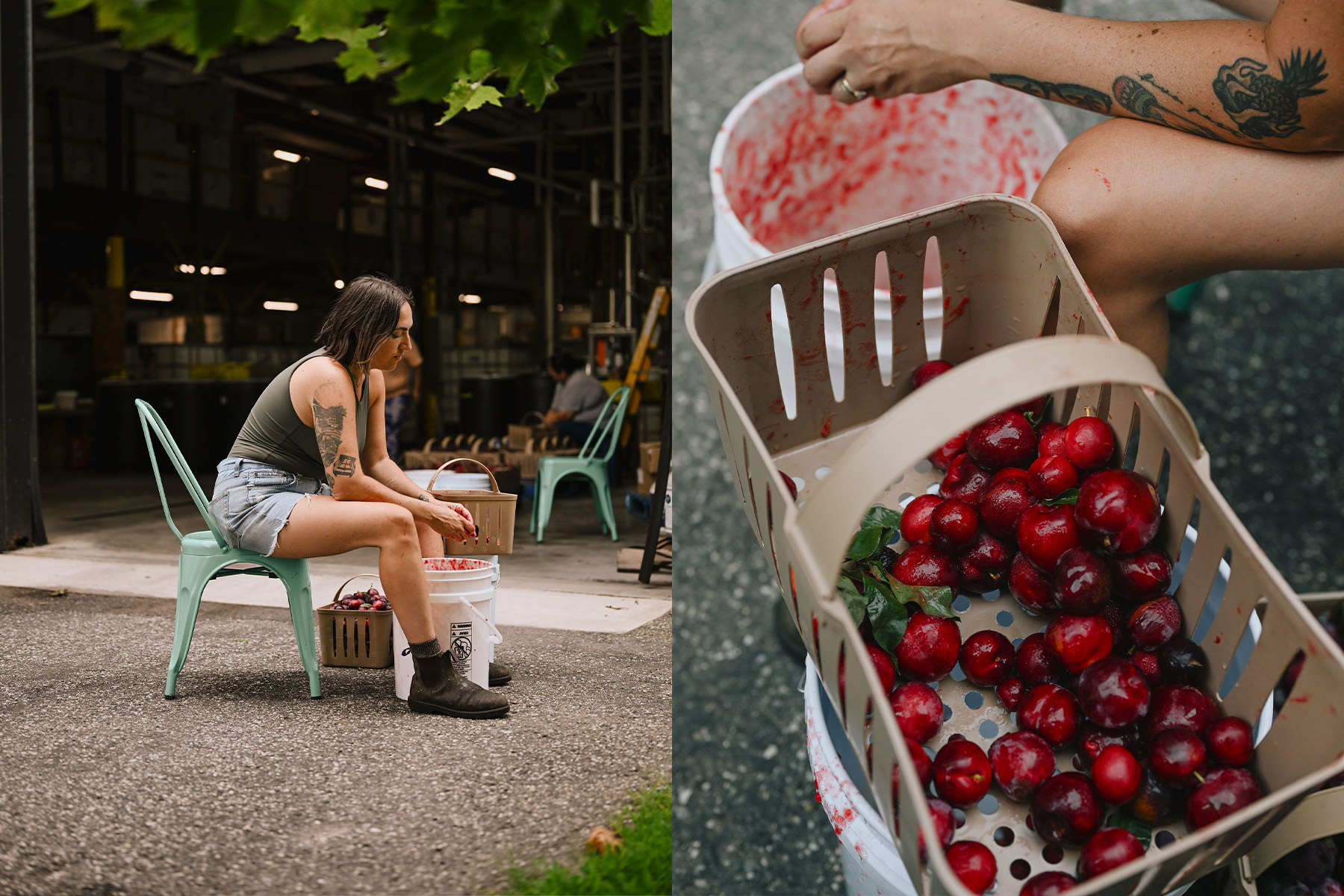
Merinoff works with several local farms, and that can dictate or inspire a new spirit. “Something will happen and a farm will reach out and say, ‘I have 2,000 pounds of beets, can you do something with that?’” she says. “I don’t think the market is dying for a beet spirit, but part of our core utility or value proposition is that we are part of a food system and we want to help keep it as closed as possible, which means not allowing food to become waste.”
So, what should you try if you visit Matchbook? While you’re there (it’s only open to the public on Saturday afternoons), you’ll probably get access to a lot of things that aren’t necessarily available in your local liquor store— more of the “R&D” side of things. But for the core products, these are some of our favorites:
Ritual Sister: This is a pineapple spirit (40% ABV), not a liqueur. Merinoff roasts the pineapples whole for a couple of days in giant fire pits, then covers them in fermenting pineapple juice. This cools for a while, then the fruit is crushed and everything is put through a still. The result is actually pretty nuanced, subtle and bright.
Metamodernity: A wheated bourbon utilizing all New York grains, including roasted oats. This adds a surprising sesame note I’ve never experienced in a whiskey before.
Late Embers: What the hell is a sunchoke? This root vegetable, also known as a Jerusalem artichoke, is nutty and earthy on its own. “They’re interesting to make alcohol from because their primary carbohydrate is inulin, the same carbohydrate that’s in agave,” Merinoff says. “ So I’ve processed them similarly to agave.” Think of this as a clean, mezcal-adjacent spirit.
Daytrip Strawberry Amaro: Some ideas from Matchbook come out of last-minute pivots (witness their bottled whiskey cocktail that was meant to be a ginger beer). Daytrip was essentially a strawberry wine filled with botanicals that was meant to be a vermouth, before the government insisted vermouth had to be made from wine grapes. Ergo, this floral, woody but strawberry-forward aperitif was born.

More Like This


This article appeared in an InsideHook newsletter. Sign up for free to get more on travel, wellness, style, drinking, and culture..