Three years ago, I set off on an 800-mile road trip between Montreal and Toronto (and back again) in a Ford Mustang Mach-E. The goal? To probe the pain points of using a battery-powered electric vehicle for long-distance travel along one of the busiest routes in Canada. Although the end result was a success, that victory was qualified by an indictment of Toronto’s EV charging options (pretty painful across the board) and my own lack of initial planning (inexcusable, to tell you the truth).
This summer, I decided to make nearly the same journey again in a new electric vehicle. The goal this time around was to explore the improvements made to the range and capability of current EVs while also charting any upgrades in charging infrastructure. After all, Toronto is Canada’s largest city, and it certainly hasn’t spent the last 36 months standing pat on its woeful EV supports.
Still stinging from my hard-earned experience with inadequate charging the first time around, I was prepared to match Toronto’s self-improvement energy by making better use of the tools available to electric vehicle owners to plan out every stage of my journey. It turns out that the city only met me halfway in terms of improving the overall experience, but that was more than enough to ensure a better outcome versus EV Road Trip 1.0.
Bigger Battery, Better Distance, Faster Charging
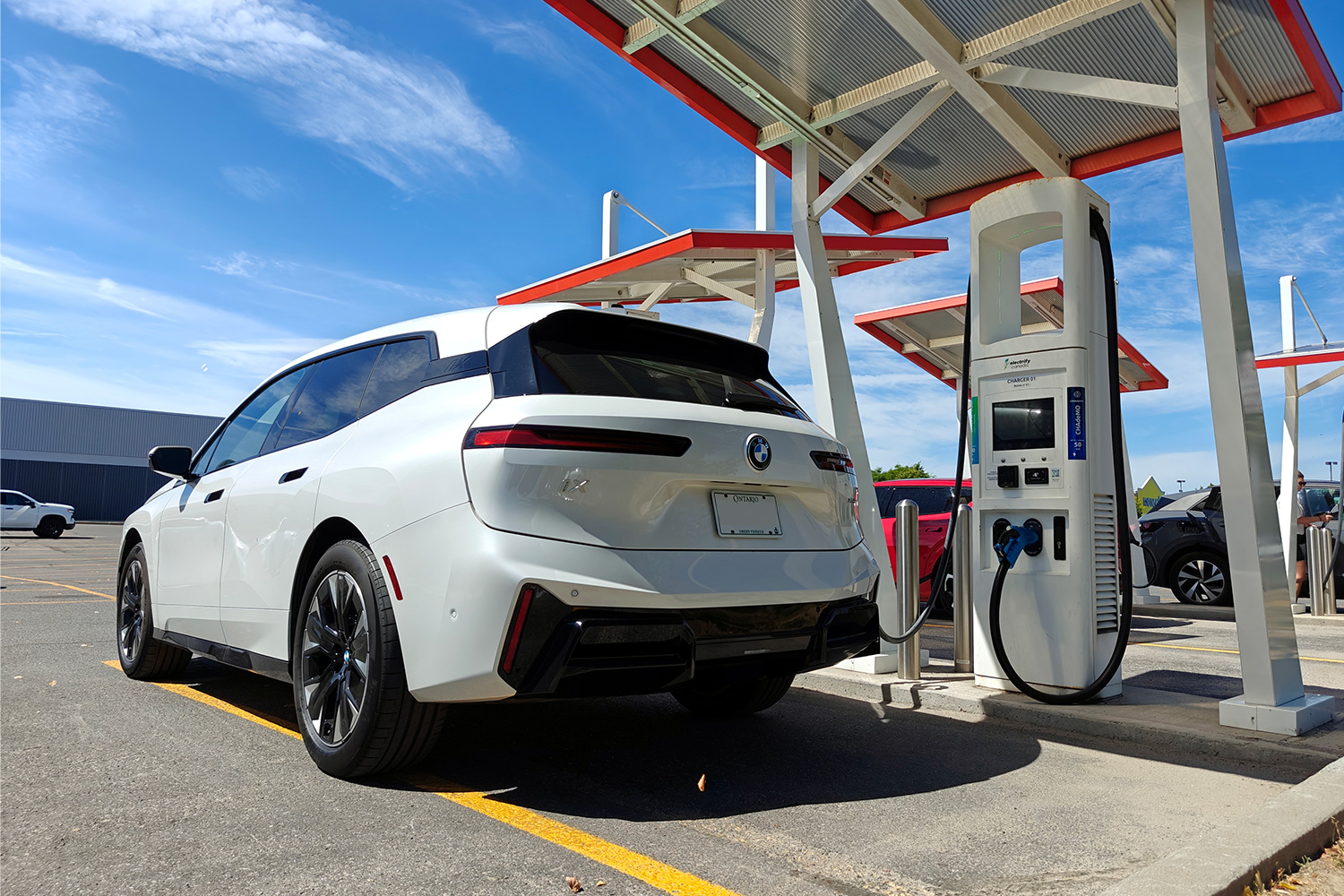
The BMW iX xDrive60 SUV that served as my electric chariot for this road trip redux offered a respectable upgrade in terms of driving range compared to the Mach-E. Its battery (which is bigger for the 2026 model year) provides up to 364 miles per charge, depending on wheel size, versus 312 miles in the Ford I last drove.
The vehicle itself was also larger, more comfortable and considerably quicker, both at the charging station (up to a 195-kW fast-charging rate) and on the road. While the additional speed offered by its 536 horsepower might not have made much of a difference in the overall calculus aside from shaking the occasional tailgater, its 113.4-kWh battery certainly did.
When I arrived at the pickup spot just north of the island of Montreal, the BMW iX was waiting for me with a fully topped-up power pack, a stark contrast to the 62% charge I started with last time I set out on this itinerary. This was important for two reasons. The first is it was much more representative of the state of charge an actual EV owner would start with before any long journey, because they’d likely be able to charge at home the night before. Second, it showed me 379 miles of driving range on the BMW’s dashboard, far in excess of its factory rating and more than enough to get me to Toronto without having to stop for juice at all.
When Driving an EV, Plan Ahead
That didn’t mean I was going to push the iX’s battery to the limit and hope that its range-guessing algorithm was right.
Before even picking up the BMW, I spent some time with A Better Routeplanner, a mobile app and website that lets you plug in the vehicle you’re driving, the destination, and elements like weather conditions and temperature, in order to get a feel for how many charging stops you might have to make.
According to ABRP, I could make it to Toronto from Montreal without needing a plug even if I started with a 90% charge. However, that would leave me with very little power remaining to schlep over to the most convenient charging station once I arrived — not to mention provide very little cushion for any unexpected detours along the way. As with the previous trip, I decided on Kingston, Ontario, as the midway charge point. This time, there’d be no need to top up along the way, allowing me to avoid the unreliable fast chargers installed at the roadside plazas along Ontario’s 401 highway.
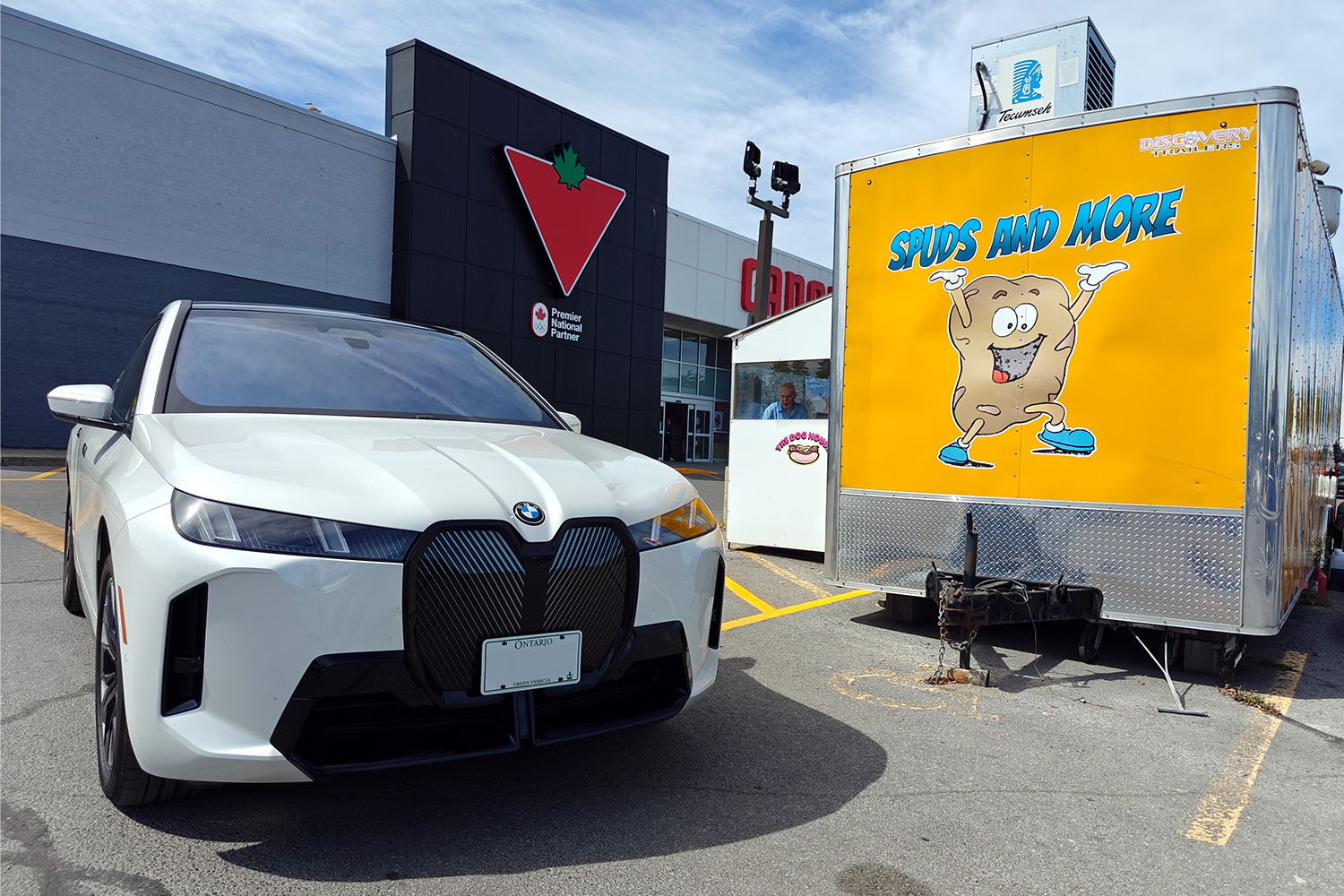
A second app — PlugShare — assured me that the Electrify Canada charging station I had used in that city three years ago still sat outside the same Canadian Tire department store, and while one of its plugs was currently operating in low-power mode, the three others were a safe bet. If that was too busy, then there was a Petro-Canada Electric Highway station even closer to our route that promised another four stalls.
Toronto Hasn’t Raised Its Level 2 Game
Would you believe that waiting for the simplest of chicken sandwiches at the combination KFC-Taco Bell took us longer than charging the BMW iX back to 80%? That 30 minutes of limbo might have set us back some on our schedule, but it gave us something to eat while we then waited the 28 minutes for the 150-kW station to fill the BMW’s battery nearly to the brim (with speeds cresting at around 135 kW).
The station was almost deserted when we pulled in, with only one other motorist hitched up to a charger. This was odd, given that the Electric Highway location we passed on the way there was not only in full use, but sported a line of at least three vehicles waiting their turn — only five minutes up the road. This spoke to the absolute necessity of using an app like PlugShare to make sure you’re not waiting to charge when there are multiple empty stations nearby.
We Interviewed 6 New EV Buyers. One Year Later, Do They Regret It?
From a chiropractor in Colorado to a retiree in Minnesota, here’s how their opinions changed after a full year of electric drivingI also took the time we spent charging to investigate energy options close to our destination using the app. It’s here that I discovered Toronto hadn’t followed in Montreal’s footsteps and installed any Level 2 charging stations along its urban streets. These units are ubiquitous in Montreal, and they make it very easy to add a few miles while shopping or having dinner in nearly every neighborhood.
While slow charging in Toronto still seems to be reserved for those lucky enough to own off-street parking, there was one aspect of the city’s EV infrastructure that had definitely improved: the availability of DC fast chargers. These Level 3 units (typically rated between 50 kW and 350 kW) had been almost exclusively found inside gated parking garages my last time through the city in an electric vehicle, requiring that I pay for both parking and electricity.
Not only has Petro-Canada expanded its fast chargers to include urban locations, but rivals such as Shell have also gotten in on the game by adding their Recharge stations into the mix at their traditional fueling locations. This meant that in addition to a small gaggle of plugs at a nearby mall parking lot, I could also access a Petro-Canada charger only 10 minutes from where we were staying.

Fast Charging Still Not an Exact Science
After leaving Kingston, we made it to Toronto without incident, and with a healthy half-battery or so of charge available to us for our sojourns around the city for the next few days.
When it came time to top up again — something we had to do twice during a busy week — our experiences with the previously mentioned gas-station charging networks reflected just how inconsistent the simple act of plugging in can be for EV owners. At the Petro-Canada station, we encountered a faulty card reader that prevented one of the two chargers from activating, which meant waiting until another customer was finished before we started our charge.
It also required us to leave a bit earlier than planned (at 65% battery instead of 80%) so that the person in the Hyundai Ioniq 5 who pulled in beside us could get their charge started after their own waiting period. This is the type of courtesy that I find charming about EV ownership; even in the face of poorly maintained equipment and borderline negligent operators (the Ioniq owner mentioned that our 98-kW charging speed was well below the norm for this particular station, which was sorely in need of attention), there is a sense of shared struggle that has electric vehicle drivers looking out for each other when they can.
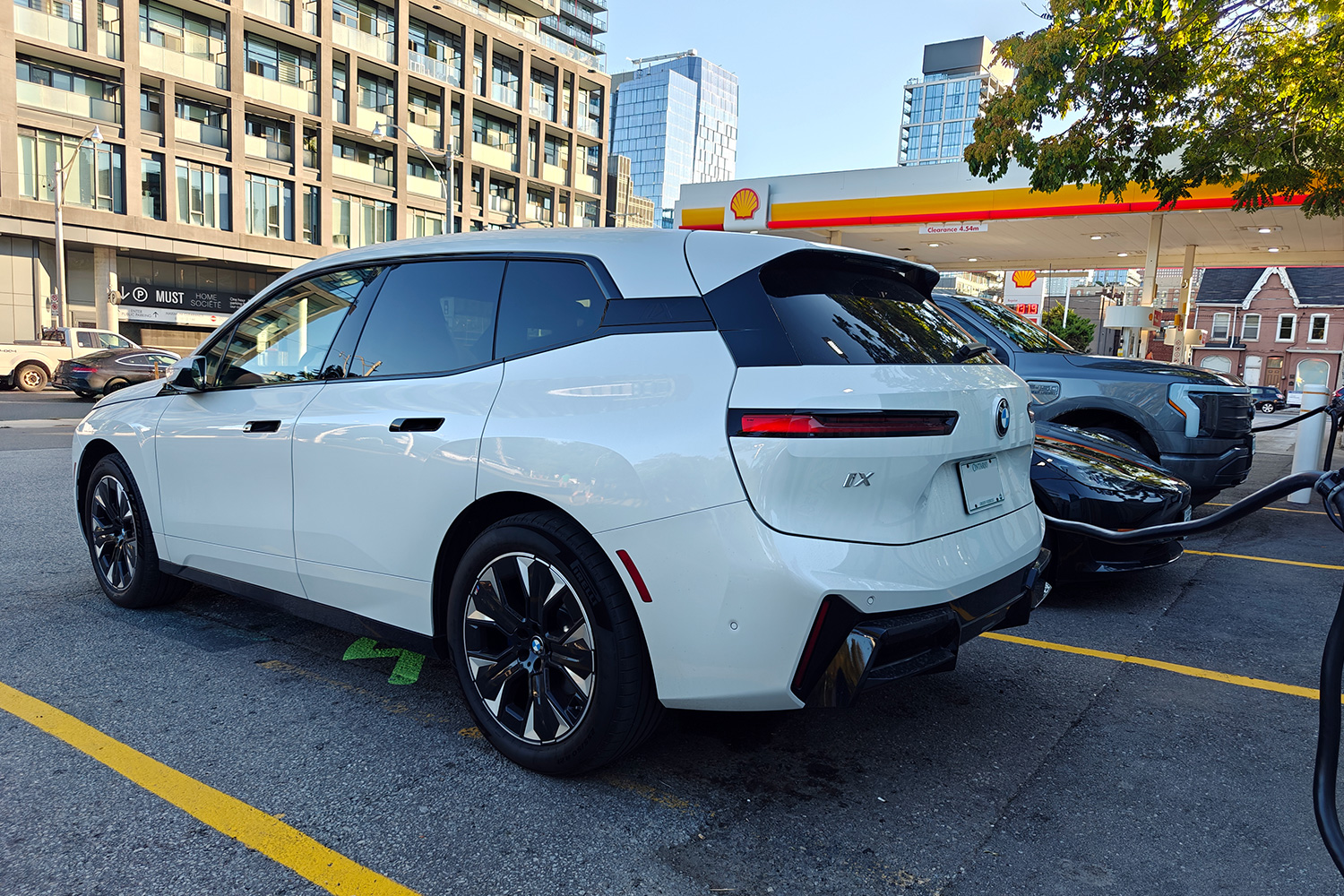
The same act of kindness was repaid to us a couple of days later on our way out of the city, when an F-150 Lightning driver disconnected from a shared Shell Recharge station so we’d top up faster. This time, with no technical snafus, it was only 22 minutes or so of plug time at 160 kW to add 40% to the battery and ready us for the voyage home.
Random Unplugging a Blight on Public Charging
Our return journey promised to be another one-stop affair, with a bit of a twist. Instead of heading back to the dealer where we’d picked up the BMX iX earlier in the week, we’d be tacking on another 90 miles of travel to get to our home base in the countryside. On top of that, since it’s bad form to sit on a public charger until a vehicle reaches 100% battery (the charging curve between 80% and 100% slows dramatically to help reduce heat and promote the health of the battery pack), we wouldn’t have access to the full might of the iX’s range at any point on this particular leg.
Reaching Kingston as a midpoint proved to be no problem, as it was only 175 miles or so away from Toronto. In the summer heat, and after enduring an endless construction detour, we rolled in with 22% on the battery. It was the next 250 miles — the distance to our eastern Quebec town — that would prove a little trickier.
Drivers Are Just Trying to Get Used to EVs. Why Complicate It?
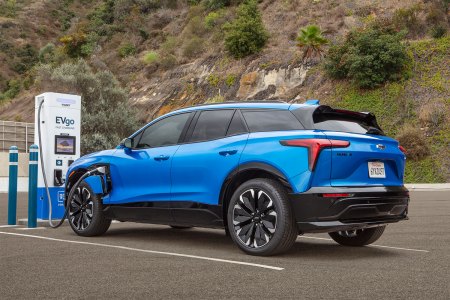
Electric cars are increasingly different just to be different. Case in point: the Chevrolet Blazer EV.Remember earlier when I mentioned the inconsistent charging experience facing down most EV owners reliant on public charging stations? That beast reared its head on our way home, even as we used not only the same Electrify Canada station but also the same exact plug as we did on the first half of our journey.
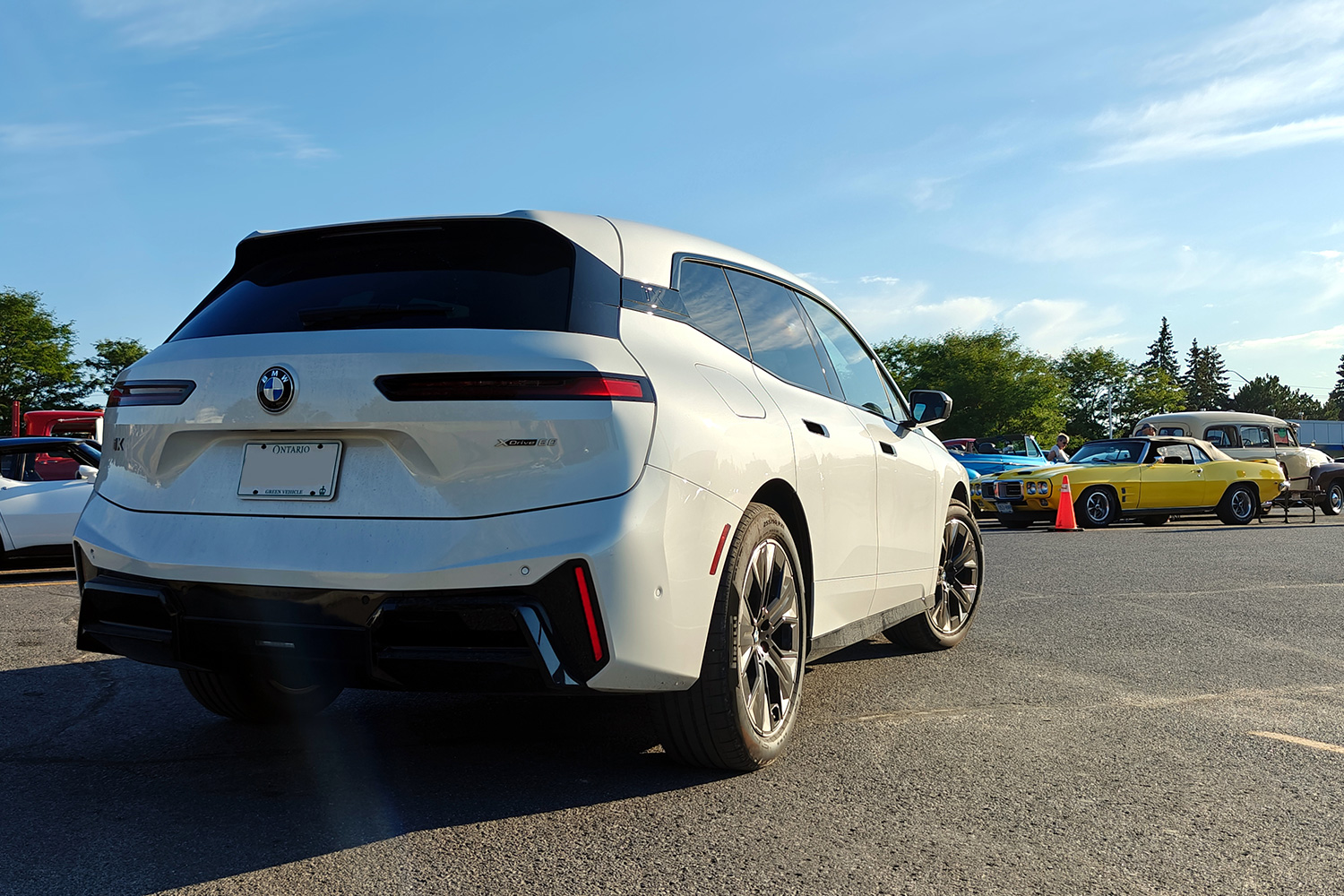
After connecting to the charger, we wandered over to a nearby hot dog stand to grab a snack and check out the local classic car cruise night taking place in the same parking lot. After 20 minutes or so, I walked back to the BMW only to discover that the charging session had mysteriously ended after 11 minutes at 43% battery. There was no error message either on the dashboard or the station itself, only a notification that I had surpassed the 10-minute grace period for idling at the plug, and was now being charged by the minute for blocking the space.
I plugged back in and sat in the vehicle to keep an eye on things, and after another 25 minutes we’d hit 80%. It was a frustrating reminder of how you can’t take anything for granted when plugged into a fast charger, and an annoying setback on a long journey (even if the car show chicken fingers helped ease the sting).
Using Every Single Electron in the iX Battery
The 298 miles of range showing after our Kingston charging session gave us a 48-mile margin of error to make it home, which felt like more than enough to push for a single sprint with no more planned stops. Just in case the iX was a little too optimistic, I had a couple of local faster charger locations in my back pocket to get us those final few miles home, if necessary — an amazing resource to have in a rural area of the province, but indicative of just how much investment Quebec has made in charging infrastructure (and a stark contrast versus Ontario).
I came quite close to needing them. The available range display started dropping almost immediately after we hit the highway again, obliterating much of our cushion, and before long it became clear that things were going to be tight. As we entered the final hour of our drive (three hours after leaving Kingston behind), I put the vehicle in its most efficient drive mode and cranked up the regenerative braking to try and beat the odds.
Warnings started to appear on the dash, first when the battery charge dropped to the single digits and the available range shrank to 40 miles, then again at 25 miles. By that point I’d turned off the climate control to eke out a little more distance. The gambit paid off. I rolled into my driveway with a 5% charge, the lowest I’ve ever run any EV’s battery, but safe and sound at home. It’s also worth mentioning that unlike some other electric vehicles I’ve driven, the low charge state in no way compromised the iX’s performance, with all systems functioning as they should right up until the end.
Plugging into my Level 2 charger, the BMW’s gauge cluster lit up to let me know I could expect a full battery at 4 p.m. the following afternoon — 16 hours later.
A Somewhat Better Tomorrow
There’s no doubt that the charging situation has improved for the better in Toronto, just not as a result of any public policy. Relying on private networks to provide DC plugs for its citizens only encourages the kind of bottlenecks that can occur when a fast-charging station breaks down. Surely street-side Level 2 charging is both technologically and financially possible for a metropolis like Toronto (not to mention similar cities in both Canada and the U.S.). It would go a long way towards easing the stress placed on Level 3 infrastructure.
At the same time, proper planning and a reasonably efficient, big-battery EV allowed me to work around a lack of charging opportunities. It’s the first half of that sentence that’s the most important, in my opinion: knowing where, when and how many times to charge is currently the key to any long-distance road trip in an electric vehicle, and making the most of limited plug time at your destination is just as critical to avoid becoming a roadside ornament in need of a tow.

More Like This


This article appeared in an InsideHook newsletter. Sign up for free to get more on travel, wellness, style, drinking, and culture..