Over a century after Ford kickstarted the modern automobile market in the U.S. with the introduction of the Model T, CEO Jim Farley has announced the company is on the cusp of another “Model T moment.” On a recent earnings call, Farley said that he will be making a major announcement on August 11 in Kentucky about the company’s “plans to design and build a breakthrough electric vehicle and a platform in the U.S.”
Naturally, speculation has been rampant. Farley offered a few additional details: that this will be “a chance to bring a new family of vehicles to the world that offer incredible technology, efficiency, space and features,” and that it will start on the consumer end with a “very low-end, super affordable” EV for urban commuter use. Beyond that, people are offering up their educated (and uneducated) guesses. Others have been hit with a severe case of déjà vu, because we’ve actually heard this line from Farley and Ford before — and not that long ago.
In April 2022 as Ford was about to begin deliveries of the F-150 Lightning, an electric version of the brand’s class-leading pickup truck, Farley wrote a LinkedIn post declaring: “F-150 Lightning Is A Model T Moment For Our Company. Here’s Why.” “Right now, the world needs zero-emission vehicles,” he wrote. “It needs us to bring them to the many, not the few.”
Unfortunately, that ambition hasn’t worked out for the F-150 Lightning. Ford planned to be able to produce 150,000 units of the electric truck annually by the end of 2023, but between May 2022 when it began deliveries and the end of July 2025, the company has sold just under 90,000 models in the U.S., per data compiled by Ford Authority, while also steadily increasing the price. By comparison, the Maverick, Ford’s economical, gas-powered compact pickup, sold over 131,000 models in 2024 alone. It’s clear which one is for the many, and which is for the few.
Why would anyone believe Farley now when he was so clearly wrong then? Partly because the electric vehicle industry as a whole is experiencing a period of rapid innovation — despite a newly hostile presidential administration — where the learning curve is steep and the goalposts shift frequently. But there are also reasons specific to Ford and Farley that seem to suggest this time will be different.
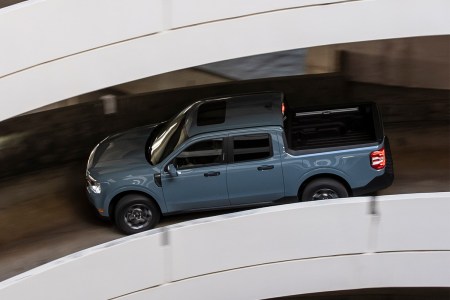
Americans Are Obsessed With the Wrong Trucks
For decades, pickup buyers have believed bigger is better. The Ford Maverick Hybrid proves the opposite.Take the location of Monday’s announcement: Kentucky. Ford is finishing work on BlueOval SK Battery Park, a massive battery manufacturing campus in the state that’s a joint venture with South Korea battery maker SK On. The two factories at the site have yet to begin producing batteries at scale for Ford (reporting earlier this year suggested Nissan was using part of one factory to produce batteries for its vehicles), so it’s possible Farley has been waiting for this moment to lay out specifically how this multi-billion-dollar investment is going to lead to the automaker’s next generation of EVs. (Although, Ford is also building new EV and battery plants in Tennessee and Michigan that are part of its electric roadmap.)
On the other side of the country, there’s another team that’s been working in the shadows for Ford whose ideas could be finally ready for primetime. Last year, Farley revealed that Ford had created a skunkworks team in 2022 — the same year the F-150 Lightning began production — that was working on a “low-cost” EV platform, with TechCrunch reporting that ex-Tesla engineer Alan Clarke was leading the effort in Irvine, California. It was later revealed that Ford had also “poached top talent” from Rivian, Lucid and Apple for the group too, per InsideEVs.
Ford’s CEO later explained on the Everything Electric podcast that they created that independent effort because he “felt like the institution of Ford would have a really tough time competing with BYD,” the Chinese automaker that is currently the world’s largest producer of EVs. He understood that a standard F-150 with batteries swapped in was not a long-term strategy to compete with the innovation coming out of China, so Ford assembled its version of a super team to think outside the box. Forget Ford v. Ferrari — it’s Ford v. BYD now.
Farley himself has also been sizing up the competition in a new way, and not just on an industrial level, but from a driver’s perspective. On the same episode of Everything Electric from October 2024, he admitted that he had been driving the SU7, the first electric car from Chinese consumer electronics company Xiaomi, after flying one from Shanghai to Chicago. “I’ve been driving it for six months now,” he said, “and I don’t want to give it up.”
Admitting your domestic competitors make good vehicles? That’s one thing. Admitting a Chinese company that’s known for smartphones makes a compelling car? That’s another, tougher pill to swallow — but an essential one in today’s market.
Three years ago when Ford started sending its F-150 Lightning to customers touting a “Model T moment,” the holes were easy to poke in the facade: it was an electrified version of a truck that debuted five decades earlier and the batteries were being made by another company. We don’t know what Farley will be announcing on Monday, but the pieces are finally in place for him to make good on that loaded phrase.

More Like This

We're always on the scene eating, drinking and traveling near and far to bring you the best of what's happening out in the real world. Sign up for IRL now.