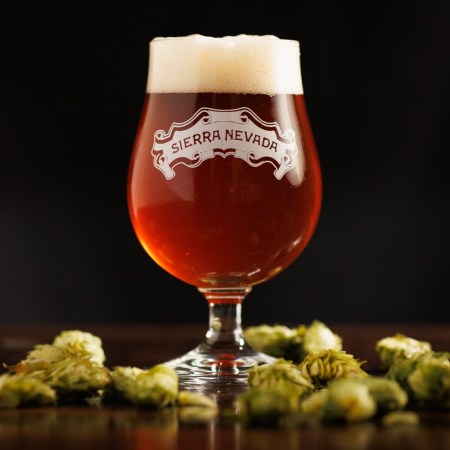
Craft beer doomsday-ers got you down? Enjoy a little palate cleanser with a big birthday: This November, Sierra Nevada Brewing Company turns 45. In an era when we’re more accustomed to news around heritage breweries sinking our spirits — see: Anchor Brewing’s 2023 closure — it’s downright heartwarming to see one of the industry’s trailblazers make it to nearly half a century with no signs of stopping.
[Home]brewing Up an American Craft Beer Industry
Picture it: It’s 1969, eight years before homebrewing even becomes legal again since its Prohibition-era ban. The biggest breweries are Anheuser-Busch, Schlitz, Carling and Pabst. But a teenage Ken Grossman has bought his first homebrewing setup, which he’d have to hide from his mother. He credits the homebrewing, home-distilling, home-winemaking father of his childhood friend for his own interest in the hobby.
“On weekends, there was often a boiling batch of beer in their house, and carboys lining their hallway bubbling away,” Grossman recalls. “I was exposed to that around eight or nine years old, and those sights and smells were deeply imprinted.”
Grossman found his other great love as a teen: the outdoors. He began hiking in the Sierra Nevada mountains and moved to Chico, California at 17. He and his friends scaled up their homebrewing operation, and their neighbors encouraged them to open a homebrewing shop, which they did in 1976; two years later, President Jimmy Carter made the hobby legal, giving homebrewing and subsequently craft beer the green light to grow.
Over the next few years, Grossman ran the shop, studied chemistry at the local junior college, and met with Jack McAuliffe, a homebrewer who had opened New Albion Brewing Company, the first new brewery since the Prohibition, with partners Suzy Denison and Jane Zimmerman in 1976. This had inspired other homebrewers like Grossman to go pro. With no brewhouse equipment easily obtainable on the market, Grossman purchased tanks from local dairy farms closing down — a good fit for brewing because they’d already had to meet hygienic standards for storing milk — and converted them into his brewhouse.
Grossman’s first brew in earnest for his brand-new brewery was a trial run of stout. The plan for Sierra Nevada was to harken back to older brewery traditions by offering “ales, porters and stouts,” a common oeuvre from breweries Grossman saw repeated in books on brewing history. His own beer interests had been shaped by his years homebrewing and developing contacts for access to raw materials like hops from Germany and the United Kingdom.
“Many of the beers I brewed as a homebrewer had a lot of hop character, which I liked,” Grossman says. He realized strong hop character could be Sierra Nevada’s signature across its beers. “This allowed us to feature hops not used in the past, like Cascade, which we focused on as our signature aroma note with its pine and citrus — it really wasn’t available in other commercial beers then.” Sierra Nevada Pale Ale was born toward the end of 1980.
Beer drinkers then and now grasp why this beer is something special. It burst onto a scene of monotonous light lagers, and its consistently delicious, hoppy yet crushable balance has secured it permanent status even as beer trends have ventured off in all manners of more extreme hoppiness. The beauty of Pale Ale would inspire countless beer fans to make a go at brewing.
“I constantly find myself now using Sierra Nevada Pale Ale as my benchmark of consistency and success,” says Josh Velez, brewer at New York City’s Talea Beer Co. “I know that no matter where I am, my Pale Ale is never more than a couple weeks old. Achieving that while keeping the product as delicious as possible is a great feat for any brewery.”
“Sierra Nevada was the craft beer my oldest brother would buy in high school on the rare occasion that we would drink something other than Milwaukee’s Best, Coors Light or Natty Boh,” says Patrick Allen, head brewer at West Kill Brewing in upstate New York. “Beyond the obvious flavor difference the brand just stood out as being something more than beer. Elevated but humble with a hint of alternative.”
Just a year later, Grossman unveiled another instant classic: Celebration Fresh Hop IPA.
“I had been to England…and had adopted the process of dry-hopping,” Grossman says. “But we weren’t dry-hopping our porter, pale ale or stout, in part because it’s messy and difficult using whole cone hops like we were. So, I chose to dry-hop our first commercial beer for the holiday season.” Holiday beers were a fairly common occurrence in Europe and a bit in the United States, thanks to examples like the Christmas Ale Fritz Maytag had debuted at Anchor. But hop advocate Grossman didn’t want to follow tradition by spicing an ale; he wanted to dry-hop it, letting hops provide full flavor and that hint of spice. Hand-selecting hops from Yakima, Washington and brewing Celebration right after the harvest, Sierra Nevada sparked the substyle of the fresh hop IPA. In 1993, the brewery would also debut the first “wet hop IPA,” using just-plucked hops that had not been dried, with Harvest Ale.
More hits would follow Pale Ale and Celebration, like the Bigfoot Barleywine-Style Ale. True to Sierra Nevada form, it introduced millions to the English style while simultaneously putting an American stamp on it with a beautifully intense hop character and bitterness.

The Actual Best Beer Cities in the United States
Many towns claim to be “Beer City, U.S.A.,” but which ones actually deserve the title?The Birth of a Family Business
Brian Grossman, Ken Grossman’s son and Sierra Nevada’s chief brewer, says he and his two sisters grew up considering the brewery their fourth sibling — another part of their family and everyday life.
“When my mom would take me to the brewery, it always had this very positive association because that’s ‘where Dad was,’” recalls Brian, who was born five years into the brewery’s run. He also calls the brewery his “first playground,” remembering playing hide-and-seek among malt sacks. When he was 15, Brian started officially working at Sierra Nevada, scrubbing open fermenters. He’d move onto working in maintenance, which he’d come to value as the most valuable education in how every little brewhouse component works.
In 2012, in need of more production space to keep up with growing demand, the Grossmans broke ground on a second location in Mills River, North Carolina. Between then and when the Mills River brewery opened in 2015, Brian had his first child. With his own life developments and the fact that he was stepping up to lead the Mills River location, it’s then that he remembers his relationship to the brewery shifting from fraternal to paternal.
“I know it’s weird to describe a building or a brewery as a sort of person, but it really is so much more than four walls and a couple of kettles,” Brian says. For example, one Sierra Nevada team member retiring this year had been with the company for 40 years. Employees truly do become like family, and the brewery has a reputation for low turnover and a happy staff. This is undoubtedly due to a decision core to Sierra Nevada’s identity, the same decision that has allowed it to grow as a leading influence from brewing to sustainability. That decision is to remain independent.
“I got to watch the industry grow through all of these various business models, seeing people I knew bringing in investors or venture funds, or going public early on,” Ken Grossman says. “None of those unfolded in a positive light.” Ken knew he wanted to remain his own boss. He struggled at times early on before banks would lend the business money, but says Sierra Nevada grew “the hard way” while breweries with early access to capital eventually faltered or original founders were booted out.
Independent, Innovative, Influential
Investors’ own interests tend to hinder slower, more thoughtful and subsequently more sustainable growth, Grossman says. While he acknowledges existing internal pressures like the business naturally needing to be profitable and the desire to reward employees well, Sierra Nevada has never had external pressures pushing them into categories where they might not want to be, or before they feel ready. Over the years, the Grossmans have developed new brands or beers according to their interests, the brewery’s own DNA and what resonates with consumers.
This has led to the stratospheric success of the “Little Thing” line, born with Hazy Little Thing in July 2018 — today, it’s the top-selling hazy IPA in the United States. It’s one of the beers that helped carve out the niche demand for 19.2-ounce cans, and it launched an entire brand of IPA variations. Sierra Nevada also took its time on its non-alcoholic beer, which paid off in the form of the well-received Trail Pass line debuted in 2023. Most recently, the brewery unveiled PILS, a premium craft lager in 8.4-ounce cans as a nod to the European tradition of serving crisp pilsners in smaller servings to retain ideal temperature and taste.
The Grossmans have been able to build and run Sierra Nevada the way they feel fulfills their own expectations for their beer and does right by their customers. This often includes doing things the pricier or more time-intensive way if it leads to the best-tasting, highest-quality beer, like using whole cone hops instead of the pellets more typical today.
“I think the use of whole cone hops is something everyone went away from in search of efficiency but there is something about that ‘green’ quality that brewers will be seeking again for the mouthfeel and structure it provides,” says Charles Hall, head brewer at Brieux Carré Brewing Company in New Orleans. “Sierra Nevada has been the best in the business at doing stuff their way.”
The Grossmans’ appreciation for those unmistakably fresh, green whole cone hop aromas led to their innovation of the “torpedo.” Dry-hopping usually involves placing hops into sacks, but Ken Grossman realized these bags often came out with dry hops in their centers, meaning the beer wasn’t able to access all of those hops. He developed the torpedo-like metal device that circulates beer out of the fermentation tank, through a column of hops and back into the fermenter. Along with the invention came Torpedo Extra IPA in 2009, celebrating the torpedo’s ability to maximize hop aromas without added bitterness.
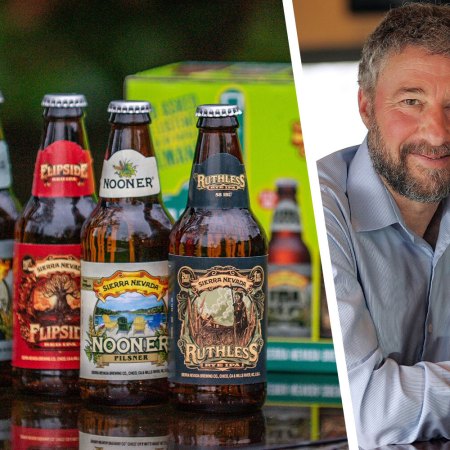
As Sierra Nevada painstakingly maintains consistency over its decades-old crown jewels like the Pale Ale, Celebration, Bigfoot, Stout, Tumbler Brown Ale and Ruthless Rye IPA; creatively barrel-ages for its Trip Through the Woods series with everything from tequila to rum barrels and all manner of fruit, spices and botanicals; and innovates from new technique to new brand; the brewery prioritizes community-building and environmentally conscious methods. For instance, Sierra Nevada spearheaded the Resilience Butte County Proud IPA open collaboration in 2018 to raise money for wildfire relief in the area. They began investing in efforts to offset their energy consumption in 2004 and started using solar panels in 2007; they have craft beer’s biggest solar array today. The Mills River location is one of the few LEED-certified production breweries in the United States; the brewery also diverts almost all of its solid waste from landfills and grows a good deal of the food served in its Chico and Mills River taprooms on-site.
Staying independent has helped Sierra Nevada remain a leader in craft beer across the board, from sustainability to community to brewing methods to the beer itself. These careful decisions have not only helped Sierra Nevada as a business thrive at 45, they’ve pushed American craft beer forward and have inspired many to join the industry and make their own marks.
Patrick Allen’s early love of Sierra Nevada motivated him to submit a video to the brewery’s 2013 competition that offered the prize of brewing a beer in the Chico brewhouse, which he won. “It’s how I essentially got my first professional job setting up a brewery at Keg & Lantern because I think the owner thought I actually brewed at Sierra Nevada,” he says. “That led me to meeting [Michael Barcone, owner of] West Kill, which is where I’ve been now for eight years…All partially thanks to Sierra Nevada for nuggets of inspiration along the way.”
“Sierra Nevada has always had a special place in my heart,” says Shawna Hays, head brewer at Miel Brewery in New Orleans. “They have held onto a quality product for so long and are always working at being more and more sustainable. They have turned into the symbol of how to start from nothing and grow a successful brewery, that we can all learn from.”
Sierra Nevada’s 45 years have included weathering industry ups and downs; Grossman acknowledges the current economic headwinds and challenges to beer sales, but doesn’t see beer going anywhere anytime soon and simply wants to keep his brewery in a good position to be a strong player during the tough times and hopefully bright future. This survival is yet another potential source of optimism for other brewers.
“Sierra Nevada is still that spark the industry needs at this moment,” says Josh Velez. “This isn’t the first time drinkers have looked at other trends and beverages…Instead of looking at this in fear, [Sierra Nevada] finds ways to push forward and in that they [find] ways to move our entire industry forward…One thing I know for sure is, as long as Sierra Nevada is around, I know our industry is bound to not only survive but come out much stronger than before.”
Meet your guide

More Like This

Every Thursday, our resident experts see to it that you’re up to date on the latest from the world of drinks. Trend reports, bottle reviews, cocktail recipes and more. Sign up for THE SPILL now.