Last year, InsideHook talked with six recent EV buyers about what they liked and didn’t like about driving their new vehicles. Charging infrastructure was one thing that came up multiple times — and it isn’t hard to see why. If you’re used to filling up a gas tank in a few minutes, waiting for significantly longer can feel like a bridge too far.
Automakers have sought a few alternatives to this, including creating faster charging stations and giving people more to do while they wait for their car, truck or SUV to charge. (The model of Sheetz is instructive here: an establishment open 24/7 where you can sit down with food or coffee and wait while your vehicle recharges.) But those are not the only ways to make the charging experience faster — and one international company has a truly novel approach to this question.
The company is the Chinese EV manufacturer NIO, and their approach is focused less on spending time recharging batteries. Instead, their approach involves swapping out batteries at a charging station — the premise being that it is faster to swap in a freshly-charged battery than to wait for an existing one to be fully recharged. Some drivers are clearly on board with this: earlier this year, NIO announced that it had completed 100 million battery swaps.
In a recent article for NPR, John Ruwitch talked with NIO executive Jason Wu about the the company’s approach. The most enticing aspect of it is the time spent swapping the batteries: just over three minutes. NPR also points out that NIO’s EVs can also be recharged in a more traditional manner; in other words, if there isn’t a NIO station along your route, you aren’t going to be out of luck.
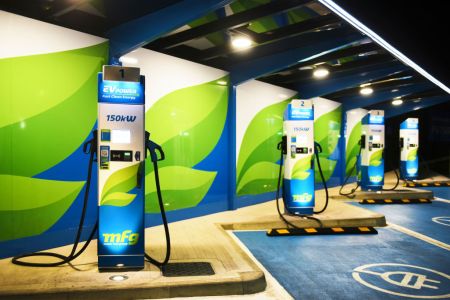
California Announces Major Investment in EV Charging Infrastructure
$2.9 billion is not a small numberAs for where the stations are located, NPR reports that around 4,000 are in place, mostly in China. Rutwich notes that NIO currently has 4% of the market share for EVs in China. That may seem small, but remember that the Chinese maket for EVs is a very large market overall. Whether such a infrastructure system could work in the U.S. is an open question, but the number of swaps NIO has accomplished to date suggest that a lot of drivers are on board with this technology.

More Like This

We're always on the scene eating, drinking and traveling near and far to bring you the best of what's happening out in the real world. Sign up for IRL now.