Not shying away from a bit of marketing hyperbole, the makers of Realizzato claim they’ve created “the world’s most environmentally-friendly and sustainable alcoholic beverage.” The brand also says that their coffee liqueur marks the first time in more than 400 years that alcohol has been fermented from a completely new ingredient using an industrial process. At first, this seems overly boastful: It’s a liqueur made from upcycled coffee grounds collected from U.K. coffee retailers. Cool idea, but the beer world is notorious for coming up with brews crafted from waste products.
But talk to Rob Murray, CEO of Murray & Yeatman — the innovative distillery behind Realizzato — and you’ll start to see the larger picture. “While we’ve done this for the coffee grounds now, the process can actually be done to any plant matter,” he explains. “We’ve done it with paper. We’ve done it with tree bark.”
The East Sussex-based distillery started the Realizzato project after the founders read an article about a similar distilling concept published in a scientific journal in 2014. The following years included several attempts at replicating this process on an industrial level, and some of their research actually involved reviewing experiments from a book originally published in 1651. Add in a two-year wait for, as Murray puts it, “the government allowing us to actually do this,” and you can see why creating a sustainable coffee spirit took more than a decade.
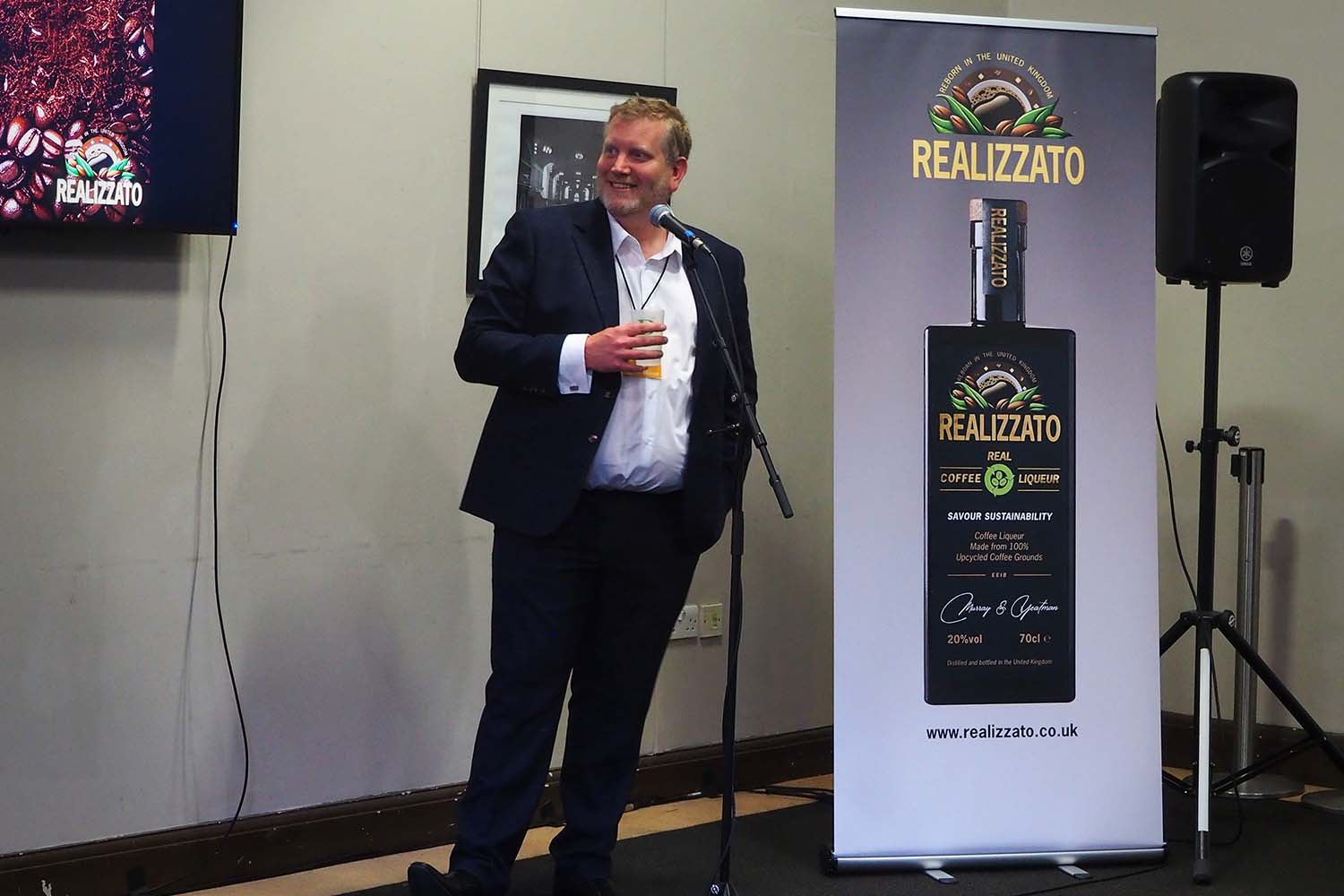
“It’s not a quick process,” says Murray, who explains (in general terms) that what they’re doing with Realizzato is essentially a special form of hydrolysis. Add in fermentation, triple distillation, blending and bottling (in all recycled materials, natch), and you’ve got an eco-friendly liqueur that costs less than $30.
“Our distillery’s main function has been a contract distillery, so we’ve always innovated and figured out ways to make flavors and some weird and wonderful things, like crisp-flavored vodka,” Murray says. “We like finding different ways to do things.”
Coffee grounds create a serious amount of waste. One ton of carbon dioxide equivalents (CO2e) is produced from each metric ton of coffee grounds put into a landfill. According to Murray’s estimate, one well-known coffee chain alone disposes of more than 240 metric tons of coffee grounds in the U.K. each day, equalling the release of 10 metric tons of CO2e into the atmosphere every hour.
And it’s not as if the booze world has been much better with its sustainability efforts. “Sustainability is something our industry lacks,” Murray says. “The spirits industry in general is also very energy-heavy. With this, our bottle is recycled, the label is recycled, the stopper is recycled. If we’ve got this sustainable product, that’s great, but then we need to really do it for the rest of the process.”
All well and good, but how does Realizzato taste? Unfortunately, two different samples never made it to my home office (blame customs). And, unfortunately, online reviews from the U.K. are also sparse. So for now, I’ll have to rely on the words from Murray and his team. “It tastes entirely different from other coffee liqueurs,” he says. “Ours is just so much more of the aftertaste of coffee, not just the initial hit. It doesn’t quite have the sour bitterness that you get with coffee initially, but you get the aftertaste, and it’s very aromatic. We’ve also halved the sugar — we found a lot [of the other liqueurs] too sweet.” He recommends the product in an inverted Black Russian (two parts Realizzato to one part vodka).

The Black Russian Is Poised for a Comeback
With the insane popularity of the Espresso Martini showing no signs of slowing, this simpler, two-ingredient cocktail is next in line for a revivalSo for U.S. imbibers, we’ll have to wait and see. But the idea behind the process — crafting spirits out of a product that would otherwise go into a landfill — could have larger benefits. “We can use what we’re doing to make Realizzato to make other spirits,” Murray says. “There are actually other food waste products or plant-based products that we’ve worked on to release further down the line. But there’s another level. We don’t have the machinery that could do it now, but if we had a still that could take it to 99% or 198 proof, we would then actually be able to create the bioethanol part, which can be used in gasoline. The process can be used for other functionalities.”
Even if the bioethanol part isn’t currently feasible, the idea of making good spirits sustainably is still a modest and worthy goal.

More Like This


We're always on the scene eating, drinking and traveling near and far to bring you the best of what's happening out in the real world. Sign up for IRL now.