Personal trainers love their quotes, jargon and back-of-the-napkin equations. Much of it makes little sense to the exercising layman. But “3 x 52” is one prescription that anyone can understand.
The credo champions three legitimate workouts a week, every week, over the course of a calendar year. That amounts to 156 workouts a year, though we’ll round down to a total of 150 workouts (to account for holidays, sick stretches and other life anomalies).
From where we’re sitting, 150 workouts a year is more empowering than intimidating. That leaves 215 days where you’re not lacing up for a run or going to the gym. It puts each week through a more realistic processor. Surely you can grab three days out of seven, no?
We’ve written about the pitfalls of running streaks before, and the dangers of overtraining. Too often, “Am I doing enough?” arrives at the expense of one’s emotional well-being and could lead to a real-life physical injury. But the “3 x 52” regimen, or “150” — whatever you want to call it — is a license to do what’s best for you. Just win the week. Find three days. Then find another three.
Approaching exercise in this way leads to two conclusions:
- You’ll discover the workouts you actually want to do
- You’ll naturally find ways to “exercise” on the four other intervening days. More on this in a bit.
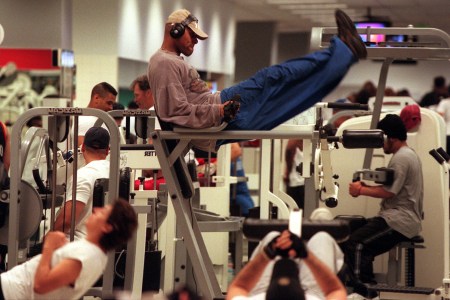
How to Make the Most of 45 Minutes in a Busy Gym
Six strategies for a more efficient session, including a top trainer’s favorite circuitLevel With Yourself
If you want to break three hours in the New York City Marathon, master Muay Thai or train at dawn each morning like a Navy SEAL, 150 probably isn’t for you. But then again, you’re clearly motivated by a specific concentration, or a brand of goal-oriented fitness, which is totally admirable (especially when the goal doesn’t involve a six-pack or “getting into wedding shape”). You have benchmarks to meet and a plan to fiercely protect. All power to you.
But for the rest of us — out here clinging to some vague, year-in/year-out concept of getting fitter, feeling better or living longer — 150 is an excellent way forward. It’s endlessly modifiable and caters to various interests and activities.
How to Pencil in the 150
If your favorite form of exercise is running (though perhaps you don’t consider yourself a “runner” and don’t particularly care about getting faster), just getting out three times a week, at three miles per run, is a perfect amount. If you favor lifting, try one push session, one pull and one focused on the lower half and core. If you’re a workout class person, it’s even easier: plug in three per week.
Notice how quickly you can get to 150 when you give other forms of exercise their due, too. If you’re on a team, a soccer game counts. If you play tennis with friends once a week, that counts. If you’re feeling bored or uninspired by your workouts, what about signing up for a yoga class on Tuesday, going for a long bike ride on Thursday and hiking with friends on Sunday? It may not constitute your “conventional” workout week, but it all goes towards the count.
There Will Be Flops
Even within this set of expectations, understand that your three weekly workouts don’t have to be perfect. In fact, they explicitly won’t be. Be prepared for at least one workout a week to be a flop. When this happens, pay attention to — just don’t agonize over — your inputs. How did you sleep the night before? What did you eat? Anything irregular at work? Consider these things, accept them, then promptly move on. It was just one of 150, after all.
Casualize Your Other Exercise
There’s a slight catch to the 150: it isn’t a permission slip to spend 215 days doing nothing. The effectiveness of three dedicated workout sessions a week is predicated on a lifestyle that values and actively courts mobility. Remember: simple movements burn calories, too.
NEAT exercise, defined as “the energy expended for everything we do that is not sleeping, eating or sports-like exercise…[ranging from] walking to work, to typing, to performing yard work, to fidgeting,” improves metabolic health and increases mitochondrial function. Making sure your four “off days” are full of NEAT exercise will provide massive physiological and philosophical benefits, helping you reanimate your willingness and appreciation for movement — and perhaps help you reach a a point where that sort of action becomes automatic.
Plus, those four days will keep your body fit, flexible and in fighting shape, meaning you’re not coming off the bench all achey on the days you actually have to perform. Casual walks on Wednesdays might not be part of your formal count, but they’ll add to the end goal just the same. With a new year nearly upon us, this is the perfect time to commit to the 150.

More Like This




Twice a week, you'll find proven advice and tips, expert interviews, deeply reported features and personal essays on living better — for however long you’re here. Subscribe to Champ now.