After President Donald Trump announced that the U.S. had captured Nicolás Maduro, the world waited for evidence that the Venezuelan leader was indeed alive and in custody. A few hours later, Trump offered one photograph as supposed proof. On the evening of Jan. 3, a second batch of images emerged, featuring a bizarre detail that shocked Pete Roberts: the dictator was wearing a hoodie from his brand.
“I got a text from one of my media guys and he’s like, ‘Maduro is in an Origin hoodie,’” Roberts tells InsideHook. His first impulse was to laugh. His second was to assume the images were generated by AI. But the founder and CEO of Maine-based Origin eventually came to the realization that, despite the internet flooding with fake images of the ousted Venezuelan president, all signs pointed to these ones being real.
In photos published by outlets like ABC News and Reuters, Maduro really was wearing one of their hooded pullovers, with Origin’s circular wave logo clearly emblazoned on the chest. The color? “Patriot Blue.”
The details of how this unintentional product placement came to be are still not clear. But Roberts has a theory, which goes like this: When Maduro arrived at Stewart Air National Guard Base in Newburgh, New York, on Saturday, it was dark. The U.S. Drug Enforcement Administration agents who escorted him from the airplane to a hangar were all wearing similar uniforms. In order for snipers stationed on roofs to clearly follow Maduro, Roberts surmises, they needed a bright piece of clothing to put on him, which a federal agent or service member had on hand.
“So he stood out like a lightning bug, right?” poses Roberts. Still, it’s just a theory. “I’m sure we’ll figure it out in the next week or two what happened when this thing cools off a little bit.”
The apparel manufacturer had a more pressing problem: to acknowledge the incident or pretend it didn’t exist? Owning the fact that the best-known model for your clothing is a longtime dictator and indicted narco-terrorist is no simple feat.
“We’re a politically agnostic brand,” he says. “But I knew this was going to be highly politicized, so I didn’t really know how to handle it.”
Lessons From Past Brand Blunders
Thankfully, Roberts knew just the person to call: Kip Fulks, an advisor and partner at Origin who got his start as a co-founder of Under Armour.
“He’s been through this scenario so many times over the years,” Roberts says, alluding to times when Under Armour logos have shown up in controversial places. One such incident took place in 2016 when a hunter sponsored by the sportswear brand was involved in a brutal (but legal) spearing of a black bear; footage of the killing sparked outrage, which led Under Armour to cut ties with the hunter, which then led to fury from the hunting community.
The State of American Manufacturing, According to 10 Companies
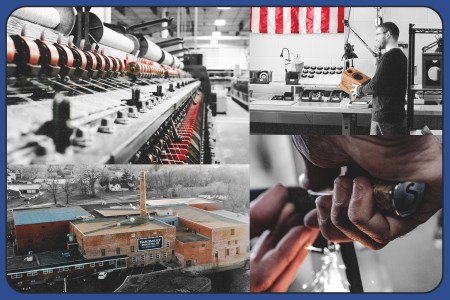
What’s the reality like for U.S. brands making blankets, furniture, cookware and watches? We asked them.Fulks advised Roberts to “lean into it,” with a caveat: don’t make it about the event, don’t make it political, just keep it focused on the product, the brand and the message. Origin, which started out making Brazilian jiu-jitsu gear, has since expanded into all manner of men’s apparel and footwear from denim jeans to Chelsea boots, with a lofty goal: “the rebirth of American manufacturing.”
“So that’s the strategy we deployed, knowing it could bite us in the ass,” Roberts says, “but the risk for us was worth it.”
Origin’s first social media post about the event, which reads “Welcome to America” and features a photo of Maduro giving two thumbs up in the hoodie with a link to pre-order the garment, has over four million views on X. A video of Roberts explaining the situation, which is largely focused on telling his brand’s history, has close to 500,000 views.
As for the pullover itself, called the RTX Brrr° Cooling Training Hoodie, which is only available seasonally in this specific blue color (thus the pre-order status), Roberts is mum on specific sales stats. But he’ll say this much: “The fabric we’re knitting right now, we probably won’t have enough to make any other color but the Patriot Blue.”
Leaning Into It, Dictator Be Damned
Maduro isn’t the first dictator to plunge an apparel brand into hot water. During a 2022 rally in Moscow, Russian President Vladimir Putin wore a five-figure parka from Italian luxury brand Loro Piana. The LVMH-owned label was criticized at the time for not explicitly condemning Putin and his invasion of Ukraine.
That cautionary tale wasn’t the first that popped into Roberts’s mind. Instead, in his discussions about how to handle the Maduro moment, he says he just wanted to avoid a similar fate to Black Rifle Coffee Company, which was embroiled in controversy after Kyle Rittenhouse was pictured in one of their T-shirts after shooting three men and killing two of them in Kenosha, Wisconsin. (Not mentioned by Roberts, but worth noting: Black Rifle has attracted negative attention many times, including the fact that many rioters on January 6 sported their gear.)
“That also went through my head,” Roberts says of Black Rifle’s Rittenhouse flashpoint, “like we need to run away from this as fast as we can, because what happens if this turns into an absolute shitstorm? And now [Maduro is] wearing Origin and there’s a negative view on the brand?”
The obvious difference between Origin’s viral moment and the aforementioned incidents involving Under Armour, Loro Piano and Black Rifle is that Maduro, ostensibly, didn’t own or choose to wear this hoodie himself. It appears that someone else put it on him. That hypothesis is strengthened by the fact that Origin has a fanbase among the type of people who serve in the U.S. Armed Forces and work as federal agents. That’s thanks in part to their made-in-America mission, but even more so due to the influence of Jocko Willink, another business partner who is a retired Navy SEAL and hugely popular podcaster with millions of subscribers. “A lot of those folks listen,” says Roberts.
There is one other facet of this moment that’s been on Roberts’s mind, which has nothing to do with how people perceive his company in the immediate aftermath of Maduro’s capture.
“This image, especially the one with two thumbs up wearing the Origin hoodie, is probably going to go down in history books,” he says. Thinking about the long life this photo could have, Roberts says it called to mind other famous images from historical moments, like the fall of the Berlin Wall and “the woman protecting her boyfriend holding a machine gun from the IRA.” The latter image, taken by Irish photographer Colman Doyle in Belfast during the Troubles, can actually be seen hanging on the wall in the background of Roberts’s recent video.
Oddly, that photograph is a perfect companion to Maduro in the Origin hoodie, as the story Roberts knows about the IRA shooter has been shown to be fabricated. Even the photographer himself said the narrative about a woman taking up the rifle of her wounded fiancé was fake. But that hasn’t stopped the legend from taking root.
Did a DEA agent take his own Origin hoodie and pull it over Maduro so snipers could better see him in the dark? Did Maduro give two thumbs up because “he liked the fabric,” as Roberts jokes in his video? We may never know. But thanks to his quick thinking when the spotlight swung his way, his version of events may just take root, too.
More Like This

This article appeared in an InsideHook newsletter. Sign up for free to get more on travel, wellness, style, drinking, and culture..