There are a few notable elements to NASA’s launch this week of a new mission to Mars, known as Escapade. There’s the matter of the Blue Origin rocket used to send the probe into space and returning successfully to Earth, making it a milestone for the spaceflight company’s New Glenn rockets. As Blue Origin CEO Dave Limb said in a statement, “never before in history has a booster this large nailed the landing on the second try.”
But there’s also the matter of the Escapade mission itself, which was launched into space now even though Earth and Mars won’t be aligned until next year. As it turns out, there’s a reason for that. For the next year, they will remain in the vicinity of Earth, moving in a pattern that NASA described as “kidney bean-shaped.” Next November, the two spacecraft will begin heading towards Mars, with the speed accumulated in the previous months making its trip to the Red Planet more efficient.
Once it gets there, the two craft that comprise Escalade will explore Mars’s magnetic fields and how the planet reacts to solar winds. According to information released by NASA, each of the two craft are the size of a refridgerator, and will collect solar energy — though the actual amount of power used will be “about as much power as a tea kettle.”
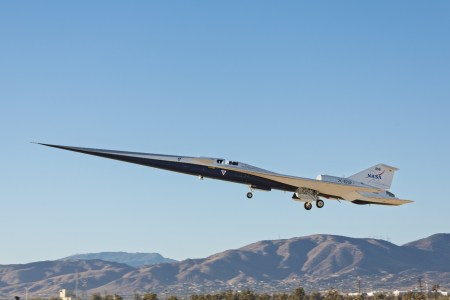
This NASA/Lockheed Martin Venture Could Make for Faster Flights
What if supersonic travel wasn’t so loud?“This heliophysics mission will help reveal how Mars became a desert planet, and how solar eruptions affect the Martian surface,” said acting NASA Administrator Sean Duffy. “Every launch of New Glenn provides data that will be essential when we launch MK-1 through Artemis.”
Escapade is scheduled to arrive at its destination in November of 2027, with its mission commencing the following Spring.

More Like This


This article appeared in an InsideHook newsletter. Sign up for free to get more on travel, wellness, style, drinking, and culture..