The Denali badge has been an incredible cash cow for GMC, giving it a sub-brand sponge to soak up dollars from luxury-seeking SUV and pickup shoppers willing to pay extra for power, style and features. The numbers vary from year to year, but it’s not unusual for the company to move more Denali units than several leading European premium marques combined, generating billions of dollars in the process.
That GMC would produce a Denali edition of its electric Sierra pickup was never in question. How it would differentiate itself from its Chevrolet sibling, however, was a little less certain, especially given that the Silverado EV beat the Sierra to the starting gate and arrived in a near-six figure First Edition RST model back in 2024 that was dripping with technology, features and creature comforts.
Flash-forward to the 2026 model year, and the playing field has been equalized. The RST is banished from Chevy’s order sheet, with the more affordable, off-road focused Trail Boss now sitting at the top of the heap. Over at GMC, the Denali is tweaked to offer even more capability than it did the previous year, all in a bid to do battle with similarly-priced Rivian R1T and Tesla Cybertruck (and to a lesser extent, its in-house GMC Hummer EV rival) as the upscale hauler of choice.
It’s a laudable effort, as the GMC Sierra EV Denali pairs its gigantic dimensions with exceptional power, an overwhelming design, and standard features that most of its would-be counterparts simply can’t match. At the same time, it brings with it a few eccentricities common to many electric vehicles built by General Motors — and a few quality concerns that feel out of place on such a highly touted, and expensive, rig.
All Battery, All the Time
The Sierra EV Denali boasts some seriously big numbers on its spec sheet. Tucked beneath the floorboards of my Max Range tester was a 205-kWh power pack, a unit whose mass accounts for nearly a third of the GMC’s roughly 9,000 pounds of curb weight. All that energy fuels maximum output of 760 horsepower and 785 lb-ft of torque from a pair of electric motors and a maximum driving range of 478 miles.
It’s helpful to think of the Ultium EV platform for pickups as enormously overbuilt battery carriers, with the goal of selling customers on its hefty range and ridiculous (sub-five-second to 60-mph) acceleration. The flip side of those gaudy figures? In my neck of the woods, the Sierra EV qualifies as a heavy-duty truck, which increases registration costs (and could impact what kind of yearly inspections are required).
All that mass also impacts efficiency, with the Denali averaging 46-kWh per 100 miles of driving during my time with the truck. That worked out to about 445 miles of real-world driving on a full charge, which is an impressive number for such an enormous vehicle but somewhat short of its factory rating — and considerably thirstier than more modestly sized electric vehicles.
At the very least, all that battery charges quite quickly. The Sierra EV can take advantage of 350 kW DC fast charging where available (although maximum speeds are typically only accessible for a portion of the charging cycle), and GMC claims 116 miles of range can be added with just 10 minutes on a plug. On a Level 2 charger, you’ll need a lot more lead time to get to 100 percent: it took me 16 hours to top up from the 68 percent mark when plugged in at home.
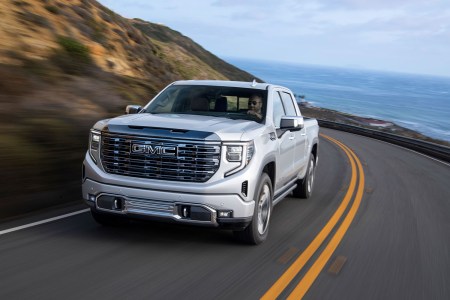
Review: The GMC Sierra Denali Ultimate Is a Triumphant Truck Do-Over
In a hot luxury pickup market, GMC proves it can still hang with Ford and RamLuxurious? Yes, but We Have Concerns
Despite its leviathan engineering, the GMC Sierra EV Denali presents a compelling luxury package. With the Silverado RST First Edition firmly in the rearview mirror, the Denali expertly assumes its luxury truck mantle, delivering a level of cabin comfort and top-shelf materials that have few rivals in the high-end truck space, especially if you’re seeking a true full-size model.
It’s refreshing to look at a dashboard that isn’t dominated by a single, stretched LCD screen, although the tall tablet erupting from the center console in the Sierra (which is paired with a more modest gauge cluster) could give Moses’ original ten commandments slab a run for its money. For the most part, GM’s software is easy enough to deal with, although some functions—such as lighting controls and exterior camera views—are buried behind a few too many menus to be useful while driving.
The most frustrating aspect of any General Motors EV is the continued lack of support for Android Auto and Apple CarPlay. It’s an irritant to the hundreds of thousands of drivers who rely on the convenience of these mobile phone mirroring systems every day.
GM is clearly on a path to monetizing driver data and doesn’t want to give anything away to third parties. Further proof of my suspicions about this strategy was found when I perused the Sierra’s software setup screens and found an entire section devoted to managing personalized advertisements within the vehicle. As far as I know, this ad delivery system isn’t active yet, but the groundwork is there, allowing the company to flip the switch when the time comes.
One other disappointing aspect of the Sierra EV’s interior? A constant rattle and squeak from its panoramic sunroof, which was loud enough to hear over both the stereo system and the sound of its tires on a gravel road. I’ve encountered more than a few rough edges in luxury Ultium models over the past couple of years, and I’m still surprised at how the automaker’s manufacturing has yet to catch up to the quality standards expected in such an expensive vehicle.
The Denali’s Drive Tech Is Unsurpassed
Back to what the Denali does well. It’s easy to forget just how heavy the Sierra EV is in a straight line thanks to its exceptional output. Even while towing my track car, the GMC was eager to outshine all comers on uphill passing lanes, fending off those overconfident souls convinced that cutting off a multi-ton truck and trailer is the safest way to spend their time. All of the above is accomplished with the smoothest possible power delivery, too.
In the corners the GMC’s mucho mass is easily identifiable. Slow things down a bit, however, and the truck’s size seemingly folds in on itself thanks to the presence of four-wheel steering. Forget crab-walking your way across the dunes — you’ll be way more impressed by how easy it is to park the Sierra EV in tight spaces by way of this feature. With a trailer attached, it made reversing and pivoting around sharp angles much simpler than in any gas-powered pickup I’ve driven over the past few years.
Then there’s Super Cruise, which is something I don’t think GM gets enough credit for. In the Denali, it allowed hands-free driving on highways and even the mapped mountain roads around my country home — whether the trailer was hitched up or not. When commuting sans-race car, it also delivers automatic lane changes to pass slower traffic. Of all the advanced cruise control systems I’ve tested, Super Cruise is the one that works the most consistently, and which does the best job of letting you know when it needs to shut down so you can take over steering duties.
A Great Luxury Truck — But for Who?
The GMC Sierra EV Denali’s luxury act is a convincing one. Forget that it relies on a battery pack that’s twice the size of its closest competitors, or that it weighs in at nearly two tons more than those other EV pickups: this brute force strategy for racking up class-leading range might be inelegant, but it’s certainly effective.
It might be a little harder to overlook the Denali’s $100,000 window sticker, but there are few, if any, full-size truck options that feature a similar array of performance, capability and coddle. The question becomes whether you really need what the GMC has to offer, or would you be just as satisfied with the more modest proportions of the Rivian R1T, or the less posh but still comfy confines of the Ford F-150 Lightning Platinum?
As EV pickups increasingly crowd the market, the Sierra EV may have a more difficult time justifying its place at the top of the pricing pantheon. For now, however, it’s the over-the-top answer aimed at customers for whom the word “most” is rarely synonymous with “enough.”

More Like This


This article appeared in an InsideHook newsletter. Sign up for free to get more on travel, wellness, style, drinking, and culture..