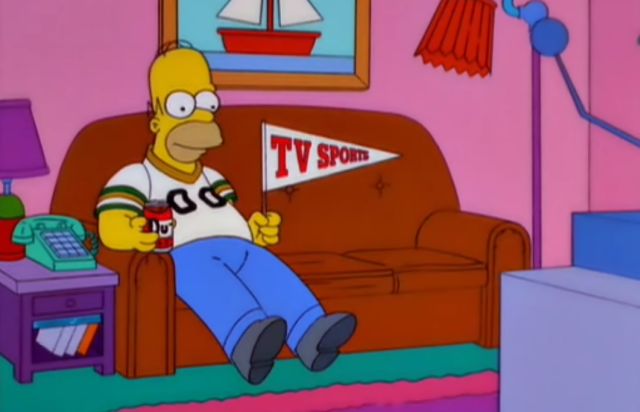
A couple decades ago, the image of a sports fan (usually a man) sitting on his couch, eyes glued to the game, was shorthand for any number of unsavory monikers: Neanderthal, deadbeat husband, Homer Simpson. What sort of person would spend this much time watching a team that “always lets him down,” when he could be hanging out with his kids, helping out around the house or — I don’t know — reading a book?
That stereotype feels quaint these days. For one, sports fandom has steadily shed stigma and reached ubiquity: In a 2023 poll, 70% of Americans self-reported as sports fans.
At the same time, the very nature of sports viewership has changed. Deriding a fan for spending too much time watching sports may no longer be accurate, because even diehard fans find it difficult to focus on the game anymore.
Phones and Fandom
Notice in that Homer Simpson photo that he’s holding a pennant, not a smartphone. Today’s sports must compete with the “second screener,” or any viewer who brings a phone, tablet or laptop into a room where the TV’s on. Second screening is already informing the type of content that streaming giants produce (dumbed-down plots, meant to be consumed with the subtitles on). It has an even larger impact on the live sports sector, where viewers often use multiple screens to watch more than one game at once, check stats and react to in-game conversations on social media.
A huge reason sports fans have their phones at the ready these days is online betting. According to St. Bonaventure University, 48% of American men between the ages of 18 and 49 have an account with at least one online sportsbook. Meanwhile, the Fantasy Sports & Gaming Association estimates that 19% of American adults aged 18 or older play fantasy sports.
What’s the appeal? It’s not just wanting to making a few bucks. Bettors report that playing “makes them more interested in the games.”
The dark and dramatic side of digital sports betting has been in the news lately — with desperate bettors sending professional athletes everything from Venmo requests to death threats. But it’s worth rewinding back to the innocent beginning of most bettors’ journeys, reflected in their relationship to sports viewership. Why did they need to make themselves “more interested in the games” in the first place?

A Surprising Superpower for Mental Health? Sports Fandom.
Industry insiders Ben Valenta and David Sikorjak on the most underrated social goodA Casualty of the Attention Economy
The through line here is our distracted age, with its relentless attention economy. Our brains are being fried by feedback loops we never asked for. Sitting still and watching a three-hour contest has somehow become a special skill — a demonstration of true emotional investment, sure, but also one of uncommon focus.
Consider the fact that even the initial act of sitting down and turning on the game has become prohibitive, as 15 years of streaming-giant prospecting has created a labyrinthine network that rewards fans’ loyalty with exorbitant monthly fees. They broke cable only to build back something stupider and more expensive. Sometimes, after spending 10 minutes trying to find the Yankees on a weekday night, I wonder what the same experience must feel like for a 75-year-old lifer. (I’m 30.)
A host of other factors are swirling around this issue: the prevalence of in-game commercial breaks (NFL games infamously feature just 11 minutes of actual play), certain leagues caving to distracted viewers (MLB instituting a slew of pace-of-play rules) and complaints from fans that the seasons are far too long, stuffed with months of unnecessary games (the NBA’s Christmas games are seen as the unofficial start to the season, even though opening week is in October).
What Do We Do About It?
So what’s the solution here? I’m not entirely sure there is one — mainly because the situation feels like a degradation, not an outright problem to fix. Sports fandom has simply changed.
I do think there are ways to preserve what’s always felt unifying and inspiring about sports fandom. Some researchers have demonstrated this particular fandom is a “underrated social good,” as a local, intergenerational concentration that brings people together.
When fans watch the game together (on the couch or at the bar), a phone’s distractive presence is more obvious and ominous. I’m not sure you have to put your phone in your drawer before turning on the game — leisure shouldn’t feel like deep work, and texting friends or family after a touchdown is a positive component of modern fandom. But ultimately, the name of the game is intention.
If you have an open evening and want to watch the game, embrace that pocket of time. Make a plan to watch it with someone, or watch it alone (and slow-read a magazine article while muting the commercials, a favorite method of mine). Come playoffs, lean into the nail-biting, crappy-sleep theatrics of it all. I’m rarely more immediate than when I’m standing an inch from my screen, screaming at the Knicks. You could also consider leagues you haven’t embraced in the past, like global contests light on adverts (English Premier League, F1) or bite-sized tournament action (golf, tennis, martial arts).
Ultimately, know that A) you’re not crazy, watching sports is harder now, and B) it’s probably up to you, alone, to control whether the experience is worth it anymore. I happen to think it is. With practice, focus and a bit of zen, we all might become Neanderthals again.

More Like This



Twice a week, you'll find proven advice and tips, expert interviews, deeply reported features and personal essays on living better — for however long you’re here. Subscribe to Champ now.