Founded in 1860 in Saint-Imier, Switzerland, Edouard Heuer’s eponymous watch brand was everywhere by the mid-20th century, from Formula 1 drivers’ uniforms to Viceroy cigarette ads. During the Olympic Games, Heuer timepieces came to define the idea of the modern automotive chronograph — even the chronograph more broadly.
As early as the 1930s, Heuer’s Autavia dashboard timers for automobiles and aircraft — the word being an amalgam of “auto” and “aviation” — were being used to track elapsed time and speed. Dual- and triple-register chronograph wristwatches were soon added to the brand’s catalog, followed by models with full calendar functionality. The 1960s saw the introduction of many of Heuer’s most celebrated collections, such as the Carrera, the Autavia wristwatch and the Monaco. Then, in 1969, the brand released the Calibre 11, one of the first automatic chronograph movements: Developed as part of a consortium with several other leading watch brands, it set the horological world aflame, proliferating through the Heuer collection and leading to the development of exciting new models and references.
In 1985, Heuer was acquired by TAG (Techniques d’Avant Garde), a Luxembourg holding company; focus shifted in those years to affordable quartz-based watches such as the 1000-series divers and the wildly popular Formula 1 pieces. In 1999, LVMH moved in to acquire TAG Heuer, building up the brand to a core pillar of its burgeoning watch business.
Today, “TAG” — as it’s affectionately known amongst younger collectors and wearers — is slowly rebuilding its reputation as a maker of first-rate chronographs. Having redesigned the Carrera as the “Glassbox” in 2023 and placed a focus on complicated movement development, it’s now a player in both the mid-tier and the haute horlogerie arenas.

The 10 Best Watches of July 2025
Unimatic’s new collection provides excellent value under $1,000, while a spectacularly complicated IWC brings down the horological houseBut to truly understand the brand, one should begin with Heuer’s vintage chronographs. Produced in a dizzying variety of collections, models, references and sub-references, these compelling timepieces helped define the very idea of the mid-century tool watch. While several of them are still in production in various guises today, many others are long discontinued and can only be found on the secondary market. The price appreciation we’ve seen within this market over the past 15 or so years is staggering, indicating a strong and growing appreciation for Heuer’s vintage classics.
From the stark simplicity of the Carrera ref. 2447N to the ingenious mechanics and beautiful dial of the Seafarer ref. 346 for Abercrombie & Fitch, these timepieces are proof positive that TAG Heuer is truly one of the world’s greatest watchmakers.

Heuer Bundeswehr Chronograph ref. 1550 SG
Produced under contract for the German Bundeswehr (armed forces) in the 1970s, the ref. 1550 SG is one of a number of such chronographs made to the same specifications by Heuer, Leonidas, Zenith and others. Measuring 43mm in stainless steel, it’s an oversized piece whose larger dimensions aided legibility and durability on the wrists of military pilots, particularly helicopter pilots. With a brushed case, dual pump pushers, a knurled crown and a bidirectional bezel with a black, fully graduated aluminum count-up insert, it features a black dial with an outer open minute track; large luminous Arabic indices; a dual-register chronograph with oversized 30-minute and running seconds registers; and a luminous sword handset. A circled “3H” in red indicated the presence of radioactive tritium lume, while a hand-wound caliber from Valjoux provides flyback capability for use in computing flight legs and other crucial information.
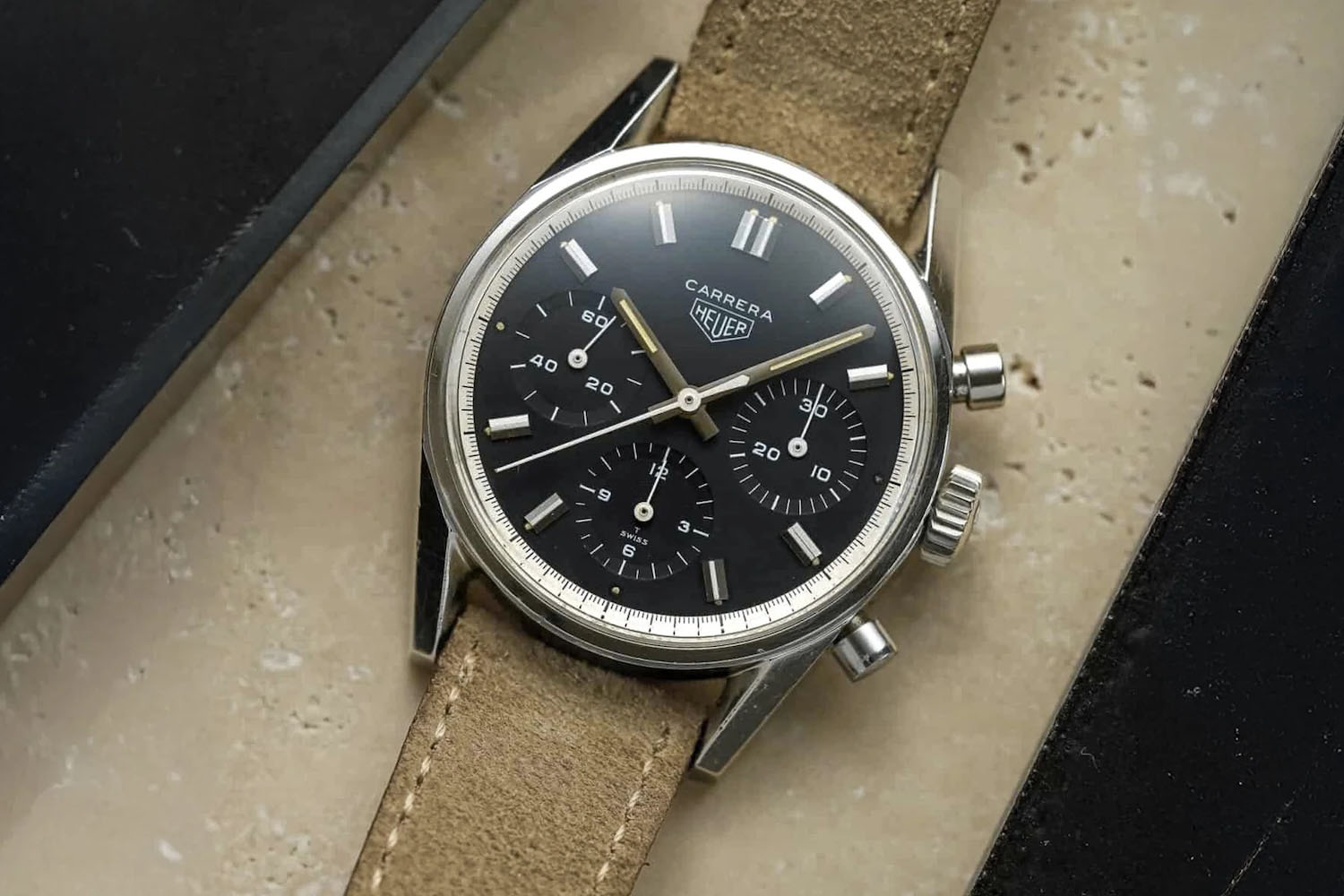
Heuer Carrera ref. 2447N
Designed by a young Jack Heuer and released in 1963, the Heuer Carrera — named after the notoriously dangerous Carrera Panamericana race that took place in Mexico in the early 1950s — is one of the most beautiful chronographs ever devised by any brand. The first-execution ref. 2447N, measuring 36mm in stainless steel, is emblematic of the collection: With its outer 1/5th-seconds scale arranged along the black dial’s rehaut; triple-register chronograph scale in black with white printing; applied, faceted indices; and luminous sword handset, it perfectly embodies the Bauhaus “form follows function” mantra by excluding any remotely extraneous design elements. (Notice, for example, the absence of an external bezel and the smaller case size.) Powered by the venerable hand-wound Valjoux 72, this lovely timepiece defined mid-century automotive racing on the wrists of some of the world’s best drivers.

Heuer Autavia ref. 2446 “Jochen Rindt”
Nicknamed in honor of the German-Austrian Formula 1 driver who famously wore one, the Heuer Autavia ref. 2446 is part of a collection whose origins lie in dashboard timers that first appeared in the 1930s. The ref. 2446, made in several “marks,” is a tool watch par excellence, with a 38mm stainless steel case featuring a rotating, bidirectional count-up insert; a black dial with a triple-register chronograph layout featuring white totalizers in a “reverse panda” arrangement; an outer 1/5th-seconds track in white; applied indices with tritium plots; and a luminous sword handset. The “Jochen Rindt” specifically described a mid-to-late-1960s third-execution dial with longer indices paired to a second-execution screw-back case featuring nicely tapered lugs. Powering it is once again the famed Valjoux 72.
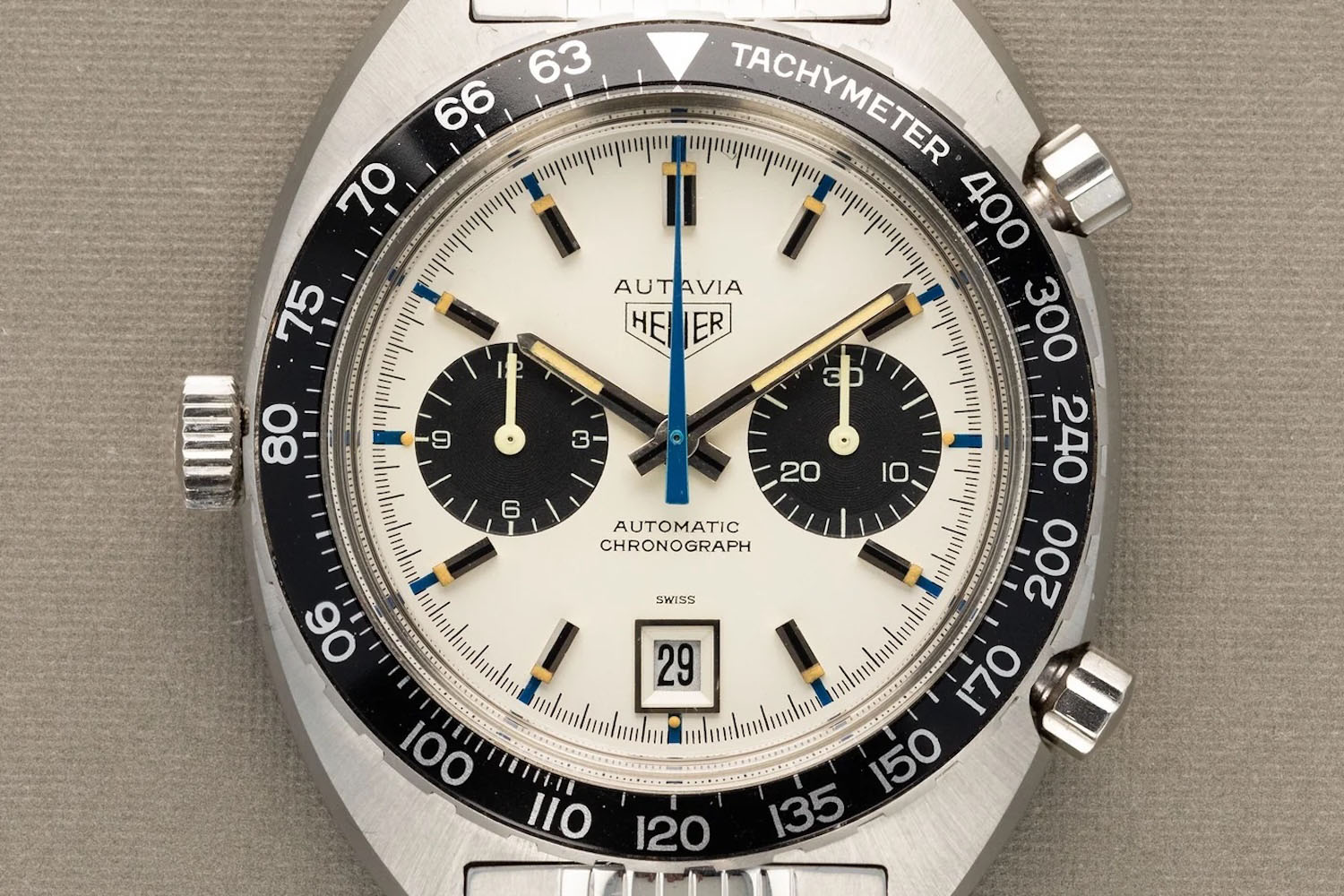
Heuer Autavia ref. 1163 “Jo Siffert”
Heuer began fitting its chronograph collections with the groundbreaking automatic Calibre 11 (and its derivatives) beginning in 1969. One of the most beloved and collectible of this crop is the Autavia ref. 1163 ‘”Jo Siffert,” so called due to its association with the Swiss-born Formula 1 driver who wore one frequently — and was even said to hawk them to his fellow drivers. Housed in a 42mm stainless steel cushion case, it features right-hand pump pushers but a left-hand crown, an odd arrangement dictated by the architecture of the Calibre 12 with its automatic winding module. Surrounding the dial is a rotating bezel with an aluminum tachymeter insert, while the dial itself is white with an outer 1/5th-seconds track, cool blue and applied indices with tritium lume plots, a dual-register chronograph layout with 30-minute and 12-hour totalizers, a date window at 6 o’clock, and a luminous sword handset with blue accents.

Heuer Autavia GMT Chronograph ref. 2446C
When Heuer introduced the Autavia GMT Chronograph around 1969, it was housed in a screw-back case. Shortly thereafter, Heuer switched to a compressor-style case — denoted via the “C” designation in the reference number — that it would continue to use for several years in the early 1970s. Measuring 40.5mm in diameter in a stainless steel housing with long lugs, dual pump pushers, and a bidirectional rotating bezel with a blue and red 24-hour insert, the colorful ref. 2446C features a black dial with an outer 1/5th-seconds track in white; luminous rectangular and red hour indices; a triple-register chronograph display with 30-minute, 12-hour and running seconds registers; and a luminous sword handset with red striping and a red GMT hand with yellow arrow. Powered by the hand-wound Valjoux 72C movement, it’s a piece with tremendous utility, combining the watch world’s two favorite complications in a single beautiful design.

Heuer Monaco ref. 1133B
Launched in 1969 with the then-new Calibre 11 automatic chronograph movement, the Heuer Monaco ref. 1133B was made famous when Steve McQueen strapped one on in the 1971 film Le Mans. Its unusual square-shaped 40mm case with a brushed finish was immediately arresting not only for its profile, but also due to the left-hand crown position necessitated by the Caliber 11’s architecture. The dial, meanwhile, with its circle-in-a-square design; bright blue color; rounded-square chronograph totalizers; 6 o’clock date window; and colorful red and yellow accents throughout the handset and 1/5th-seconds track, was both classically “Heuer” and distinctly avant-garde.

Heuer Camaro ref. 73443
The Camaro, launched around 1968, was only produced for roughly four years. Why, you might ask? Interestingly, it was never fitted with Heuer’s then-new Caliber 11 automatic movement, meaning it was quickly superseded by automatic Carrera, Autavia, Monaco and other models that had been given new cases and movements. Nevertheless the Camaro — named for the Chevy Camaro that was dominating the American automotive market at the time — was a distinctive chronograph that deserves collectors’ attention. With its 38mm steel cushion case with handsome radial brushing, it cuts quite the figure; its dial, meanwhile, was available both in more staid monochrome executions as well as more colorful “exotic” designs. Both two- and three-register versions exist, all of which are powered by Valjoux movements. The ref. 73443, with its white “panda” dial with brown totalizers and tachymeter scale as well as its bright orange accents, is particularly cool.

Heuer Monza ref. 150.501
Introduced in 1976, the Heuer Monza celebrated the 1975 victory of the Heuer-sponsored Ferrari team at the Italian Grand Prix in Monza. (Austrian-born driver Niki Lauda came in third, while his teammate Clay Regazzoni placed first, leading to Ferrari’s first Constructors’ Championship in 11 years.) Notable for being the first black PVD-coated watch in the Heuer catalog, the ref. 150.501 is actually machined from brass rather than stainless steel. The black dial, meanwhile, features an outer tachymeter/pulsometer track along the rehaut and a unique two-register chronograph display. The automatic Calibre 15, an offshoot of the famed Calibre 11, necessitates a staggered layout with the running seconds register placed slightly above the plane of the 30-minute totalizer. With its black tonneau case; red, yellow and white accents; and automatic movement, this unique racing chronograph is one of Heuer’s most compelling vintage offerings.
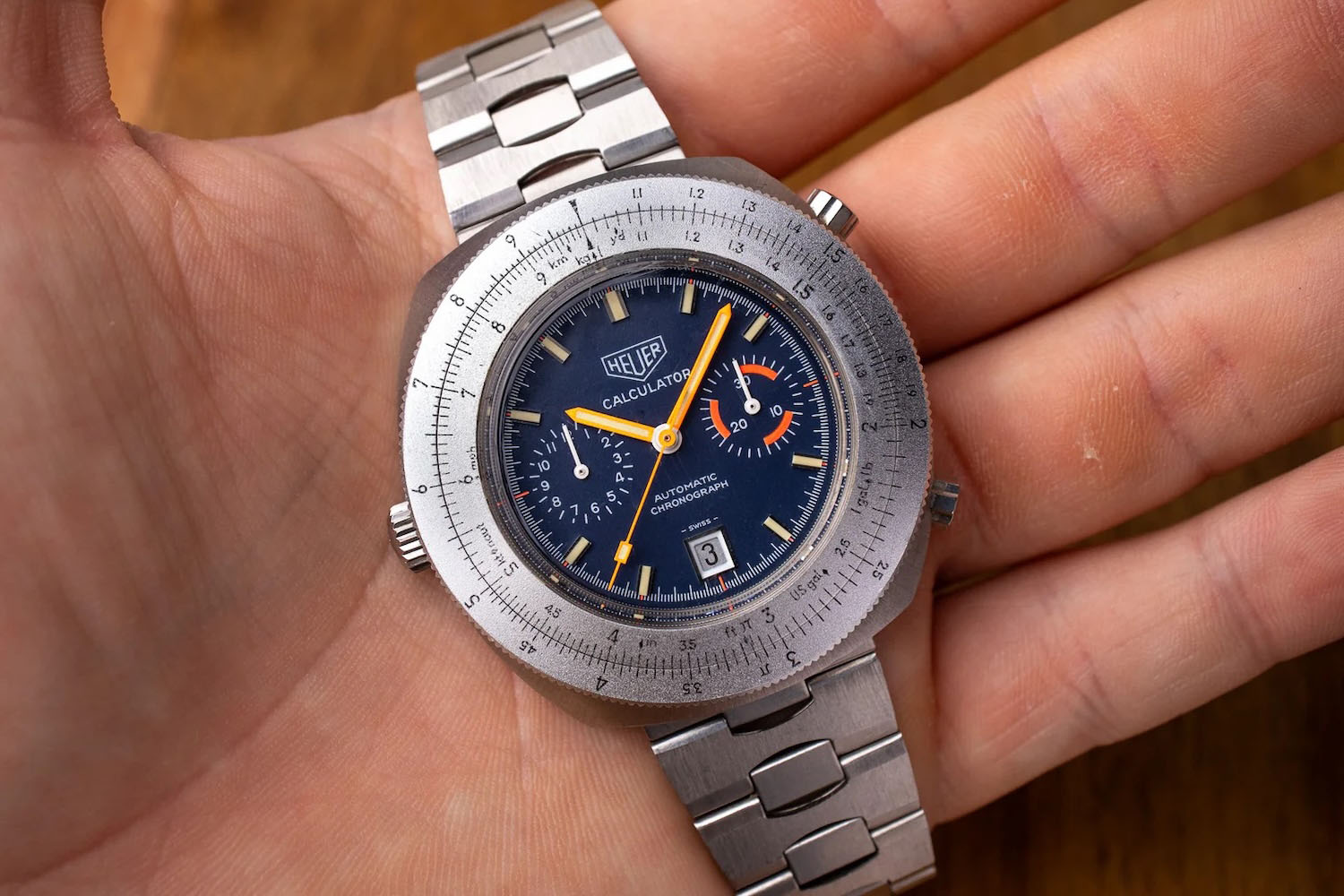
Heuer Calculator Chronograph ref. 110.633
In the days before the portable computer — let alone the smartphone — watches such as the Breitling Navitimer and Heuer Calculator Chronograph allowed the wearer to compute mathematical equations on the fly. Launched in the early 1970s, the ref. 110.633 is no slouch of a watch: Measuring 46mm in stainless steel, its tonneau-shaped case features the now-familiar left-hand crown of Heuer’s automatic Calibre 11-derived movements. Its arresting deep-blue dial — with its bright orange, white and red accents throughout the chronograph registers, handset, outer 1/5th-seconds track and indices — is likewise familiar territory. But the two-piece bezel, with a fixed inner section and outer rotating ring, is a unique tool that allows for the computation of fuel consumption, distance, speed, rate of elevation and simple multiplication. Paired to a steel multi-link bracelet, this behemoth of a watch is an encapsulation of everything that was cool about 1970s industrial design.
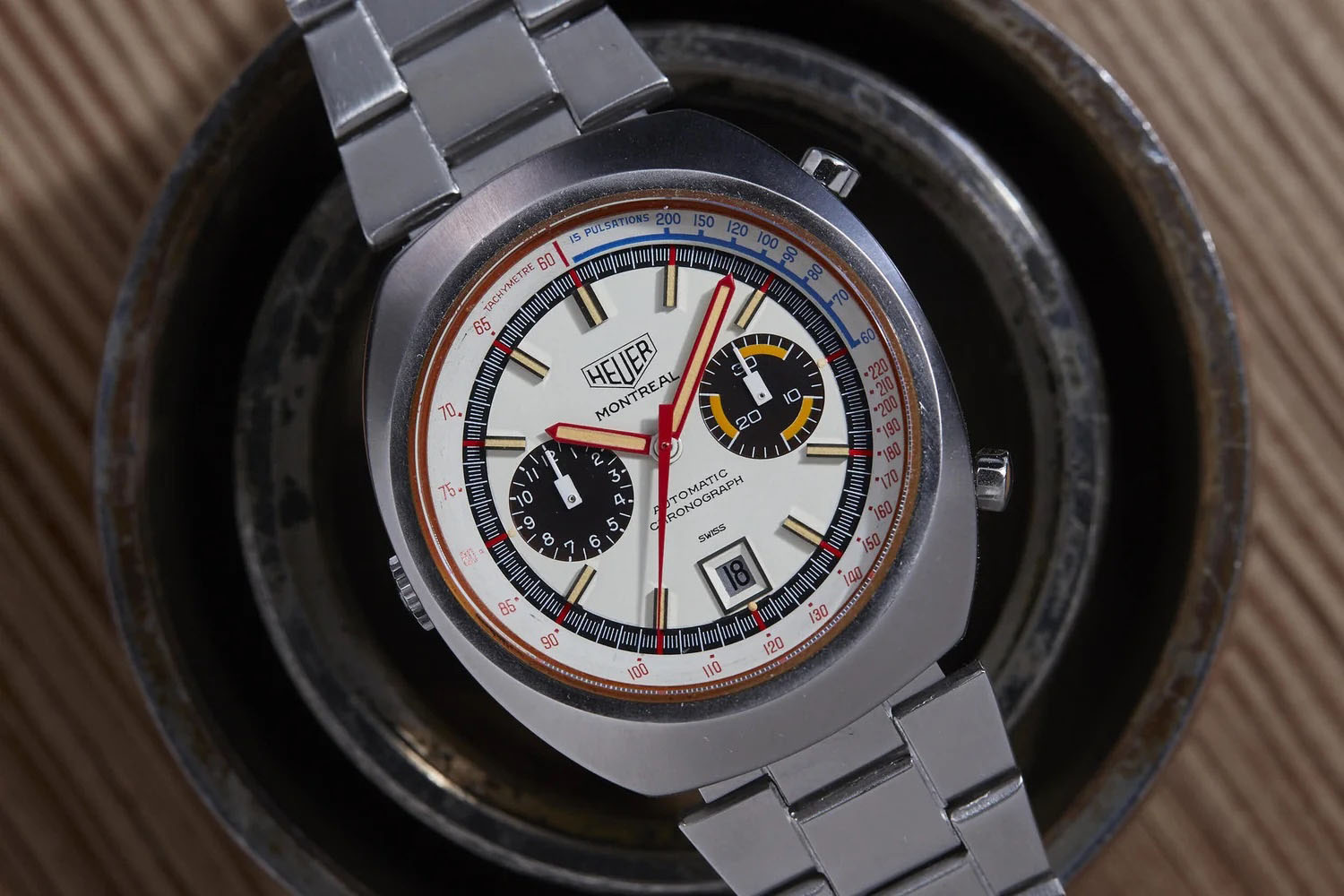
Heuer Montreal ref. 110.503
Not too dissimilar aesthetically from the Calculator Chronograph, the Heuer Montreal ref. 110.503, introduced in 1972, likewise features liberal use of red, white and orange throughout its blue dial. Featuring a dual-register chronograph with 30-minute and 12-hour totalizers as well as a date window at 6 o’clock and a dual-scale rehaut, it’s powered by the brand’s Calibre 12 automatic movement. The case, however, is a 42mm cushion design with barrel pushers, a left-hand crown and hooded lugs that accept a two-piece strap or steel multi-link bracelet. Also made with a white dial [pictured above] with contrasting registers or, later, with a black or blue monochrome dial powered by the Valjoux 7750, the blue-dialed ref. 110.503 is particularly fetching.
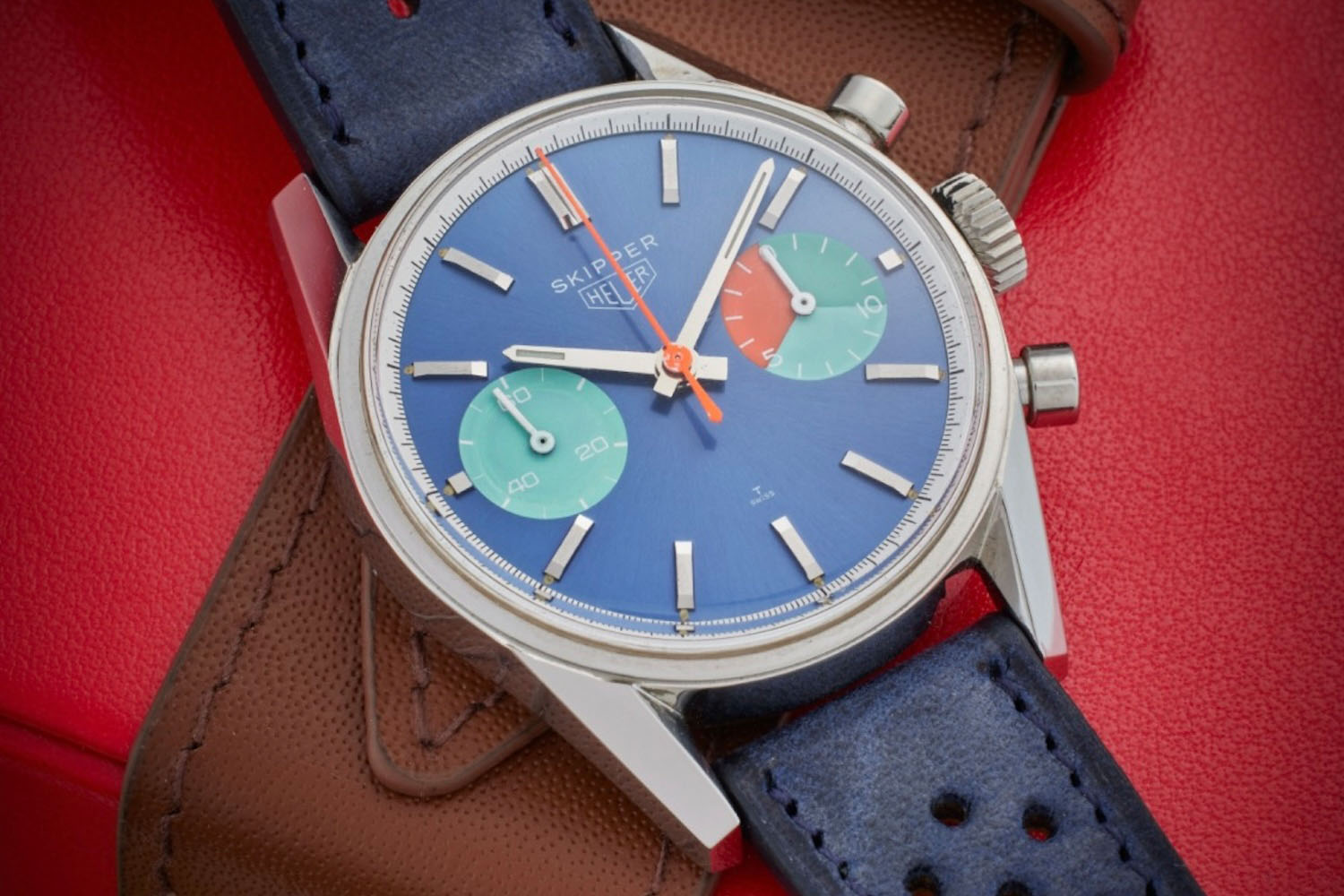
Heuer Skipper ref. 7754 “Skipperrera”
What you’re looking at is one of the rarest, most desirable vintage Heuer watches ever made. Launched in 1968, this unique yachting chronograph features dual subdials in a special teal tone taken from the deck of the Intrepid, the vessel that won the America’s Cup in 1967. Housed in a 36mm Carrera case with sloping lugs, dual pump pushers, a signed crown and an acrylic crystal, it features a 1/5th-seconds track in white along the rehaut; a deep blue dial; applied, faceted indices accompanied by luminous pips; a luminous sword handset; and two chronograph registers, a 15-minute totalizer at 3 o’clock in teal, green and orange used for timing regatta countdowns, and a teal running seconds register at 9 o’clock. Housed in numerous cases and made in several configurations during its decade-long production run, the ref. 7754, produced in perhaps just 20 examples, is most certainly the most beloved.
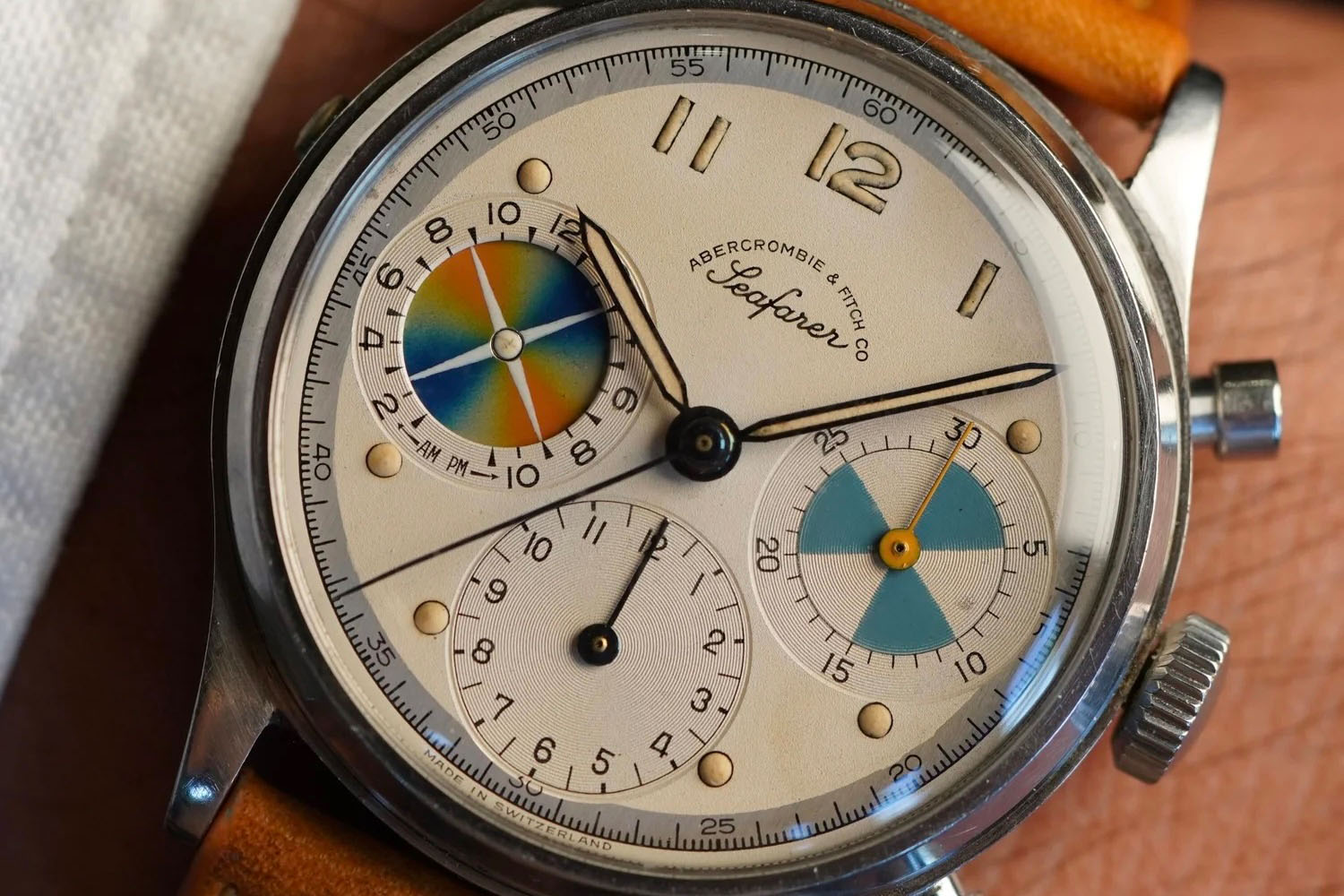
Abercrombie & Fitch Seafarer ref. 346 by Heuer
In the late 1940s, a school-age Jack Heuer joined forces with his physics teacher to devise a mechanical system for tracking high and low tide. Integrated into a wristwatch and retailed by Abercrombie & Fitch — then one of America’s leading outdoor retailers — the Solunar didn’t sell well. However, when it was combined with Heuer’s signature chronograph complication in the form of the Seafarer, sales took off. The ref. 346, a second-execution take on what became a series of Carrera- and Autavia-cased Seafarer watches, is particularly fetching. Housed in a 37.5mm stainless steel case with pump pushers and a large knurled crown, it features one of Heuer’s most compelling dial designs: an outer 1/5th-seconds track frames a combination of round, luminous and Arabic hour indices, while a unique three-register design features a blue and white 30-minute register; an oversized 12-hour counter; and a colorful tide indicator that fades from blue to sand to orange colors. Produced in limited quantities and retailed by A&F, it’s the definitive “IYKYK” vintage Heuer.

More Like This
The world of men’s style, from the streets of NYC to the showrooms of Milan, run down weekly by writer and photographer Christopher Fenimore.