At Watches and Wonders Geneva, Patek Philippe tends to operate with the quiet confidence of a maison that doesn’t need to shout. Releases are incremental, complications are refined rather than reinvented and the overall message is usually some version of We’ve been doing this longer than anyone, and we’ll keep doing it our way.
That approach continues in 2026, though the context this year is particularly interesting: the Nautilus — one of the most culturally dominant luxury sports watches of the past half-century — celebrates its 50th anniversary, a milestone that has inevitably shaped the brand’s headline releases. Alongside several commemorative Nautilus pieces, Patek is also expanding the relatively new Cubitus collection, revisiting its Rare Handcrafts tradition with a rather theatrical automaton wristwatch, and adding fresh complications to familiar pillars of the lineup.
The result is a slate that ranges from technically ambitious to unabashedly whimsical — but unmistakably Patek.

Nautilus 50th Anniversary Models
Any discussion of Patek’s 2026 lineup starts with the Patek Philippe Nautilus. First introduced in 1976 and designed by the legendary Gérald Genta, it helped define the “luxury sports watch” category. Fifty years later, it’s less a watch model than a cultural object, one that Patek approaches with careful restraint whenever the anniversary spotlight comes around.
For the golden jubilee, the manufacture is leaning into historical cues while maintaining the modern Nautilus formula. The most notable piece is the new ref. 5610/1P‑001, which returns the collection to a more compact 38mm format. Inspired by the proportions of medium-sized Nautilus references from the 1980s — particularly the ref. 3800 — the platinum watch wears with a notably slender 6.9mm profile and sticks to a purist hours-and-minutes display.
The design leans into the brand’s history, with a blue sunburst dial with the collection’s signature horizontal embossing, white-gold baton markers, and the familiar interplay of polished and satin-brushed surfaces across the case and bracelet. Inside is the ultra-thin, self-winding caliber 240, its 22K gold mini rotor engraved with the anniversary inscription “50 1976 – 2026.” As with many of Patek’s platinum watches, a discreet diamond is set into the case, here tucked into the hinge at nine o’clock.
Alongside the platinum model, Patek is also introducing two larger 41mm “Jumbo” Nautilus anniversary references in white gold: the ref. 5810/1G‑001 and the ref. 5810G‑001. Both feature a streamlined display with only hours and minutes, emphasizing the purity of the original Nautilus design. Each features the same ultra-thin caliber 240 and a case measuring just 6.9mm thick, maintaining delightfully slim proportions.

The Best New Watches of Watches and Wonders 2026
All the most important releases from the biggest names in watchmaking, from Universal Genève to Jaeger-LeCoultreThe two versions differ mainly in presentation: The 5810/1G-001 pairs its blue embossed dial with a fully integrated white-gold bracelet, offering the most traditional take on the Nautilus formula. The 5810G-001, however, opts for a navy composite strap with a textile motif and cream stitching and adds baguette-cut diamond hour markers to the dial for a slightly more dressed-up look. Both are limited editions, with the bracelet version capped at 2,000 pieces and the strap variant at 1,000.
Finally, Patek adds a curveball to the anniversary lineup in the form of the Nautilus Desk Watch ref. 958G‑001, a white-gold desk clock that translates the model’s design into something closer to a miniature piece of horological sculpture. Housed in a roughly 50mm case inspired by the Nautilus silhouette, it runs on the manually wound caliber 31-505 8J PS IRM Cl J, an eight-day movement with day, date, small seconds, and a power-reserve indicator. The hinged case doubles as a stand, allowing the watch to sit upright on a desk, while a sapphire back reveals the movement within. Only 100 examples will be produced.
Taken together, the new Nautilus releases serve less as a radical reinterpretation and more as a reaffirmation of the model’s enduring formula. In Patek’s universe, that’s exactly the point.

Cubitus Perpetual Calendar Skeleton ref. 5840P
The Patek Philippe Cubitus Perpetual Calendar Skeleton Ref. 5840P marks the first grand complication to enter the Cubitus family. The collection only debuted in 2024 but has already become one of the brand’s most closely watched experiments.
Housed in a 45mm platinum case, it pairs the Cubitus line’s square-with-rounded-corners aesthetic with a fully skeletonized perpetual calendar movement. The new caliber 28-28 Q SQU is shaped to match the geometry of the case, a detail that underscores how seriously Patek treats the architectural relationship between movement and exterior. Where things get more visually adventurous is the monochrome treatment of the movement: plates, bridges and the gold mini rotor share the same rhodium finish, punctuated only by heat-blued screws and a Calatrava cross on the rotor. Even the jewels are rendered in clear sapphire wherever possible, giving the movement an almost architectural transparency.
Technically, the perpetual calendar follows familiar Patek principles: At its core is a 48-month cam system that tracks the full four-year leap-year cycle, allowing the calendar to automatically distinguish between months with 28, 29, 30 or 31 days. Barring the Gregorian calendar’s occasional century exceptions, the watch will remain accurate for generations. The moon phase display also departs from tradition. Rather than the typical two-moon disk rotating over two lunar cycles, the mechanism uses a single large moon that completes one full rotation every 29.53 days — one lunar month — creating a more dramatic visual effect.
It’s a bold piece for a collection that’s still defining its identity and an unmistakable signal that Patek intends Cubitus to sit firmly in grand complication territory.

Calatrava Alarm ref. 5322G
The Patek Philippe Calatrava line has long served as the brand’s canvas for classic complications, and the Calatrava Alarm ref. 5322G continues that tradition. Alarm watches are relatively rare within the modern catalog of Patek Philippe, which makes their occasional appearances noteworthy. The 5322G brings the complication into the restrained Calatrava aesthetic while emphasizing the brand’s attention to acoustic performance and mechanical refinement.
Inside is the new self-winding caliber AL 30-660 S C, a 524-component movement beating at 4 Hz and equipped with a Gyromax balance and Spiromax silicon balance spring. The alarm is set via a crown at four o’clock and displayed through twin apertures at 12 with a day/night indicator. When activated, a hammer strikes a coiled gong — closer to minute-repeater architecture than a typical alarm — producing a clear chime regulated by an inertial governor.
The complication is housed in a 41mm white-gold case with a hobnail “Clous de Paris” caseband, paired with a lacquered gradient dial featuring Arabic numerals and a pointer date at six. In short, if you’re going to use a mechanical wrist alarm in place of your iPhone to get you out of bed in the morning, you could do much worse than this elegant Calatrava.

Celestial Lunar Complication ref. 6105G
The Patek Philippe Celestial Lunar Complication Ref. 6105G represents one of the more poetic corners of the modern catalog at Patek Philippe, a watch less concerned with everyday practicality than with showing off the maison’s incredible feats of micro-engineering.
Housed in a 44mm white-gold case, the watch displays the night sky as seen from the Northern Hemisphere, with a rotating sapphire disc charting the apparent motion of the stars and the Milky Way across a deep blue dial. An elliptical frame outlines the portion of the sky visible above the horizon, while additional scales track sidereal time, the lunar phase and the orbit of the moon.
Powering the display is the self-winding caliber 240 LU CL C, an ultra-thin movement built around Patek’s micro-rotor architecture. The movement drives three superimposed sapphire discs that rotate at different speeds to reproduce the sky’s motion in real time while maintaining a slim profile, thanks to the 22K gold mini rotor. The result is equal parts astronomical instrument and high watchmaking spectacle, a miniature Antikythera Mechanism for your wrist.
Rare Handcrafts Automaton “The Crow and the Fox” ref. 5249R
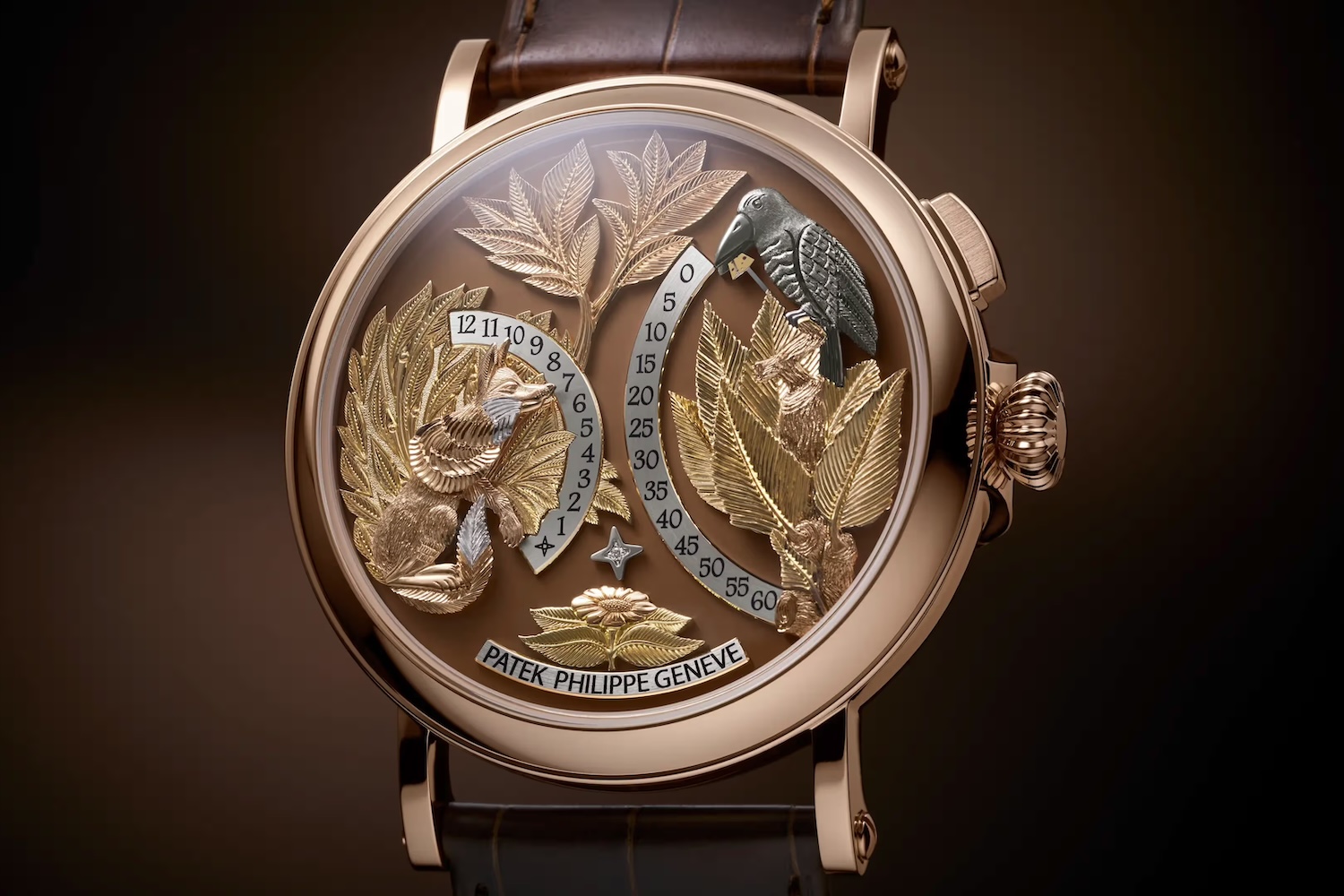
If the Celestial captures the imagery of the cosmos, The Crow and the Fox ref. 5249R embodies the beauty of storytelling. Inspired by a 1958 pocket watch now housed in the Patek Philippe Museum, this automaton wristwatch transforms Jean de La Fontaine’s famous fable into a mechanical performance.
Press a button at two o’clock, and the scene comes to life: The fox indicates the hours using its paw and muzzle, while the crow reveals the minutes as a wedge of cheese drops from its beak along a retrograde scale. Release the button and the entire display snaps back to its resting position.
Inside is the self-winding caliber 31-260 PS HMD AU, incorporating a complex mechanism that reveals the hours and minutes only when summoned by the wearer. The dial itself is an exercise in artisanal patience: Hand-engraved gold appliqués depicting foliage, animals and decorative elements require roughly 150 hours of work per piece. It’s the kind of watch that exists partly to demonstrate what’s possible when mechanical ingenuity meets traditional decorative arts.

More Like This




The world of men’s style, from the streets of NYC to the showrooms of Milan, run down weekly by writer and photographer Christopher Fenimore.