In 1952, the Aircraft Owners and Pilots Association (AOPA) — an American-founded non-profit and the world’s largest aviation organization — approached Willy Breitling, scion of his family’s eponymous watchmaking brand, to commission a timepiece for its members. Specifically, AOPA needed a chronograph that would allow its user to easily compute important information like speed, distance, fuel consumption and other calculations crucial to flying before the advent of flight computers. Breitling took the logarithmic slide rule scale from its WWII-era Chronomat, adopted it into a rotating bezel and married it to an oversized 41mm stainless steel case. Powered by a hand-wound Venus movement, this watch was given the moniker “Navitimer” and debuted with the AOPA logo on its dial. Three years later, it hit the broader market bearing Breitling’s own winged logo, taking on the reference number 806, and birthing a horological icon.
During more than seven decades of production, the Grenchen, Switzerland-based watchmaker has made solid-gold Navitimers, platinum Navitimers, automatic Navitimers and ana-digi Navitimers. But until now, it has yet to make a traditional Navitimer from titanium. What prompted the brand’s first such experiment? As of February 5, 2026, Breitling is now the official watch partner of both Aston Martin and the Aston Martin Aramco Formula One team, marking the watchmaker’s official return to one of the world’s most popular sports. Having been worn by famed drivers Jim Clark and Graham Hill, the Navitimer is cemented in the minds of both automotive and horological aficionados, and the brand itself pushed its race-worthy bona fides in period advertising. (A particularly good one reads: “You have to be serious about driving to spend £93 on your chronograph. Breitling specializes in making chronographs for specialists.”)
With shared origins in the early 20th century, both brands have automotive roots: Aston Martin in building its luxury sports cars, and Breitling in producing devices that measure time, particularly the elapsed time calculated down to the millisecond during races. As early as 1907, company founder Léon Breitling designed a stopwatch (the “Vitesse”) that could measure speeds up to 250 km/h. From this auspicious beginning, the brand would go on to develop all manner of instruments — particularly chronographs — meant for measuring not only elapsed time but also speed, distance, fuel consumption, rate of descent and more. Adopting this technology for wrist-worn timepieces used by pilots, the Swiss firm found its chief calling, yet it never abandoned its Earth-bound, four-wheeled roots.
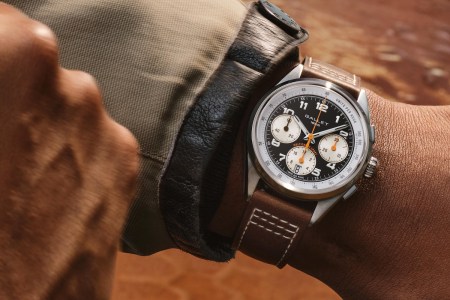
A Historic Swiss Watchmaker Is Getting a Relaunch
Owned by Breitling, Gallet is priced more affordably than its parent brand and offers revivals of classic tool watchesThe new Navitimer B01 Chronograph 43 Aston Martin Aramco Formula One Team watch celebrates the partnership in a suave and subtle way. Rather than slathering logos or an abundance of text on the model’s already-busy dial, Breitling elected to reference Aston Martin (and racing more broadly) through clever incorporation of automotive nods. Within a 43mm titanium case — the first use of the lightweight metal on a ref. 806-like, traditional Navitimer — sits a diver crafted from carbon fiber, a material used in F1 cars. Astron Martin Racing Green accents are visible throughout the black texture, while a lime green central seconds hand references the Aston Martin Aramco Formula One Team’s colors. The Navitimer’s signature beaded slide rule bezel is present, allowing for on-the-fly mechanical computations, while a triple-register chronograph display with white subregisters allows for the tracking of elapsed time up to 12 hours.
These days, rather than being powered by a hand-wound Venus movement, the Navitimer features the Breitling Manufacture Calibre B01 as its power source, an automatic mechanism with a column wheel and vertical clutch for smooth chronograph operation; a date complication; 70-hour power reserve; and 346 components. COSC-certified, the version within boasts a matte-black, PVD-coated tungsten winding rotor bearing the Aston Martin Formula One Team logo. Rounding out the feature set is a black textured leather strap made to resemble a racing harness — fitted with a lime green interior, it cinches shut with a Breitling-signed stainless steel folding clasp.
Clocking it at 43mm wide and 13.69mm tall, the Navitimer B01 Chronograph 43 Aston Martin Aramco Formula One Team is limited to 1,959 pieces, in reference to the first year that Breitling participated in Formula One. By no means a compact watch, its heft should be diffused somewhat by its titanium construction. And let’s face it — when you’re screaming down the track in your Vanquish at 200 mph, you’re probably not concerned that your chronograph is poking out from beneath your shirtsleeve. For longtime Breitling diehards, the debut of the first titanium-cased traditional Navitimer will be a welcome enough development on its own. For Aston Martin fans, the announcement of a timing partner with serious racing heritage will no doubt be a source of delight. Making its debut as a partnership at the Australian Grand Prix in Melbourne from March 6 through 8, the Aston Martin-Breitling mashup no doubt has many exciting laps ahead of it — and hopefully, many more exciting chronographs.

Breitling Navitimer B01 Chronograph 43 Aston Martin Aramco Formula One Team
- Diameter: 43m
- Movement: Breitling cal. B01 automatic
- Water Resistance: 30m

More Like This




The world of men’s style, from the streets of NYC to the showrooms of Milan, run down weekly by writer and photographer Christopher Fenimore.