The interwar years were a particularly fertile period in industrial design. The Bauhaus school, founded in Weimar, Germany, in 1919 by Walter Gropius, famously decreed that form should follow function. Art Deco, which began to proliferate more broadly following the Paris International Exhibition of Modern Decorative and Industrial Arts, from which it derived its name, called upon ancient Egyptian motifs and futurism in a modality that emphasized geometric shapes, broad use of color and a streamlined (if maximalist) aesthetic.
During the 1930s, a lesser-known but decidedly compelling offshoot of Art Deco called Streamline Moderne came to the fore. Also known as style paquebot (or “ocean liner style”), the Streamline Moderne movement utilized form factors based upon the sleek geometric shapes of ships, trains and aircraft. The use of parallel grooves created the impression of speed or motion, while rounded corners, long horizontal lines, round windows shaped like portholes and ample use of glass, concrete and chrome favored a functional aesthetic based upon modern machinery. Gone was the outré coloration and splendid decoration of Art Deco, jettisoned in favor of something elegant yet subdued. Take a look at an American municipal building or a transportation hub from this period, and you’ll recognize the look immediately.
How does this relate to watches? Well, this artistic approach is evident in a relatively obscure pre-reference 1271 Audemars Piguet model dating to 1929. Rather than featuring a traditional display with a set of hands that point to indices around the dial periphery, this timepiece is a “jump-hour” watch — one in which the dial consists of a metal cover with dual apertures displaying instantaneously changing hours and “dragging” minutes. The numerals, printed on rotating discs hidden behind the cover, provide a highly precise (if whimsical) presentation of the time, one with its origins in 17th-century night clocks and 19th-century pocket watches. As the wristwatch proliferated in the wake of World War I, Audemars Piguet began producing jump-hour models to splendid effect, making some 347 between 1924 and 1951.
The pre-reference 1271 — made in 14 pieces spanning white gold; two-tone white and yellow gold; two-tone white and green gold; and a pièce unique in platinum — was almost entirely sold prior to the 1929 stock market crash that ushered in the Great Depression. Inspired by the Streamline Moderne movement, it features a rectangular, Tank-like case with prominent gadroons (effectively decorative inverse fluting) spanning the brancards (or case sides) that create a sense of motion.
The platinum piece, held today by the Musée Atelier Audemars Piguet in Le Brassus, Switzerland, inspired the brand’s latest release, the Neo Frame Jumping Hour, which was unveiled today alongside a new Royal Oak with an openworked perpetual calendar movement, among other exciting debuts. Rather than a one-for-one reimagining of a vintage reference such as those housed within the maison’s Re[Master] program, the Neo Frame is a thoroughly contemporary piece and features AP’s first-ever automatic jump-hour movement.
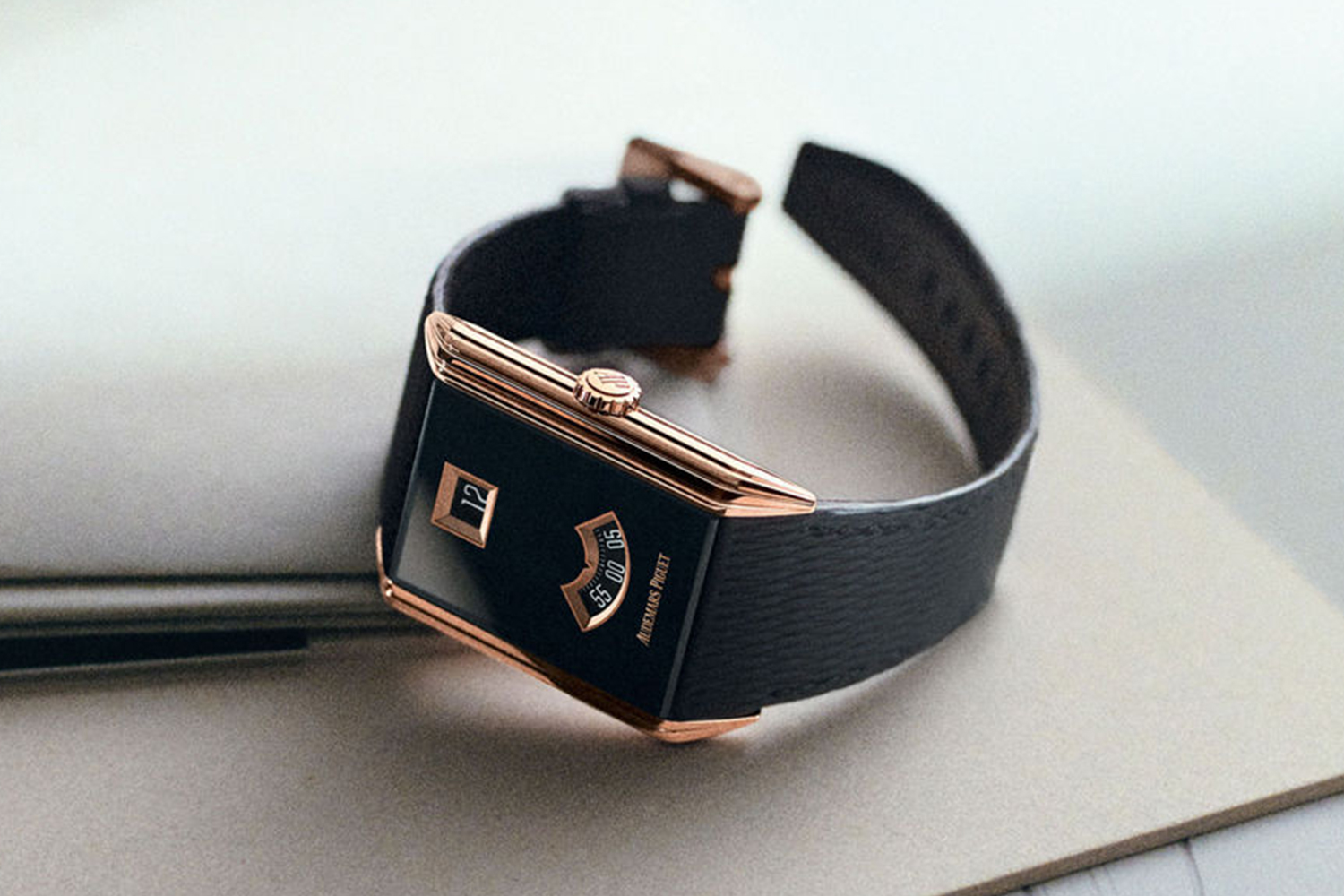
Housed in a 32.6mm by 34mm 18K pink-gold case, its rectangular form boasts eight gadroons on each flank that collapse into the watch’s lugs, maintaining the pre-reference 1271’s sense of dynamism while allowing more room to be given over to the dial. Unlike the 1271 (and other early AP jump-hour watches), the metal dial has been replaced with a black PVD-treated sapphire crystal bonded directly to the dial plate and then screwed into the case. Fitted with dual gold-framed apertures, it displays instantaneously jumping hours and dragging minutes printed in white on black backgrounds, with the contemporary Audemars Piguet wordmark present at the bottom. (For those curious: The hour disc is constructed from titanium, while the minutes disc is machined from aluminum.)
Even the Neo Frame’s strap has been given careful consideration: Produced from black calfskin leather, it features a new textured motif that matches the inky tone of the dial and complements the case’s swooping, pointed lugs.
Omega Just Dropped a Frosty Ceramic Seamaster for the Winter Olympics
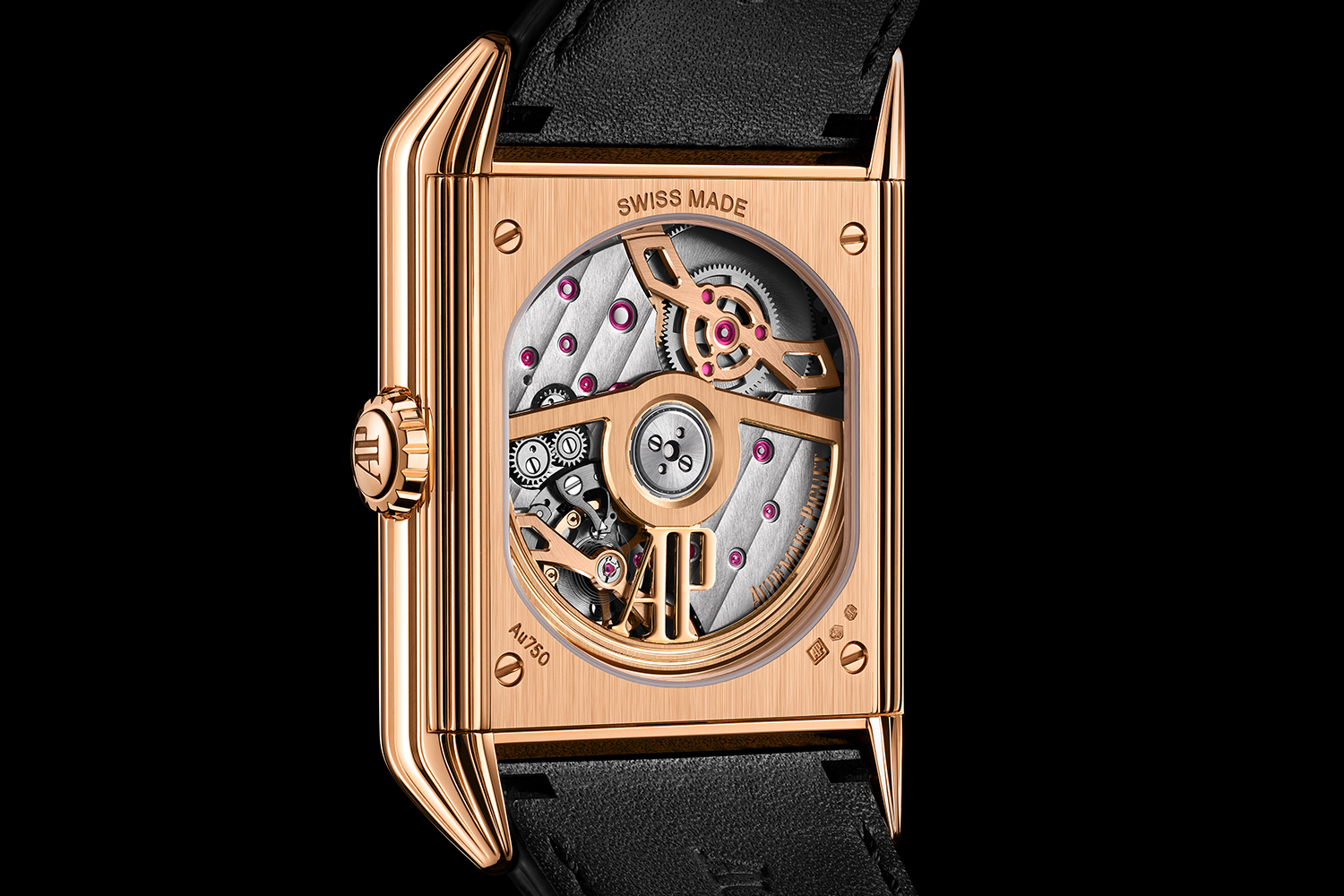
The much-hyped Seamaster Diver 300M rounds out a trio of Milano Cortina 2026 exclusivesAs beautiful as the watch is aesthetically, it’s the new Calibre 7122 self-winding movement that’s sure to excite much of the horological community. Rather than fit the Neo Frame Jumping Hour with a hand-wound movement, AP opted to develop its first-ever automatic jump-hour caliber; based upon the Calibre 7121 found in Royal Oak “Jumbo” models, it packs 293 components, a 4-Hz beat rate and a healthy power reserve of some 60 hours. Measuring 4mm tall, it manages to keep the watch’s case depth to an eminently manageable 8.8mm overall thickness, allowing the Neo Frame to easily slip beneath the cuff of a dress shirt. It’s this distinctly modern movement — with its shock-absorbing construction, ample Côtes de Genève, skeletonized winding rotor and flowing bridge design, all visible via a sapphire caseback — that makes the Neo Frame Jumping Hour a thoroughly modern creation, rather than merely a reissue of a vintage museum piece.
Though jump-hour watches eventually fell out of favor in the mid-20th century, the 2020s have seen a significant revival in their popularity, with models such as Cartier’s Tank à Guichets and Louis Vuitton’s Tambour Convergence all riffing on the design. (The latter admittedly features both dragging minutes and hours, but the “aperture” concept remains present.) Now that Audemars Piguet has seen fit to enter the space, there’s little doubt that the category will continue to gain favor in the broader horological arena — especially if trend-conscious brands lose the appetite for simply reissuing vintage references one for one, or eventually run out of references to reissue altogether.
The output of past decades, inspired by distinct and idiosyncratic design movements such as Streamline Moderne, still have the capacity to inspire entirely new watches through a distillation of their collective design values. Ironically, it’s the microbrand movement that’s perhaps best mastered this concept, with brands such as Baltic, Toledano & Chan and anOrdain crafting fresh-feeling pieces that are nevertheless clearly inspired by vintage watches, or by the past more broadly.
Perhaps AP can lead the way in the adoption of such methods among the larger, more established brands. With their history, design acumen and resources, there’s no telling what kinds of compelling ideas the old maisons would cook up. If the Neo Frame Jumping Hour is any indication, the results might be nothing short of a revelation.

Audemars Piguet Neo Frame Jumping Hour
- Diameter: 32.6mm x 34mm
- Movement: Audemars Piguet Calibre 7122 automatic
- Water Resistance: 20m

More Like This

The world of men’s style, from the streets of NYC to the showrooms of Milan, run down weekly by writer and photographer Christopher Fenimore.