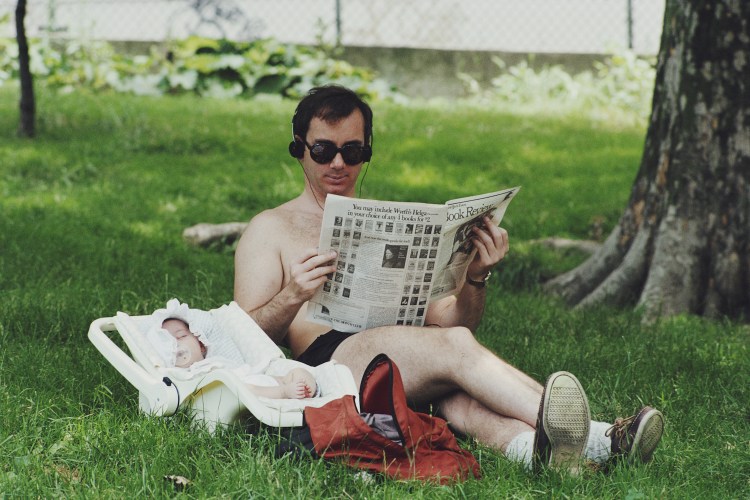
In a world obsessed with ticking off goals, downtime is seen as the antithesis of the progress we’re all supposed to be striving for. These days, everything has to be tracked; even reading and sleeping have been sucked into a vortex of challenges and reports. As a result, any period of time where we aren’t “achieving” can now make us feel guilty, and even — whisper it — lazy.
I know this feeling well. As a freelance writer, every day feels like starting from zero. Freelancers know that creating something worthwhile (and by extension, paying rent) is entirely up to you. When editors were slow to return to their desks this past January, I began to panic, certain I was a failure as a writer…and as an adult. It wasn’t just that I was worried about money; I was anxious because despite all the emails I’d sent out, I had nothing to do.
I was raised to work hard, and I’ve always had trouble taking time off. But as I came to realize by week three of this involuntary time “off,” rest can actually be the best thing for recharging your batteries and your enthusiasm.

The Charge by InsideHook
A wellness newsletter to help you move better, think clearer and stay in the game longer.
Downtime Isn’t an Enemy of Progress
Whether you’re trying to find work or training for a marathon, downtime is a crucial element to consider. “Laziness is actually a vital part of fitness,” says Dhara Patel, a physician associate at Kuon Healthcare, who’s worked with athletes for over a decade. “The body doesn’t improve during workouts; it improves during rest, when it has time to recover and adapt,” she says, adding that athletes who don’t rest face higher injury risk, slower progress and performance plateaus — no matter how hard they train.
Aubrey Hunt, a psychology educator at Willow Ridge, says that being lazy is equally as important for the mind. An urge to slow down is the brain “communicating a necessity to rest, or drawing a line for a reflection.”
A 2016 study from Florida Gulf Coast University seems to confirm this, suggesting that taking time off from physical activity allows us to spend more time in deep, internal thought. Meanwhile, a 2022 study analysis confirmed that micro-breaks are “efficient in preserving high levels of vigor and alleviating fatigue.”
“Neuroscience has proven that when we withdraw from our daily hustle and bustle, the brain switches to what is known as the ‘default mode network,’ a situation where it isn’t engaged with outside activities, but instead is processing data, strengthening memories and even leaking creative ideas,” Hunt adds. As a result, she says that people who allow themselves some time off without feeling guilty about it often come back to their work with a clearer head and a greater drive.
In my case, time off helped me come up with story ideas I actually cared about, and I even started outlining a new novel. Still not convinced? I asked five professional athletes and innovative creatives to share their own lessons in “laziness” — how it’s helped them find new inspiration and (eventually) smash new goals.
5 Lessons in Laziness
1. Talk shop with others
“If I’m on a roll and have gotten into a routine, I need to allocate time to pause and reset,” says Andrew Fisher, frontman of the band Basement. “Giving my ears or my brain a break means I can come back refreshed and ready to dig in again.
“That’s in an ideal world. Usually, I struggle with allowing myself time to rest as I feel agitated or guilty, even though I know how important taking time out is to the creative process. It’s rare that inspiration comes amid the grind — more often than not it comes at night, or on a walk, or laying in the grass, or after having a phone conversation with a good friend whose energy and passion inspires me. Time out with other creative people is incredibly important. I owe a lot to that.”
2. Laziness is a signal
“The word ‘lazy’ gets treated like a moral diagnosis in sport,” says Lecia Mancini, a runner and coach from Montreal. “If you’re not training, building, posting, improving, you’re slipping. But in real life, most runners hit stretches where the drive just isn’t there, and it doesn’t always mean you’re undisciplined. A lot of what we call laziness is your system asking for a reset in the only language it can get you to listen to.
“Strava doesn’t help. It can feel like a constant scoreboard in your pocket. You open your phone and see friends stacking workouts while you’re over here pickling in laziness. That contrast can feed the cycle. Guilt turns into avoidance, then avoidance turns into a full embrace of ‘lazy’ until it starts to feel like your new identity.
“The part we ignore is that running has a mental tax, too. You have to plan the route, fuel properly, figure out a kit based on weather, keep your mind engaged with runner’s math, music, a podcast or a chatty run pal. That battery needs to recharge too. After a long day of work or classes, sometimes all you can muster is sitting around and doing absolutely nothing. Is that laziness, or a nervous system tapping out? ‘Laziness’, from my experience, is often my mind and body enforcing rest and recovery before the next cycle.”
3. Drop your guard
“[In our business] most of the time you’re working under a time pressure to deliver an idea, a deck or make quick decisions on a shoot that will ultimately impact the success of the project,” says Kieran Sills, director of London creative agency Open.
“I don’t think you can get to the best point under that kind of stress. Historically, I struggled to switch off because it was met with a guilt that I wasn’t actively thinking about an idea or a project. But over time, I’ve realized that the best ideas come to you in those moments of relaxation in between — exercise, travel, a lot of the times in the shower for some reason.
“I think when you drop your guard, you open yourself up to more possibilities. Rather than having tunnel vision for the things you need to tick off, you can embrace a conversation, hear a sound or see something that can trigger something in your brain and it’ll help you make a connection you’re looking for.”
4. You can’t force ideas
“Creativity does not come from forcing it,” says writer S.J. Watson, whose novel Before I Go to Sleep was adapted into a film starring Nicole Kidman. “Following the success of my debut novel, I experienced a profound shift in my sense of self. I was no longer someone with a day job who also wrote — I was a writer. Full time. And so, any time I wasn’t writing? That was nothing more than laziness.
“Perhaps unsurprisingly, that approach backfired dramatically. I began to punish myself for not being as productive as I thought I should be. I’d deny myself the film I wanted to see or the gallery I’d been eager to visit until I’d ‘earned’ it through work. And worse, I’d deny myself rest, too.
“I eventually realized that those things weren’t rewards for productivity, they were fuel. Creativity does not come from forcing it. For me, I’ve learned it comes from ‘resourcing days’ when I write 100 words then give myself permission to go see an exhibition, take a walk, watch something I’ve been meaning to see or, sometimes, do nothing at all. These are the days that feel free, and that freedom allows ideas to percolate.”
5. Rest builds hunger
“In cricket, you’re taught that momentum only comes from constant effort,” says Matthew Hoggard, a former champion English cricketer. “If you’re not training, bowling or analyzing, it’s easy to label yourself as lazy. I certainly felt that during quieter periods in my career, even around big series like the Ashes. When the schedule eased or form dipped, the instinct was always to do more.
“Those slower moments turned out to be hugely important. Rest kept me fresh, physically and mentally. More than that, it grew my hunger to get back at it. Time away from the daily grind reminded me how much I missed competing, preparing and testing myself. The desire to get back only sharpens. Cricket is a long, demanding game, and relentless intensity isn’t sustainable.”

More Like This

Twice a week, you'll find proven advice and tips, expert interviews, deeply reported features and personal essays on living better — for however long you’re here. Subscribe to Champ now.