Earlier this summer, Ford CEO Jim Farley made the auto industry equivalent of Babe Ruth’s called shot: he had information to share, he said, that would mark “a Model T moment.” It’s one thing to imply that a company has a big announcement; it’s another to say that you have news on par with a development that changed both the automotive industry and manufacturing as a whole.
There were plenty of reasons for optimism, and now that Farley has made his announcement, we’re in a better place to see just how game-changing this might be.
On Monday, he wasn’t focused on touting a new vehicle, or even a new family of vehicles in the traditional sense. Instead, what he revealed was a new process — one that Ford plans to use to make EVs on a much larger scale for less money. The big names shared in the announcement were the Ford Universal EV Platform and Universal EV Production System — hardware and processes, rather than boldly-named vehicles.
That said, there was one vehicle announced, the first to be produced under this new system. Ford referred to it as “a midsize, four-door electric pickup” with a targeted price around $30,000, and said that it would be made in Louisville, Kentucky, and available to drive in 2027. Ford is working on achieving 0-60 times comparable to those of the Mustang EcoBoost.
“From Day 1, we knew there was no incremental path to success,” Farley said in a statement. “We empowered a tiny skunkworks team three time zones away from Detroit. We tore up the moving assembly line concept and designed a better one. And we found a path to be the first automaker to make prismatic LFP batteries in the U.S.”
As Andrew J. Hawkins reported at The Verge, these LFP (lithium iron phosphate) batteries are designed to be more affordable, given the absence of both cobalt and nickel. Industry analyst Karl Brauer of iSeeCars suggested that this could involve some tradeoffs. “Prismatic batteries do have some disadvantages in terms of rapid power delivery and overall vehicle performance, but for this application these disadvantages either won’t be an issue or Ford is confident it can address the issues,” he told InsideHook.
You Should Take Ford’s “Model T Moment” Seriously This Time
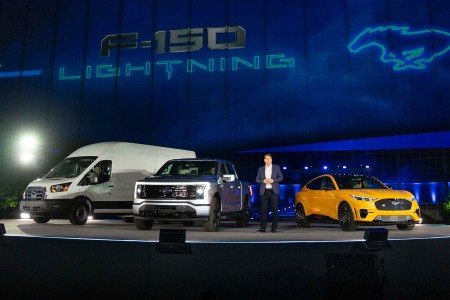
CEO Jim Farley’s comments may seem like déjà vu, but plenty has changed for the automaker since the F-150 LightningFord is touting the cost savings involved in both this new platform and production system. According to Farley, the former will make vehicles 15% faster to assemble, one of several improvements needed to make this new generation of EVs friendly on the wallet. (The word “affordable” appears five times in Ford’s announcement.)
“If Ford can produce a compact truck that offers as much or more interior space and overall functionality as a RAV4, at a starting price of $30,000, it should find demand for this vehicle,” Brauer said. “The bigger questions relate to range and equipment level. A $30,000 vehicle with very basic features and a 150-mile range will be a tough sell, but if a larger battery option and premium features drives the price up to $35,000 or $37,000 it will be competitive with internal combustion models like the RAV4, the Chevrolet Colorado, even Ford’s own Ranger.”
Brauer predicted that such a vehicle “should sell 40,000-plus units annually.” By way of comparison, Ford has sold 19,258 Mustang Mach-Es this year, according to Investor’s Business Daily. Time will tell if these new methods are comparable to the creation of the Model T — but for now, Ford’s announcement gives car enthusiasts plenty to anticipate.

More Like This

We're always on the scene eating, drinking and traveling near and far to bring you the best of what's happening out in the real world. Sign up for IRL now.