Every great anti-drug PSA ends with the descent into madness.
Before Helen Hunt starred in Mad About You, she snorted a fistful of PCP synthesized in a high school chem lab and threw herself out a window. Scott Baio was a ganja-fueled near-manslaughterer on Stoned, and 12-year old David Faustino sniffed coke and drowned in The Drug Knot.
The drug terror which gripped parents and tickled smokers — Cheech and Chong 2 released the same year as Stoned — lasted through the late 2000s, when my fifth grade class watched a video of a girl who had smoked weed and deflated into a flesh balloon. Even as a 10-year-old, I was skeptical — my camp counselor hid a bong in his duffel bag and he was the coolest, least schizoaffective person I knew.
You’ll forgive me then, for not believing my local Cheech when he told me God was in the Georgia wilderness, on the vines of a shrub with serrated leaves. He called it “moonflower”: a nightshade with faded lilac blossoms. Apparently a friend of a friend had eaten its seeds and now had a vacant look behind his eyes. Sometimes he could not tell whether he was dreaming or awake.
A couple months later, I read a book called Breaking Open the Head, a thick volume by Daniel Pinchbeck charting his induction into psychedelic shamanism. Pinchbeck wrote about a broke traveler who, chasing a buzz, ate three flowers from a plant called datura stramonium.
“‘For three days, I had no idea what was happening to me,’” he quoted. “‘I remember, at one point, I was climbing a mountain, going up rock by rock, hand over hand. Then I came back to myself, and I was actually crawling along the sidewalk on my hands and knees.’”
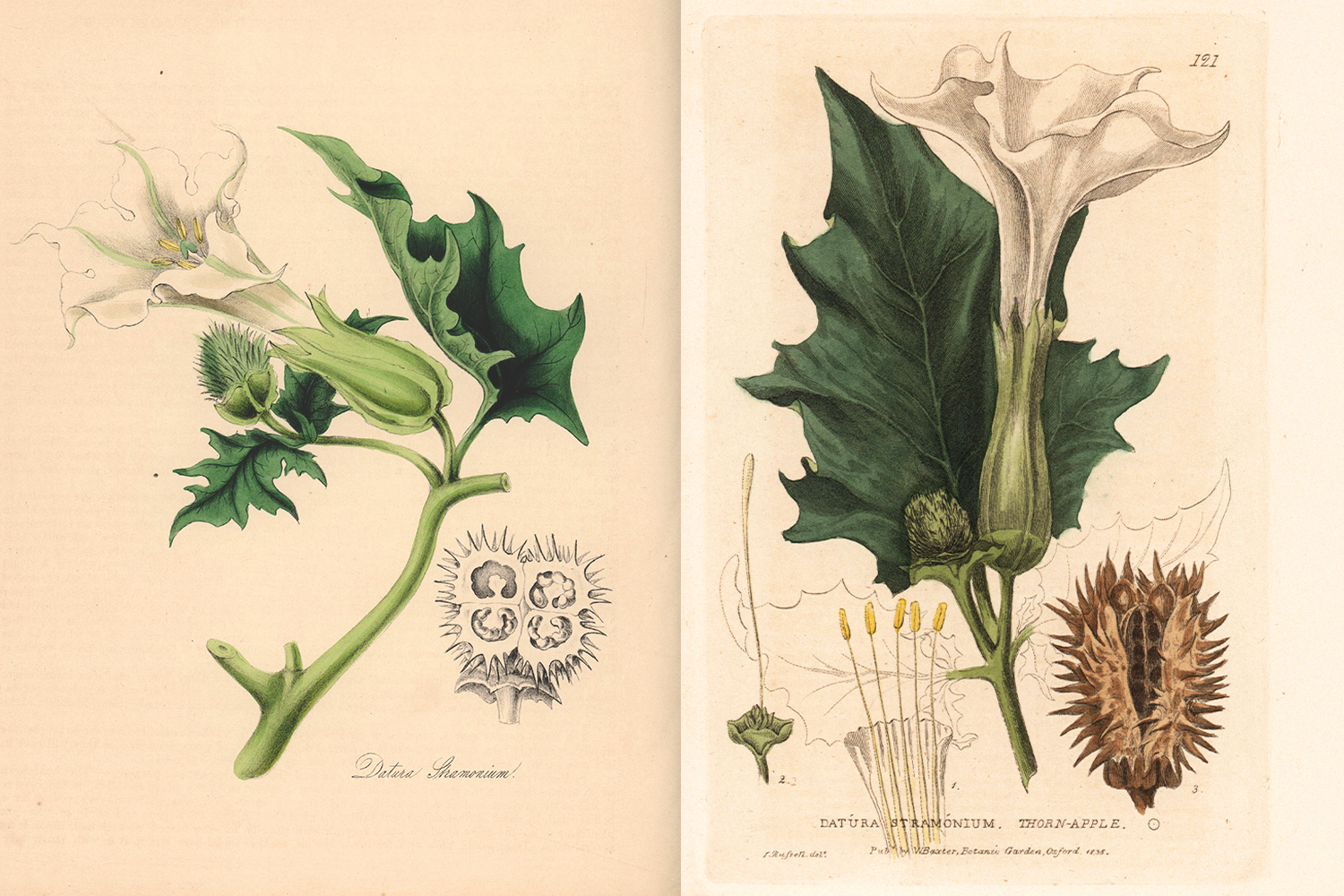
He was talking about moonflower. The plant (common name: jimsonweed) was as described: a days-long hallucinogenic trip from hell. While psychedelic drugs like psilocybin and LSD maintain a barrier between real and imagined, deliriants like daturas eat away at rational thought, eventually depriving the user of their grasp on reality. People who consume jimsonweed often forget taking the drug entirely. Others experience acute psychosis.
“Datura is very dissociative. Trips last for three days,” Pinchbeck tells me. “People have no idea who they are and believe they are in different scenes and realities, but it is just delusional, or maybe spirits if you believe in spirits.”
In some Indigenous nations, adolescents would take a massive dose of jimsonweed and “unlive their former lives,” per Pinchbeck. The trip could last two weeks. When he came to, a shaman would interpret the initiate’s visions and determine the course of his life.
Jimsonweed appears across non-Western philosophies, too, usually as a gateway to another place in time. In Taoist mythos, datura was a “circumpolar star” through which envoys could descend from the cosmos; Buddhists claimed heaven sprinkled daturas with dew as Buddha preached, and flowers from the plant appear woven into Shiva’s hair in Hindu tradition.
Seven years after his trip, Pinchbeck’s traveler visited the Huichol nation, an Indigenous tribe native to the Sierra Madres. “The shaman looked at him for a moment, then turned to his friend and said one word in the Huichol language,” Pinchbeck wrote. “‘Datura.’”
Jimsonweed is an aggressive non-native species and adores disturbed soil. In 2019, CBS News reported daturas (a genus of nine species) breaking through the sidewalk across the Upper West Side of Manhattan. The City of New York announced its intent to remove them, but the battle was already lost. Jimsonweed is among the most common invaders in the United States, and it has grown fond of the city’s cultivated beds, parks and tilled soil. On a walk through Downtown Brooklyn, I found an enormous datura innoxia, which spilled over a garden bed and into the street. Each of its two dozen seed pods was powerful enough to kill an adult many times over.
iNaturalist, an organism-tracking app fueled by user data lists over 1,000 datura sightings in the Manhattan area, most of them in Central Park. The majority are stramonium, a traditional medicine staple responsible for our country’s most embarrassing zombie, witch and werewolf frenzies.
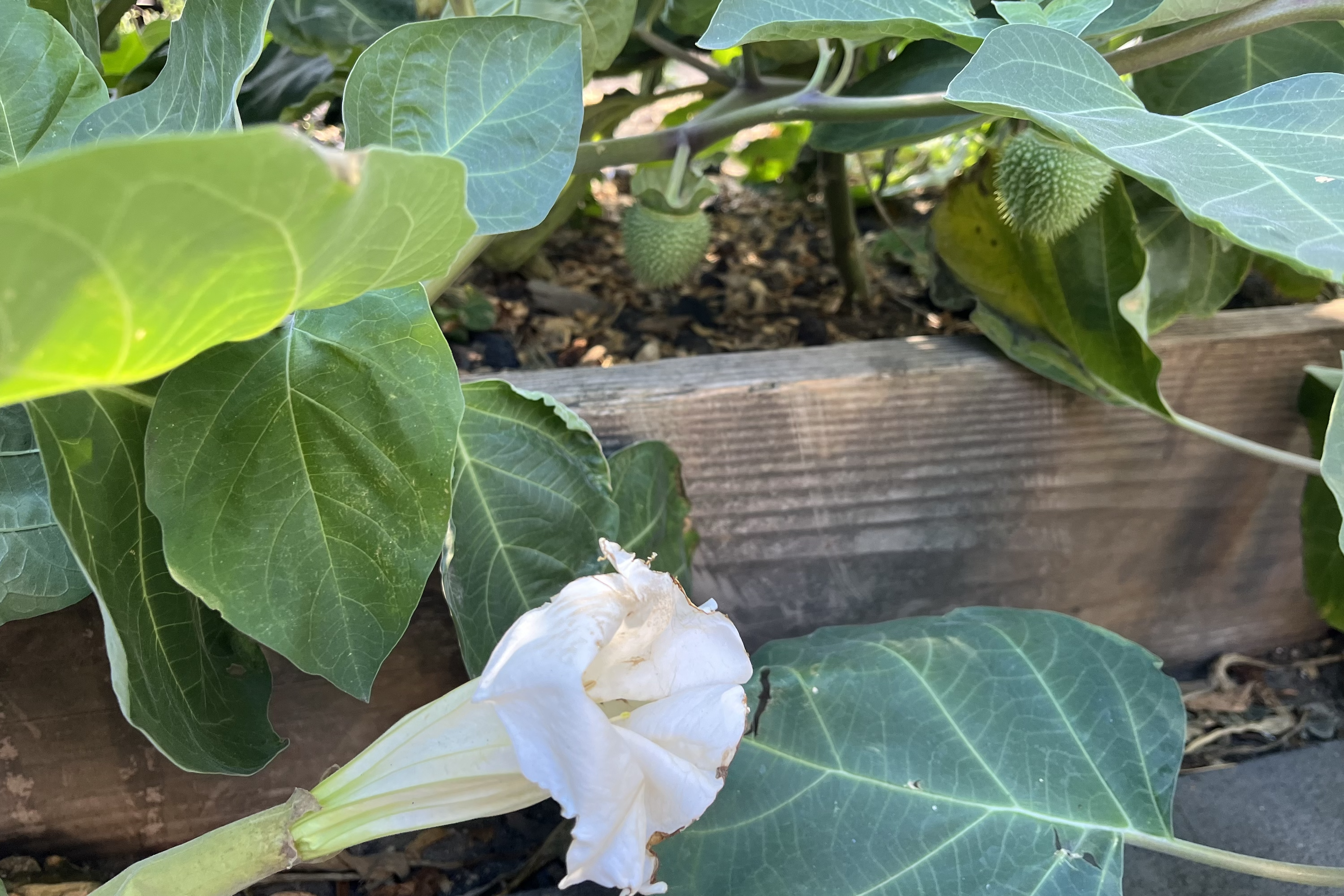
Indigenous peoples “had moved [datura stramonium], probably from the tropics to the temperate zone. And it’s likely they were trading it,” Dr. Robert Naczi tells me. Naczi is the Curator of North American Botany at the New York Botanical Garden, a specialist in Northeastern floristics. “The plant was already well-represented in herbarium specimens in the 1880s from as far north as Northern New York.”
Jimsonweed is a “corruption of the word Jamestown, from Jamestown, Virginia,” Naczi explains. “I can only surmise that the Europeans learned about it from other people. I doubt that they went experimenting with every wild plant in their settlements.”
In the 1705 History of Virginia in Four Parts, colonial historian Robert Beverly follows a group of British soldiers sent to quell Bacon’s Rebellion against the royal governor. Recognizing the telltales of edible nightshades like eggplant and tomato, the cohort boils jimsonweed into a salad and descends into “pleasant comedy”:
“They turned natural fools upon it for several days: one would blow up a feather in the air; another would dart straws at it with much fury; and another stark naked was sitting up in the corner, like a monkey,” wrote Beverly. “After eleven days [they] returned to themselves again, not remembering anything that had passed.”
Wild animals are repulsed by datura’s natural odor, which makes the public safety question one of human concern. Unlike other natural hallucinogens like peyote and psilocybin, jimsonweed is not regulated under the Controlled Substances Act.
“It’s a dangerous plant, but it is a beautiful plant, too. Some people grow it intentionally,” says Naczi. “It’s here, it’s common, and it isn’t realistic to remove it from everywhere it occurs.”
Naczi is also aware of datura’s potential for abuse. In high school, a lunchtime prank war turned foul when his classmates began slipping each other stramonium mickeys.
“‘Chris took two or three seeds and put them in the other guy’s sandwich. He was out of school for three or four days. He didn’t die, but he was seriously intoxicated,” Naczi says. “That really made me aware of how powerful this plant is, especially when it’s misused.”
Jimsonweed blossoms in late summer and dies with the first frost. It’s still hanging around now, cascading over garden walls across the United States. Naczi is right — it’s a pretty flower — but look, don’t touch, or Scott Baio might play you in his next after-school special.
More Like This


This article appeared in an InsideHook newsletter. Sign up for free to get more on travel, wellness, style, drinking, and culture..