The other week, on the way to Yellow Rose for dinner, my friend Brian and I were having a conversation about our world’s neverending fascination with Anthony Bourdain. We had just seen Tony (2026), Matt Johnson’s biopic that focuses on a single summer a young Bourdain spends in Provincetown, where he shucks oysters in a grimy kitchen with even grimier characters, and tries to win over the heart of his crush while growing into the figure the world would know him as decades later. It’s a standard coming of age with the undertones of a kunstlerroman, though that’s more a product of my own projections. Nothing in the film really suggests he will go on to become a mythic personality, and though he pretends to be in Provincetown under the auspices of a writing fellowship, there’s no indication that his writing is that good. In the film, you get the feeling that Bourdain, played by Dominic Sessa, has a sense of his own fraudulence, and after watching Roadrunner, the Bourdain documentary released in 2021, you have to wonder if that insecurity followed him throughout his life.
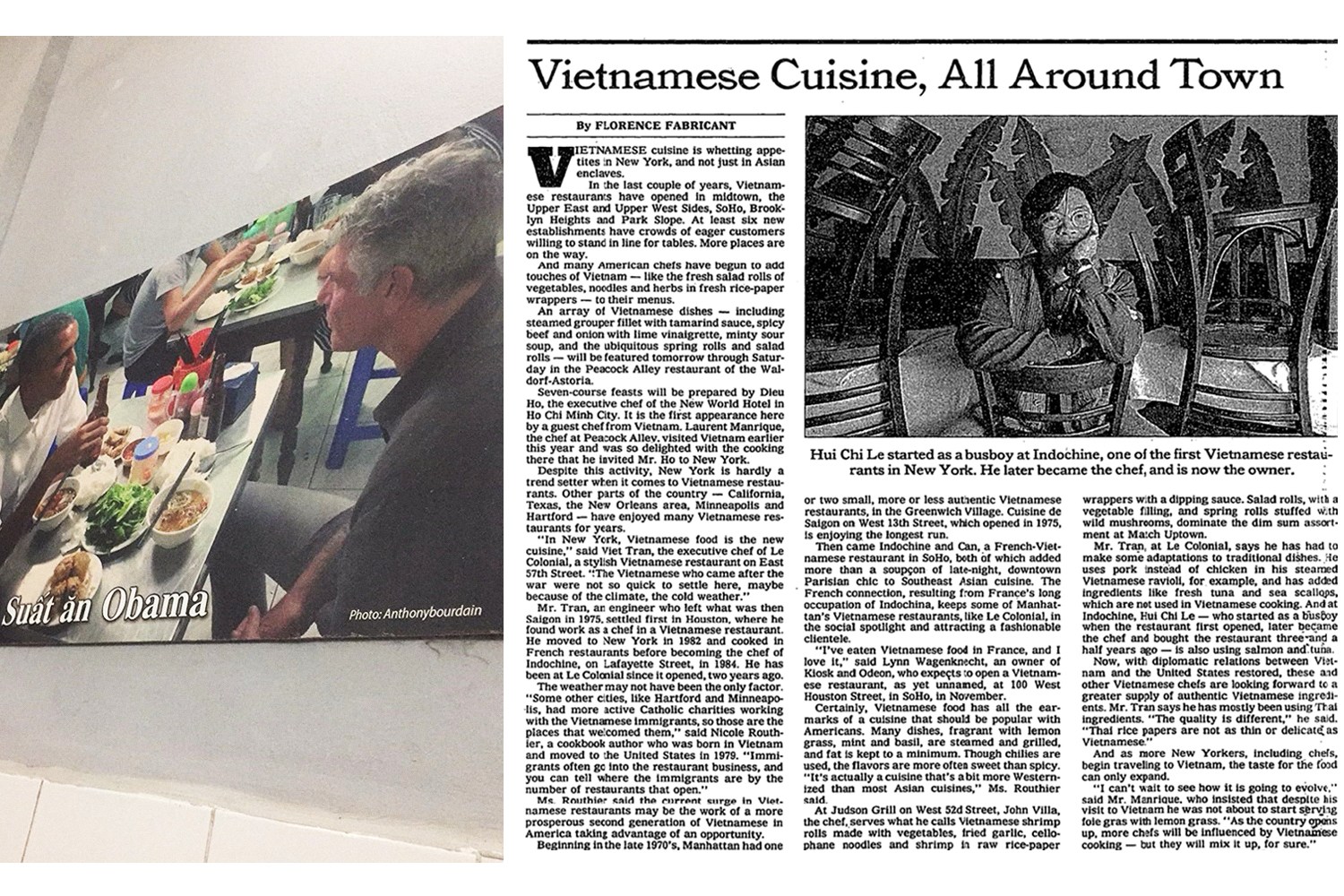
My own personal Bourdain obsession comes from watching episodes of No Reservations and Parts Unknown as a kid with my father, who was a chef at Brian McNally’s Indochine in SoHo and Le Colonial in Midtown in the ’80s and ’90s. We were drawn in because Bourdain was one of the first American personalities to really highlight Vietnam’s cuisine, having gone there in 2002 as part of his first show, A Cook’s Tour, and returning on every subsequent travel series he’d done. Bourdain would butcher the names of the dishes, but it was fine, because being there was all that mattered. As our always fish-out-of-water host, he waded through the cultures of the world with a blend of reverence and irreverence, constantly juxtaposing the highbrow and the lowbrow. He loved getting his hands dirty, and eating a greasy burger as much as an exquisite foie gras. This sensibility is clearest in an episode of Parts Unknown set in Hanoi, where he sips cold beer with former President Obama and rips bundles of bún by hand.
There are obvious reasons as to why he’s become a larger-than-life personality in our cultural consciousness. He was a Hunter S. Thompson type – a weary, but wise traveler with insight gleaned from experience and talking to the less buttoned-up folks of the world; he was even easier to appreciate than Thompson, because you didn’t have to read a book, coming off as worldly without ever leaving your television set. From the outside, he lived an envious life, becoming famous off of time spent traveling and dining. Even the drugs, the booze and the tortured inner soul all contribute to the cult of personality around him. After all, we love bad boys. We also love late bloomers, and perhaps no one better exemplified that you too had time to turn your life around and become famous in your 40s. (Pay no mind to the fact that his mother was an editor at the New York Times and might’ve had a hand in helping him publish his now famous New Yorker essay that would make him a star.)
While Bourdain is partly famous because he was a singular, engaging and talented individual, I want to believe that there are other reasons why no one has become as famous ever since. The story of Anthony Bourdain’s legacy and success is as much a story of the business of media as it is about the idiosyncrasies of a single man. Around the time of his first show in 2002, A Cook’s Tour, digital media was in its nascency. VICE was already cool, but they were over a decade away from starting Viceland, the TV network that spawned properties like Action Bronson’s F*ck That’s Delicious or Eddie Huang Huang’s World, food and travel shows that were clearly indebted to Bourdain’s series. He embodied the ethos of VICE in TV form before they did, and by the time they figured it out and started spinning out personalities of their own, the landscape had drastically changed. His spiritual successors were navigating a fractured world, competing for attention on a crowded internet, which made it harder for viewers to coalesce around a single star. Sure, one can make the argument that he did it first, but by the time anyone else tried to, the doors had closed on reaching that level of ubiquity ever again. The godfather of the form came to fame at the tailend of anything resembling a monoculture.
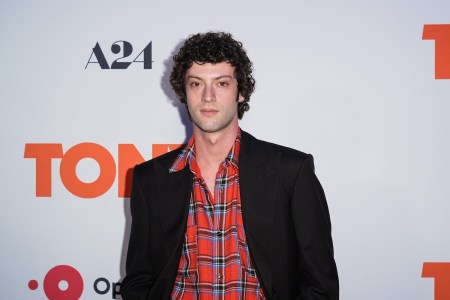
Dominic Sessa Is Taking “Tony” Press Tour Tailoring to Parts Unknown
A plaid shirt under a massive black suit? No reservations here.These days, the food and travel format has only become further atomized. Open your phone and in a few taps you can watch a vertical video of your favorite spot being “discovered” by an influencer so hellbent on getting footage of him biting into that juicy burger or dumpling that he forgets to speak to the people putting their food together. To Bourdain’s credit, his shows were captivating and riveting precisely because of the humanity at their core. Food and activities were a pathway not just into the lives of individuals, but into ways of living far from our own.
Despite the pervasiveness of lifeless, food influencer content, at least some of his acolytes are trying to keep the feeling alive. Eddie Huang is resurrecting Huang’s World with Complex, and Kareem Rahma’s longer-form version of his Keep the Meter Running series feels spiritually Bourdain, even if it’s less eloquent. Whether they’ll succeed and prove that there’s an appetite for this type of content, or fail because they’re holding onto a dated model of media, gripped by nostalgia for old forms like Vice’s CEO Shane Smith, remains to be seen.
To bring it back to the movie, I was surprised by its staid nature given Johnson’s other work. A color-by-numbers biopic with an excessive use of needle-drops feels like a far cry from the guy who made Nirvanna The Band The Show The Movie, but maybe those are the compromises you need to make to get a greenlight. Perhaps its distributor, A24, can’t take risks on edgy films anymore, now that their valuation is north of 3.5 billion dollars and Josh Kushner sits on their board of directors. The media landscape Bourdain came to prominence in is long gone, and I find it hard to imagine that CNN, soon to be owned by David Ellison if the Paramount merger goes through, would’ve let Bourdain’s outspoken critiques of authority, imperialism and Trump make it to air.
At the very least, we got a sweet, coming-of-age movie that lets us revel in the past.

More Like This
We're always on the scene eating, drinking and traveling near and far to bring you the best of what's happening out in the real world. Sign up for IRL now.