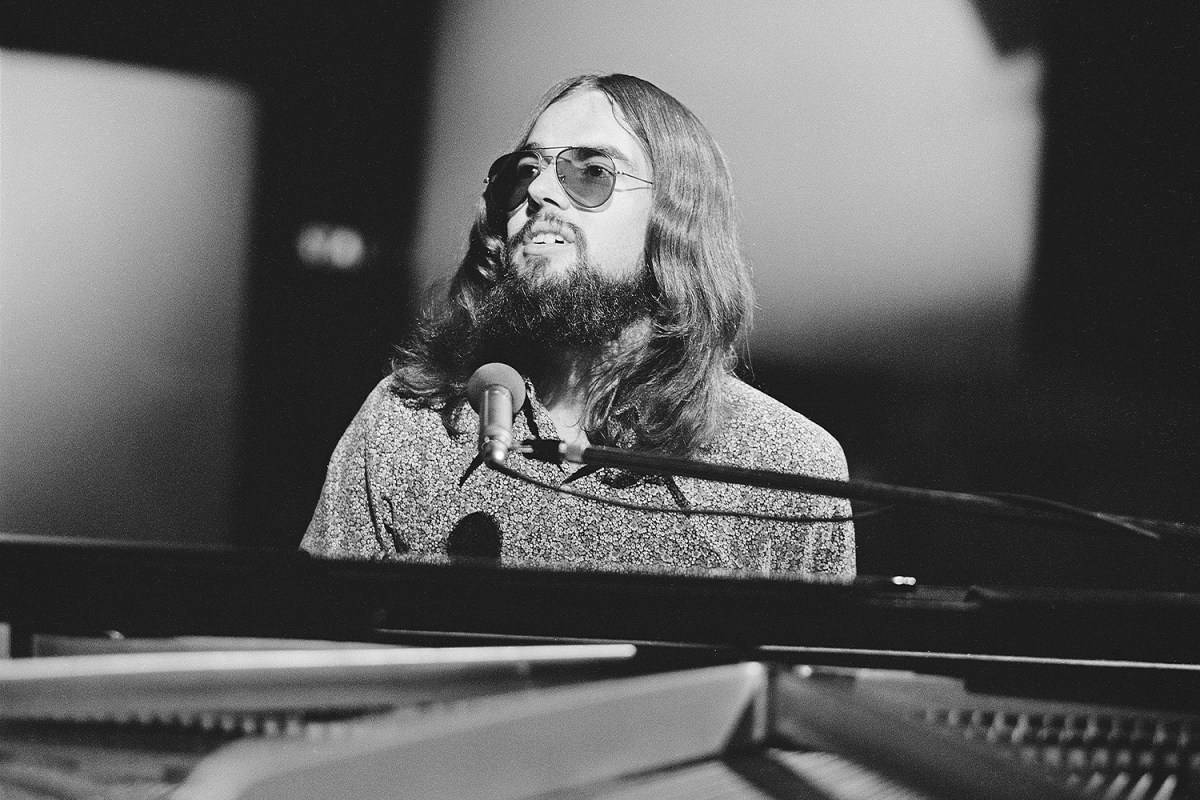
The man behind the man. It might as well be the name of a country and western song. Maybe one by Glen Campbell.
It’s also the perfect description of one of Campbell’s key collaborators, the songwriter Jimmy Webb. And yet, to suggest that Webb merely toiled in the background, scribbling lyrics and chord progressions, is neither fair nor accurate. While the name might not be familiar to younger generations, Webb is an absolute legend — the type of songwriter so prolific, his hits so braided in the tapestry of American pop culture, that he long ago transcended the title of songwriter and became a star in his own right. “By the Time I Get to Phoenix” — that was Webb. So was “Galveston,” “Wichita Lineman,” “MacArthur Park.” Webb’s work has been recorded and performed by everyone from Frank Sinatra to Isaac Hayes, Barbra Streisand to Donna Summer, Willie Nelson and Johnny Cash to Art Garfunkel and, yes, Glen Campbell himself.
A legendary run, indeed, and one that continues even today. In recent years, both Kanye West and Kendrick Lamar have sampled songs written by Webb. Now 80 years old, with Grammys and platinum records galore, plus inductions into various halls of fame, nobody could blame Webb for resting on his laurels; for kicking back, content to collect residuals and enjoy what’s left of a life he probably never could have imagined as a country kid — the son of a U.S. Marine-turned-Baptist preacher — growing up in Oklahoma.
But Webb thought differently. After unearthing several of his songs that were never recorded, the musician began tinkering. He began working on them, then recording them. The result: Yours For The Taking: The Found Songs of Jimmy Webb, released on Sun Records this October. There’s a PBS performance celebrating the album’s release.
I recently called Webb to talk about his storied career. Our conversation was both sprawling and intimate, chatting about what it was like writing “Wichita Lineman” in a single afternoon and having it messengered across L.A. to Glen Campbell; an aborted project with his old pal Warren Zevon, one that he’s never previously discussed; and how all his life he’s never properly grieved his mother.
James Jung: Are you still a vinyl purist?
Jimmy Webb: Purist is not the word I would choose. I’m an enthusiast, I guess. I love the sensation of really going through the whole ritual of taking an album out of the jacket and smelling it. There’s just a whole ambiance to the thing that I’ve missed a lot over the years. And it’s interesting to watch as some of the young people are going back to that because there’s a pride of ownership, there’s a pride in putting the album up on the wall where you can see it. Some people say there’s a difference in the sound. I don’t think it makes any difference. I think it’s the aesthetics and the ritual of vinyl that are important.
When you talk about the sensory details of an album, is there one record from your past that really comes to mind?
I think the most important album that I ever bought — and I think that it remains a milestone and still is one of the most important records ever made — was a 33 ⅓ long player called Modern Sounds in Country and Western Music by Ray Charles. It was his idea to cut Hank Williams and some other country writers with a beautiful, very dense, lush string backing, which was furnished by my friend Marty Paich. I mean, I had no idea I would ever be in the same room with Marty Paich. But later in life, he would actually let me go over his scores and show me how he did that album and was a great teacher to me and mentor. His son, David Paich, organized the band Toto.
What’s your songwriting process and has it evolved over time?
I think that it starts out when you’re a kid, a teenager, more than likely when the hormones start racing through your system and you become aware that girls aren’t just annoying, loud, shrieking things. At that moment in life, I think we’re very vulnerable emotionally and I think that songs have a tremendous impact. And I remember, for instance, the first time I heard “Baby I Need Your Loving” by the Four Tops and it just brought me to my knees.
So I think that my process started with the first record that knocked me on my butt. Because it’s like, I want to do something like that. I want to make something like that. Or that evokes that. Something that gives me the same feeling as that.
In the record business at that time, there would be a hit, like “You’ve Lost That Lovin’ Feeling” or “Baby I Need Your Loving” or “Takin’ It to the Streets.” And in time, the record company would follow that, literally follow that with the eponymously named “follow-up record.” It was called a follow-up. So what I used to do was, I would listen to the initial release and then I began to write my own follow-ups. OK, if I was writing a follow-up, what would I write for this artist? And so then, with bated breath, I would wait for the real follow-up to hit the radio and I would make a comparison between what I had done and what they had done. For the first few years, clearly they outclassed me almost in every department, but I’m working my way up the ladder. I’m learning every time. Every single time a record comes out, I’m learning something from it.
One of the first cuts I ever got was a Dick Glasser production for Warner Brothers of The Everly Brothers. I had lived my whole life with The Everly Brothers. When I was six years old, I heard The Everly Brothers. Now I’m writing for The Everly Brothers. And I could do that because I had had so many encounters with The Everly Brothers in my mind, in my imagination, in my follow-ups that I wrote for The Everly Brothers.
He just slapped it on his record and rapped over it. And nobody ever called me. Nobody ever called my producer … And, so, I kind of got angry about it.
– Jimmy Webb on Kanye using his song “Do What You Gotta Do”
Tell us about “Wichita Lineman,” which you wrote for Glen Campbell. How’d that hit come to mind?
I wrote “Wichita Lineman” as a follow-up! It was put to me in exactly those terms. They’re saying they want a follow-up to “By the Time I Get to Phoenix.” Glen wanted another town song. And I said, “Glen, I’m kind of not writing town songs anymore because I don’t want to be the guy who writes town songs.” My strategy was always to be a moving target. And I think I’ve done that pretty well.
Anyway, Glen said, “Well, how about, could you make it geographical?” And I said, “I could probably do that. Let me work on it for you.”
He was calling me every five minutes that day because he really wanted a song. The songs he was hearing, he hated. He had a pile of songs. He hated them all.
And so I worked all that afternoon and I said, “If you guys would stop calling me” — them being Glen and Al De Lory — “this would go a lot faster.”
About 5, 5:30, I got tired of writing. I had two verses of what I thought was a pretty good little tune. So I packaged it up and I called the messenger service, which was essential in Hollywood. Your motorcycle man was your best bud. It was a cassette, and there were some lyrics. There was a note and it said, “Dear Glen and Al, I’ve got a couple of verses here. Let me know what you think of them because I think maybe it needs a bridge and it might need a third verse. It’s definitely not finished. Let me know what you think. Love, Jimmy.” Boom, biker goes off with it.
I didn’t hear anything about it for a good three weeks. And I thought, well, if they’d wanted me to finish it, they would have called me. Was I plunged into a well of despair? No, because that’s what I do. I write things and I send them out and people turn them down — 90% of the time it’s a turn down. The songwriting business is a very low percentage return deal.
Three weeks later, Glen and I had an overlap. His session went long and I was coming in late to the same studio, Armin Steiner’s up Yucca on Argyle. I came in as they were finishing and I said, “Oh, hi Glen.” And he said, “Hi, Jimmy.” He was just messing with his guitar. I said, “Listen, just before this becomes a thing, because it’s not a thing, you guys didn’t cut ‘Wichita Lineman.’” And I said, “That’s cool. It wasn’t finished and I wish I had had a little more time on it, but I know you guys were in a real hurry.”
Glen said, “Hold it, hold it.” He said, “‘Wichita Lineman’?”
I said, “Yeah.”
“We cut that,” Glen said.
I said, “You cut that?”
He said, “Yeah, me and Al cut that.”
I said, “You guys didn’t see my note then. It needs a bridge. It wasn’t finished.”
Glen said, “It is now.”
And how about Sinatra?
Mr. Sinatra got to the point where it was difficult for him to learn new songs. But up until that point, he was pretty good about recording my songs. I think there’s about four of them. Which isn’t bad. I mean, it’s not like Sammy Cahn who had 90 Sinatra records.
Did you ever collaborate with Warren Zevon?
I loved him. I used to always go down and see him at the Bottom Line when he played there. Even after he stopped drinking, I would go down there and sit in the dressing room and drink whiskey and watch him watch me drink whiskey, which is a terrible thing to admit. It’s an awful thing to be doing.
I have a story for you. Warren and I were talking and emailing pretty steady there around 20 years ago or so. I had played a Rob Mathes song for him — a deeply spiritual song, “Although It Is the Night.” It’s one of the best things I ever heard in my life.
Warren wrote me back and said, “You know, I’ve been thinking about doing a spiritual album.” If I was a false-teeth-wearing man, my false teeth would have been on the floor at that point because that’s something I never expected to hear War say. I asked him one time, “Can I call you War?” And he said, “Nobody else does, but you can if you want to.”
So I called him War. And he said, “I’m going to do a spiritual album. Would you consider doing the lyrics?” I thought, what a dream project this would be: Warren Zevon, Jimmy Webb doing a completely different thing. Not gospel, not evangelical, but spiritual.
And I said, “Man, I’m your guy.” I started sending him lyrics and he started sending me things and we started talking about some of our favorite poets. I’m not even breathing a word of this to anybody because I’m afraid if I mention this to somebody, that the spell will be broken. I’m thinking this because this is going to be too good to be true. This is going to blow people out of their pants.
He wrote to me one day and he said, “I went to the doctor yesterday and they’re telling me I have six months. I’m kind of rethinking the idea of the spiritual album.”
That’s a story that I’ve never told publicly, really.
What’s the best version of “By the Time I Get to Phoenix”? Who did the best job on it?
I like Nick Cave’s performance — it captivates me. There’s a dark side. If you listen to their version of the record, the purples and the dark blues start revealing themselves.
Since I First Heard You: The Avalanches and Me
Twenty-five years after “Since I Left You” blew his mind, our editor-in-chief meets Robbie Chater and Tony Di Blasi to talk “No Bad Memories”When someone samples you on a song, do they tell you in advance?
That’s a good question. When they first started doing this, there was a level of disrespect that was rather shocking. For instance, Kanye West used my song “Do What You Gotta Do,” which was actually recorded by Roberta Flack and Nina Simone and Linda Ronstadt and, like, 10 other people. He just slapped it on his record and rapped over it. And nobody ever called me. Nobody ever called my producer. Kanye had renamed the song “Famous.” It was actually about Taylor Swift. I had always been a Taylor Swift fan. I didn’t want anything to do with putting shade on Taylor Swift. She wasn’t even the Taylor Swift of today, the powerhouse. She was a young girl who I admired. And, so, I kind of got angry about it. Marty Bandier, who’s my rabbi over at Sony, called Kanye, and Kanye told Marty that he thought Nina Simone wrote that song. And I said to Marty, “So you’re saying that Kanye thought it was OK to lift Nina Simone’s song?” To make a long story short, Kanye offered me 45%. I don’t disavow rap music. I don’t dislike rap music. I don’t particularly love it, but I don’t hate it. And I think that artists have a right to create. So, to keep the peace, I said, “OK, I’ll take it.”
Now, with Kendrick Lamar, they were much, much more respectful. They contacted us and said, “Listen, we’re using ‘MacArthur Park,’ and we want Jimmy to know that.” You know, here’s the deal, and here’s what we suggest, and such and such and such.
One thing that had me ticked off about Kanye was not Kanye, it was NARAS [National Academy of Recording Arts & Sciences]. There were 13 writers on “Famous.” It was nominated for Song of the Year, and they were all gonna get Grammy Awards. All 13 guys were gonna get Grammy Awards. But the only guy not listed for a Grammy Award was me. And it was actually my song, and my song was the only recognizable song there was. I felt like, well, there’s a principle here. I mean, this is all silly to me, but there’s a principle, which is: if these guys are getting a Grammy, why am I not getting a Grammy?
What’s the concept behind the new album? Why these songs? Why now?
I like to be completely honest and open about the origin of these songs. Some of them were passed over by other artists. There’s a song called “Winter Clothes” that I was preparing for Mr. Sinatra. And as usual, the pressure was on. I wasn’t quite finished with it. I went over and sat with him. I always enjoyed him. I’m sitting there and I’m thinking, am I going to play “Winter Clothes” for him or not? I said to myself, I’ll slip it by him and he’s going to cut it. He’s going to cut it. Even though the lyrics, they’re a little weak in the second verse. But he’s going to cut it and it’s going to be an album. So I started playing “Winter Clothes.” I get over into the second verse, and he said, “Hold it.” He said, “Stop.” He kind of leaned on the piano on his elbow and he said, “Well, that was only about half baked, right kid?” You could throw a curveball past Roger Maris, but not Frank Sinatra. The ears were there. He heard everything.
All songwriters have a trunk. We call it “the trunk” because it becomes more and more full of songs that have been discarded or ignored or passed over for some reason or another. So I’m sitting in this meeting with my genius producer, Fred Mollin, and my wife Laura, who’s brilliant as well, and we’re listening very dispassionately to these old demos and some finished records. And we’re all thinking, wow, these are pretty good. Some of them are even better than pretty good. And then my producer, Freddy, kind of smiled at me and he said, “Now you have a chance to do them again.” All of us were just kind of silent for a little while. And it was like, yeah, you know, that’s right.
William Maxwell, the late fiction editor at The New Yorker, was once asked by Charlie Rose what quality he saw in all the writers he’d edited. Maxwell said “deprivation.” He goes on to explain that he had never met a writer who hadn’t experienced some loss and was making it up to themself through art. You lost your mother when you were in your teens. As a songwriter, does that Maxwell quote resonate with you?
It does in a way, but it’s also … I’ve lost other things. But that episode [his mother dying], it remains kind of a mystery to me. I’ve been sober for almost 30 years now. I see a therapist. Not every week, but I did for a while. But there’s one part of my experience that’s a mystery to me. That I can’t talk about. And that is what it meant to lose my mother. It’s almost something that I have excised from my experience. For many, many years, I couldn’t see her, actually couldn’t picture her. And, lately, I’ve been able to do that. I’ve been able to conjure up my own picture of her face.
I think that the shock [of losing his mother] was beyond. I’ve never said this publicly. I’m a little self-conscious about it. But I think that the shock or the trauma was beyond the ordinary trauma. Not that there’s any ordinary trauma. But whatever it was, it was a double dose. It was something so impactful. I’m 80 years old and I’m still struggling with trying to remember exactly what order things occurred in. I remember going to the hospital. I remember her saying something to me that I probably won’t repeat. I remember odd, disjointed things. The first thing that I do remember, sort of contiguously, was saying goodbye to my father. He had the station wagon all piled up with mattresses and things. It looked like something out of John Steinbeck. You know, the Joads, we’re headed back to Oklahoma. Go figure. I remember my father gave me $40 and said, “Son, this is the hardest thing I’ve ever been down in my life. I wish I had more, but this is all I’ve got.” And he handed me $40 and he drove away. This is what I did know: I knew that my father had been destroyed.
Is there a song that you could point to and say, “That was me grieving my mom”?
No. I think that’s the song I need to write. And I can’t. But I better write it pretty soon. You know, it’s going to be too late, pal. I’ve only got a limited amount of time to work out all my psychological problems, you know? But I think losing your mother is a big deal. I hope you don’t think I’m being completely strange, like a weirdo, like a potential psychopath when I say this, but I don’t think I’ve ever grieved over it. I don’t ever think I’ve ever broken down and cried about it.

More Like This

This article appeared in an InsideHook newsletter. Sign up for free to get more on travel, wellness, style, drinking, and culture..