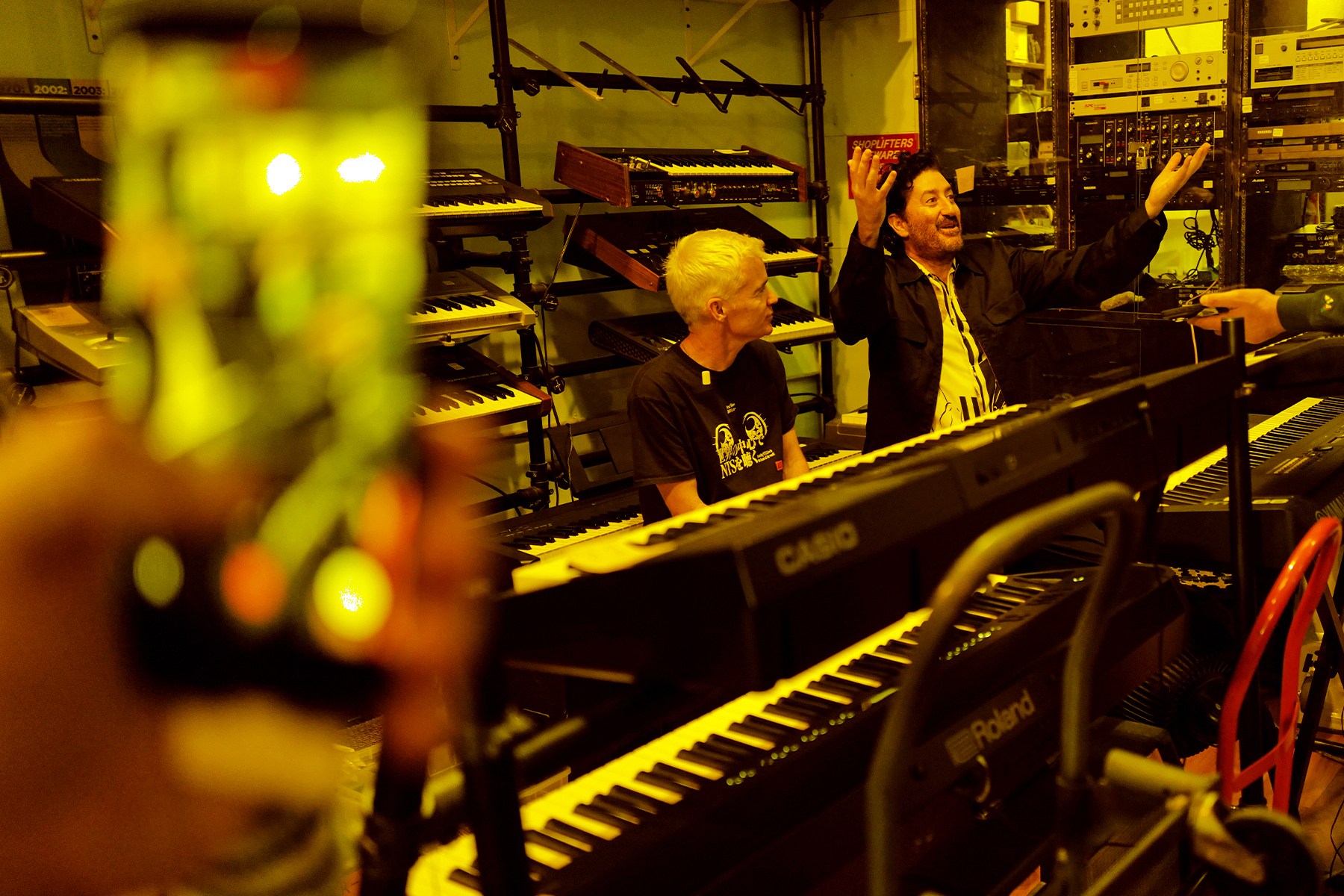
“We made our first record on that,” Tony Di Blasi says from a cluttered corner in the back of Rogue Music, an old shoebox of a music gear store tucked away on West 30th Street. He’s pointing to an Akai S2000 sampler high up on a shelf — the budget model that made its debut back in 1995. It’s no bigger than a VCR, all knobs and buttons and a big floppy-disk drive, plus — presumably — three decades worth of accumulated dust. “All of it was done on that.”
“All of it” means the 3,500 meticulously stitched together samples comprising Since I Left You, the seminal, genre-defying debut that made Tony and bandmate Robbie Chater, aka The Avalanches, household names among a certain type of electronic music head at the start of this century.
I am one such 46-year-old head, now standing before my Australian music heroes, both of whom cut unassuming figures. Tony: disheveled, charmingly so, his wavy black hair swept back and his stubble rivaling the fullness of his mustache; his expressive arms constantly in motion. Robbie: pensive, dreamy, almost fragile, his close-cropped hair so white it appears blond, lending him a towheaded innocence as he sits on a stool to Tony’s right picking at an açaí bowl — his last-minute lunch. The boys are in town from London, their new home, where they just played a DJ set with Dimes Square darling The Dare (the crowd was very fashionable, they tell me with a laugh), and tomorrow they’re off to L.A. for another gig. It’s all a build up for their new record, No Bad Memories.
We’ll get to that. It is, after all, why I am here and why the band’s label gave me access to them, under the stipulation that we conduct the interview in someplace “nontraditional.” Hence: Rogue Music. But for now, it’s Since I Left You that I want to linger on.
“This was studio gear, but we took it on stage,” Robbie says, pointing again to the S2000 sampler. “We were like 19, 20 years old, very young and trying to make electronic music. Every song was just on one floppy disk. So we’d have to eject it, load the next, which would take 30 seconds, all while the crowd’s just sitting there, waiting.” He shakes his head. “There’s a certain sound when a floppy disk isn’t loading properly.”
That sound — a kind of mechanical crunching — became one of the building blocks of No Bad Memories, the band’s fourth album. And yet, putting it so blithely, as if The Avalanches have simply released one record after the next, would suggest a career that’s been anything but smooth sailing.
A Personal History
I first heard Since I Left You in the summer of 2001 while studying abroad in Paris. The album had come out in Australia on Melbourne’s Modular Recordings the November prior, but it hadn’t reached Europe until XL released it that spring (it would be another seven months before it reached American shores). One afternoon that July, my roommate — a fellow American — brought the CD home from Fnac, the chain where we bought the bulk of our music. I was a budding culture snob, and suspect of my roommate’s taste in electronic music, specifically due to his habit of conflating its many subgenres.
“It’s like a house-trance-trip-hop thing,” he said, unwrapping the cellophane and placing the CD on the tray of our stereo.
I must’ve groaned. For the past eight months I’d been his spirit guide into the world of dance music. We’d hit Paris’s most proper clubs: Rex, Batofar, Queen. We’d caught the right DJs: Laurent Garnier, Marshall Jefferson. It had also been the year of Daft Punk’s Discovery and Basement Jaxx’s Rooty, both of which we caned nonstop in our creaky, fourth-floor walkup (“Please block your windows,” a neighbor once wrote on a piece of paper they slipped under our door).
Whatever skepticism I harbored due to my roommate’s underselling of the record was dispelled some 48 seconds into the album’s opener, the titular “Since I Left You.” “Get a drink, have a good time now, welcome to paradise,” a man said over a bed of flutes, strings, chunky beats and cooing backing vocals. It felt like I’d stepped into the pool party from Boogie Nights. Soon enough a female vocalist took over. “Since I left you, I found a world so new,” she sang, over and over and over.
On paper, Since I Left You is a breakup album, and yet to my 20-year-old ears it contained multitudes more. Here was nostalgia and heartbreak and childhood and endless, endless yearning, all wrapped up in a cinematic party record. It hit you like Phil Spector’s Wall of Sound (a reference that I did not have in my arsenal at the time), and continued with one track bleeding into the next like the B-side of Abbey Road, the record my father tortured me with as a child.
Since I Left You burst with callbacks, whispered vocals, mariachi guitars, horse neighs and foghorn blasts, plus snippets of Madonna, Cerrone and Camp Lo, each sample so sneakily lifted from its original source you hardly recognized it. Even more beguiling were the hooks, disappearing as quickly as they’d appeared, like half-remembered memories playing on a radio station whose signal was all too soon swallowed up by static.
The first time listening to Since I Left You felt like finding a message in a bottle washed up on shore, of dopamine distilled, whereas Wildflower sounds like the dusty old recordings left behind by some forgotten ethnomusicologist.
My roommate and I played Since I Left You again and again that afternoon and into the evening. I remember the green Kronenbourg bottles we held, how the sun slanted through the living room window and pooled on the apartment’s brown carpet. In the end, my roommate had been right: this was house-trance-trip-hop and whatever other kitchen-sink genres you reached for in a bid to classify the record’s kaleidoscope sound.
“Plunderphonics” was the taxonomy critics finally agreed upon, lumping Since I Left You in with other groundbreaking, sample-based records like the Beastie Boys’ Paul’s Boutique and DJ Shadow’s Endtroducing. By the time I returned to college for the fall of my senior year, The Avalanches — then a mysterious sextet who had hardly ever given an interview or appeared on TV — had become lingua franca among a certain class of music snob (read: college radio DJs).
The band’s lore only deepened once I moved to New York City. It was 2003, peak Strokes, Interpol and DFA Records, and yet among those in the know, name-dropping The Avalanches was the type of game-recognize-game reference that signaled you knew what was up. Sure, it had been three, then four, then five years since the band had recorded Since I Left You, but there’d been morsels to keep us satiated and hopeful along the way. DJ mixes and indie rock remixes, plus a password-protected download to “Ray of Zdarlight,” a mashup of Wham! and Digitalism that got people wondering: was this a new single teasing a forthcoming sophomore record?
“It was just a mashup I made for DJing a little bit,” Robbie tells me in Rogue Music with a laugh. “And then XL, our label in England, was so excited to just have anything that they pressed up some vinyl.”
Modular further stoked the hype, assuring fans that The Avalanches had “made the record of their lives.” The boys played ball, proclaiming, “It’s so fucking party you will die.”
The problem was that The Avalanches didn’t have anything. There were wrong turns and half-finished songs. Sickness, stints in rehab, sobriety, psychedelic-drug pilgrimages and four of the band’s original six members finally leaving to, you know, get on with real life. Tony and Robbie stayed the course, going into debt, borrowing money, playing the odd DJ gig to somehow stay afloat. Concerned friends worried, all while the 10 years following Since I Left You swelled into 15. There were offers of a reunion tour, but that was the last thing the remaining duo wanted. Fans and friends alike began to fear: would Since I Left You become another record so genius it could never spawn a follow-up? Another Loveless? Another In the Aeroplane Over the Sea or The Miseducation of Lauryn Hill?
“It would’ve almost been kind of legendary,” Robbie says to me, a twinkle in his eye. “One and done, right?”
“I don’t know what year it was, but there was this sense of everybody being just like, ‘Oh, they’re never going to do it.’” he continues. “And almost then we felt a bit freer to finish. Because everybody had given up on us.”
Tony nods in agreement. “I often say, it’s like in Shawshank, the tunnel that he crawls through. I guess after a certain amount of years, it was like, ‘We’ve got to just see it through, regardless of if anyone likes it or not.’ We were so determined. We kind of had to go through that shit tunnel to get there.”
Robbie looks over at Tony from his stool. He smiles. “It really bonded us together for life.”
Through the “Shit Tunnel”
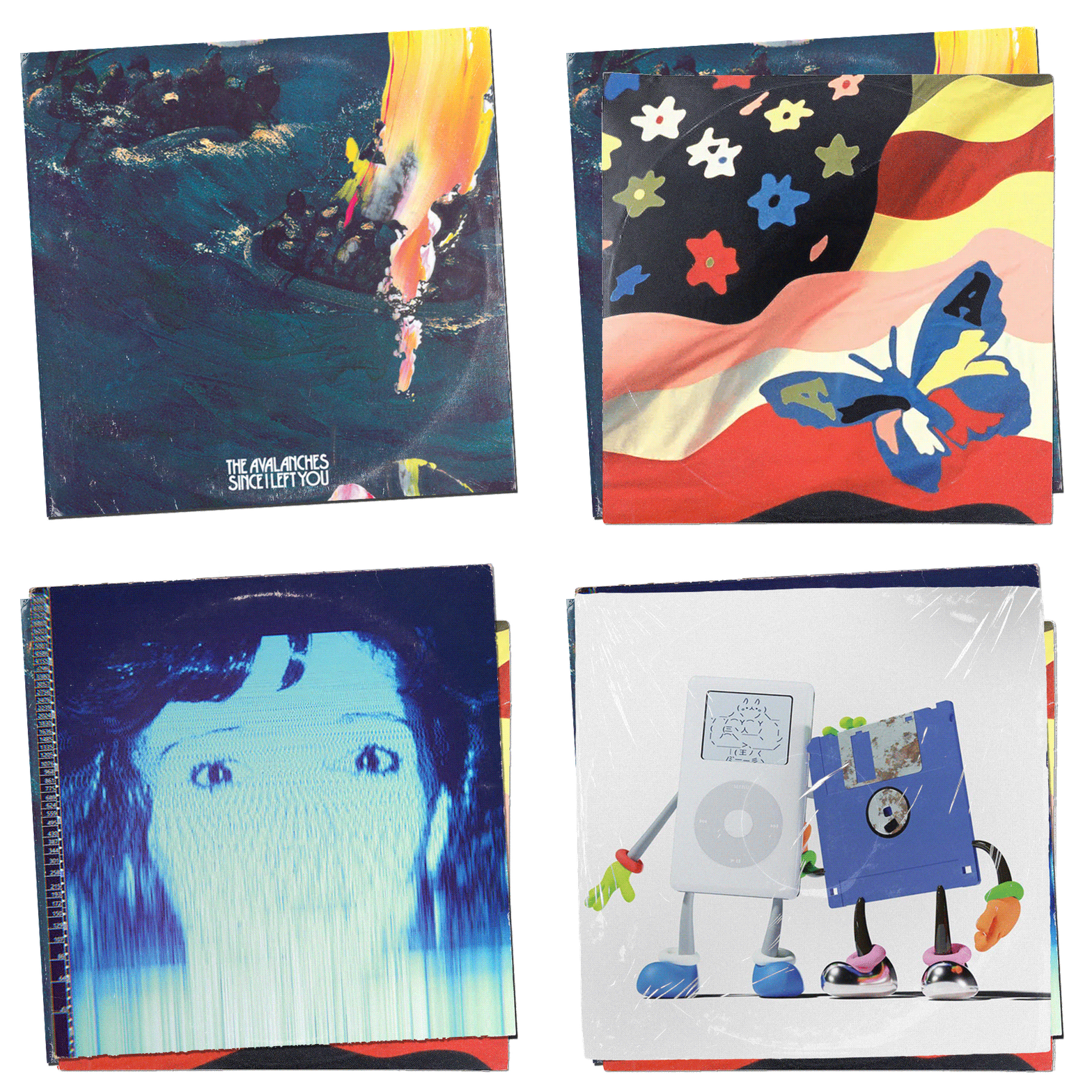
As for the other end of that shit tunnel, that would be Wildflower, released on July 1, 2016. The album cover is an ode to Sly and The Family Stone’s There’s a Riot Going On, but the sound of the record feels more Brian Wilson, with a dash of Rodgers and Hammerstein. Again, there are plenty of samples, only this time they were supplemented by an eclectic mix of guest stars. Everyone from Danny Brown to Toro y Moi, MF Doom to Father John Misty to Biz Markie lent vocals.
Still, how good could a sophomore album possibly be that came out almost two decades after the original?
This was the question my friends and I asked ourselves on the first night of listening to Wildflower. We had bonded decades earlier over our love of music, with The Avalanches being a shared obsession. Now we were on Block Island for the weekend. I remember the three of us — along with our wives — drinking and sitting around the dining room table of the Vrbo we’d rented. Someone had a small wireless speaker. It was dark outside. I pressed play on my phone.
The first experience of listening to Since I Left You felt like witnessing a high-wire act. After a certain number of tracks, one worried that such momentum, such magic, such a never-ending origami of reinvention, could not possibly sustain itself. The anticipation of listening to Wildflower offered the exact opposite tension: would the record yield any good tracks?
Yes, it did. Plenty. “These guys just have it,” I remember one of my friends saying that night at that dining table on Block Island, looking up at the rest of us with a face of relief. While not as consistent as Since I Left You, the highs of Wildflower are high, perhaps even higher. At the time, Robbie described the album’s structure as a roadtrip that brings the listener from the city to the countryside, all while on acid. There is an unspooling and a mellowing as the record progresses, culminating in “Saturday Night Inside Out,” a fuzzy, lo-fi dream of a track made all the more magical by David Berman’s spoken-word lyrics. It’s a song that evokes hometowns and childhood and first love and the people you leave behind.
“[‘Saturday Night Inside Out’] took years and years to develop, to turn it into an actual song,” Tony says. “We couldn’t even retrieve the files, so we had to rip the MP3 off a CD we’d burned — that was the highest quality we had of that song. Then, like 15 years later, David did this incredibly beautiful spoken word stuff that really kind of brought it home. It taught us that a thing can just sit there for years and years until it finds that piece that completes it.”
The Avalanches seem to have an obsession with survival and formats. The first time listening to Since I Left You felt like finding a message in a bottle washed up on shore, of dopamine distilled, whereas Wildflower sounds like the dusty old recordings left behind by some forgotten ethnomusicologist.
Life, Music, Death
On their third record, 2020’s We Will Always Love You, Robbie and Tony pushed this idea even further, playing with the concept of music as interstellar communication beamed into the cosmos. Love, life, death — it’s all in there. At the time, it was just the type of record I needed. I was living in Switzerland with my wife and our two young sons. My father had recently died. Dad had been a mountain man who’d grown up just over the border in Austria. After chasing my mother to America, he spent the next 40 years of his life mourning his Alps.
My wife and I had moved to Switzerland for her job, but just as potent a pull was the romantic notion that I could live the life my father had given up for my mother and me. How ironic then, how cruel and indifferent the world had been, that a year into our adventure my father got sick, and three months later he passed. I was supposed to use our time in Switzerland to write a novel, a coming-of-age book, one in which my larger-than-life father loomed, well, large. After his death, I found myself trying to shoehorn every inch of the man into the narrative, as if I could write him back into existence. The book became bloated and unwieldy. Instead of writing, I’d often drive around the mountains, a big weeping mess.
During that same time, my friend, one of those guys from Block Island, sent me an advance copy of We Will Always Love You.
“Don’t share,” he warned me.
I’d already heard a handful of the singles that the band had dropped on Spotify. None of them struck much of a chord. Blame it on grief, the beginnings of fatherhood, my wife and me (as is perhaps true for all sleep-deprived parents) sometimes at each other’s throats.
But listening to the album in full recontextualized those first singles. The Avalanches aren’t a singles band. Their work is meant to be heard in its entirety, every track in order, one flowing into the next, with callbacks to preceding songs, ghostly echoes of a previously used melody or sample, vibrations of the past. Maybe that’s why I love their music — how it proves that nothing is ever entirely gone.
The guest lineup was even more impressive than that of Wildflower. Blood Orange. MGMT. Rivers Cuomo. Johnny Marr. Karen O. Jamie XX, who told The New York Times that Since I Left You was one of the first albums he ever bought, and that, “it led me to want to discover how people made music that sounded like that.”
You have to begin with a heart, a thought and a feeling, and you’re following it. If you try and define something, then it’s kind of like you’ve already told yourself where you’re heading.
– Tony Di Blasi on the making of No Bad MEmories
Over email, Karen O tells me that We Will Always Love You is “potentially in my top 10 favorite records of the 21st century.” After hearing the finished product, including her own contribution, “Dial D for Devotion,” she “DMed [Robbie and Tony] about having an out-of-body experience of pure love on a mind-altering substance.”
My experience was more grounded. The album’s significance wasn’t lost on me, from the opening track’s posthumous voicemail left by a loved one, to the famous heartbeat and brainwaves of Ann Druyan, future wife of Carl Sagan, compressed into a minute-long recording that the couple then sent into space via the Voyager 1 and Voyager 2 spacecrafts.
But, as with all the music The Avalanches dream up, it was an easily forgotten moment that I clung to hardest. “Overcome” is a three-and-a-half-minute track that comes on the album’s back half. A loop riding a simple click track, fleeting vocals and piano keys filigreeing the music, all of it soft as a whisper.
Autumn in the Alps. The yellow larches. The icy clarity of the blue skies. The sun slanted low, the shadows lengthening across the velvety fields. “Overcome” became my soundtrack to this landscape, as well as to my own internal landscape, however turbulent. I played it on repeat in the car. I fixated on one sample in particular. “This is to the Champagne crew,” an unknown man intones. “We do not need anybody, we are independent.” I could feel my father, now 10 months gone, starting to slip from my day to day, my sadness losing its shape, its sharpness. I could feel myself ready to live a life less informed by his own, to be more of me, whatever that was. And yet I didn’t want to lose that grief because losing it felt like a betrayal of my father.
I attempt to tell Robbie and Tony all this while we chat in Rogue Music. Of my love for their albums, and how I’ve braided each with my own life. I try to do this as succinctly as possible, all without coming off as a sycophant or a fool. I keep telling myself I am there to interview them, not the other way around. I remind myself to please adhere to at least some shred of journalistic integrity.
Instead, I say: “Unfortunately, I listened to the new record in the office yesterday.”
The guys laugh. So do I.
“I bet it was, like, password protected,” Robbie says, referencing how music labels share advance album copies with the press. He still sits on the stool, shelves of synthesizers stacked behind him. He shakes his head. “Oh, God.”
Tony agrees. “How boring. But it’s very appropriate, especially if there was a fax machine in the background in the office.”

#DadRock
Indeed, the office setting was appropriate. While No Bad Memories continues with The Avalanches’ tradition of casting an impressive array of guest stars, from Panda Bear to Portraits of Tracy, Loaded Honey to Barry Can’t Swim, as well as returning guests Karen O, Jamie XX and Rivers Cuomo, it is another sample-based record at its core. This time around, the source of those samples is corporate — jingles, old advertisements, the sounds of now-obsolete technology that once housed our most precious and personal memories, back when the world was more physical and full of friction.
“I don’t know if this is going to sound pretentious,” Robbie says, “but I feel like I had feelings about the world as a kid, and confusion and excitement, but I couldn’t express it, and then music was a way to be able to do that, and actually, even this, it might seem odd, but sample-based music, I feel, is very expressive.”
Initially, No Bad Memories was intended to be “just a party record.” Or, in Tony’s words, “let’s have only eight songs, no big fucking concept.” The guys — now both in their early 50s — weren’t keen to spend the next half decade or more crawling through another shit tunnel. But, that’s just not how The Avalanches operate. Old songs were discovered, snippets of jingles, odd sound effects, much of it lifted from YouTube and shared via text between Tony and Robbie and Andy Szekeres, of Australia’s Midnight Juggernauts. After helping produce We Will Always Love You, Andy officially joined the band. The process of gathering so much material became a full-time job, all conducted through texts, each day beginning with “good morning” and ending with “good night.”
“It’s like a marriage,” Tony laughs.
Part of that marriage includes shaping all the material they’ve gathered. This involves patience, and being comfortable with uncertainty, and the type of nonlinear bushwhacking that a patchwork album requires, where the past is always informing the future, and vice versa. Sometimes, Tony tells me, a track can be there for years and years until it finds that piece that completes it.
“It’s like Robert Frost wrote,” I say, because writing is the way I relate to the world. “‘No surprise for the writer, no surprise for the reader.’”
Robbie brightens. He perks up on his stool. Beams at me, all big blue eyes. At this moment, he doesn’t look a day over 30.
“That’s a crazy perfect quote. We don’t know what we’re making at the beginning, you know, and it’s a journey and a discovery, it’s an interrogation of yourself and your own place in the world, in a way.”
Tony nods, standing there amid all of the store’s once cutting-edge technology.
“You have to begin with a heart, a thought and a feeling, and you’re following it,” he says. “If you try and define something, then it’s kind of like you’ve already told yourself where you’re heading.” Robbie pauses, takes his time with the next thought. “[You have to not be] afraid to get lost, and not afraid if it’s going to take time and you’re going to miss out on an album cycle or people will forget about you. That kind of thing.”
A day after our interview, The Avalanches play their DJ gig at The Silverlake Lounge in L.A. My two friends attend. The first being the guy who sent me that advance copy of We Will Always Love You six years ago; the second is in town for his father’s funeral. They need a break from life, they say. I give them both shit over text — is it cringe, I wonder, for two middle-aged dads to go out dancing on a weeknight? All the same, I am envious. Weeks later, on the Friday that No Bad Memories drops, we spend the morning debating its merits over text. The tracks are great, we decide, but are there too many interludes? Too much of a commitment to the commercial bit interrupting the typical Avalanches flow?
“It’s a grower,” my friend says, who — just like last time — has already had the album for a few months.
He shares “Under Yr Power,” and types: “the most classic.” Indeed, it’s vintage Avalanches, infectious and far too short — AM Gold quickly spun up and then, just as quickly, blown away by the wind.
The following day, Saturday, I drive my family to Vermont to visit my mother, now 85 and living on her own these nearly seven years since my father’s death. My wife sits shotgun, my two sons — ages eight and six — in the backseat. They want to listen to Zombie Nation, “Kernkraft 400,” the jock jam they’ve been torturing me with all year. But today I have the perfect excuse.
“No,” I say, hitting play on No Bad Memories. “Daddy has to listen to this for work.”
I point to the album artwork on our car’s media console. I tap the caricatures of the second-gen iPod and the floppy disk. I tell the boys that I used to have both. They don’t respond. My wife, to her credit, acts interested. She asks a few questions about the record, which is all I need to start middle-aged-music-guysplaining my favorite band. The music pumps out of the car’s speakers, vacillating somewhere between city pop and hyperpop, with some of those classic Avalanches soul sample flips stitching it all together. It is, to borrow an apt yet hackneyed phrase, bursting with joy.
And then “Magic Wand” comes on, a collab between The Avalanches and Scottish electronic musician Barry Can’t Swim. My wife begins swaying her shoulders. The beat is buoyant, the melody cinematic, the cooing female vocal sugary and high pitched, like the voice of a pop star you can’t quite place. The kids dance in the backseat. For a moment it is perfect, and then the track ends.
“But that was so short,” my wife says.
I explain to her that that is part of The Avalanches’ magic. How their songs slip through your fingers, one bleeds into the next, the record constantly shifting and changing. I go on and on.
I’ve lost her. The boys are looking back out the window, counting down the seconds until they can hear Zombie Nation again. I am my father, extolling the virtues of Abbey Road while 10-year-old me sits in the backseat, barely listening and bored out of his mind.
No Bad Memories keeps playing. It is a beautiful fall day, both sides of the road a Technicolor tapestry of oranges and reds and yellows. Other trees are completely barren, some still green, as if untethered from time. I sneak glances at the boys in the rearview mirror. I wonder if one day they’ll appreciate The Avalanches the way I finally learned to appreciate my father’s Beatles. And if they do, if they’ll remember this drive, or maybe just a trace of it, a feeling.