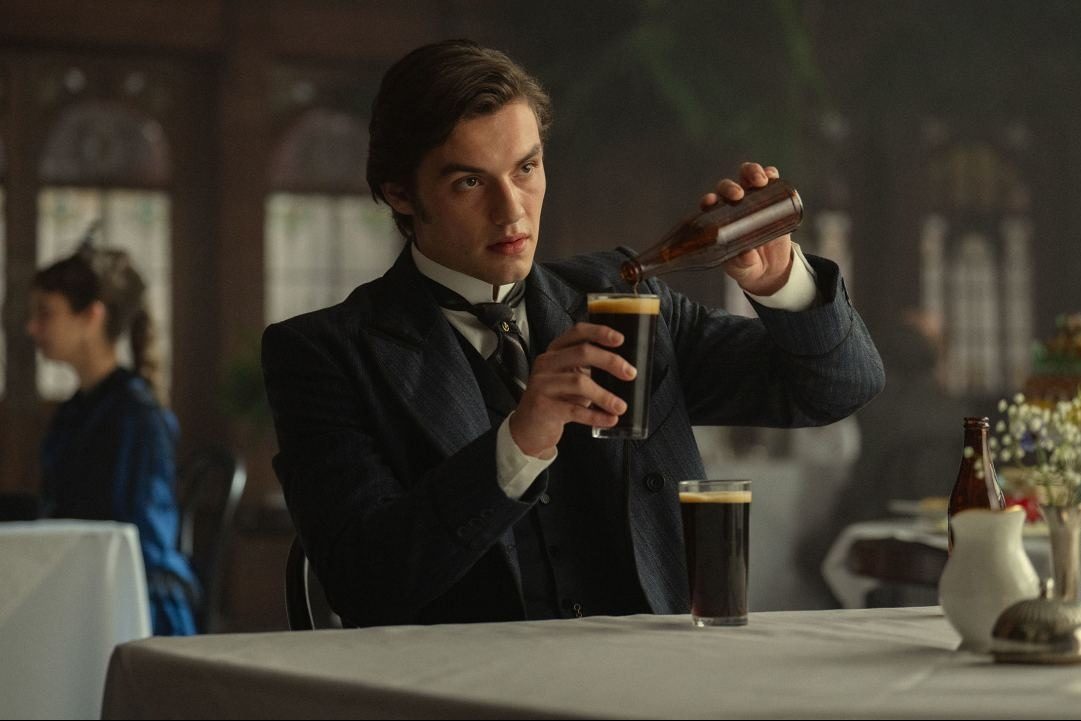
Here in the States, the chatter surrounding Netflix’s House of Guinness has been mostly positive. The new series from Peaky Blinders creator Steven Knight has earned comparisons to HBO’s Succession — mostly because of its “four dysfunctional siblings jockey for position after inheriting their late father’s lucrative empire” premise — and generated a lot of buzz for actors James Norton and Anthony Boyle (and the latter’s highly publicized nude scene). It’s a fun, fictionalized tale of the Guinness family’s efforts to expand their famous brewery while adapting to the times, those times being 1868, shortly after the death of patriarch Benjamin Guinness.
But while the series has been warmly received in the United States and U.K., Irish critics have been tearing it to shreds, taking issue with the show’s historical inaccuracies, the questionable accents by some of the English cast members playing Irish characters, and the stereotypical depiction of the working-class Irish and members of the Fenian Brotherhood. While Norton — who is English — has become a bit of a heartthrob, thanks to his portrayal of Guinness family enforcer Sean Rafferty, The Irish Times likened his Irish accent to “a steampunk Mr. Tayto.”
That same publication took the show to task for its inauthenticity and questionable depiction of Ireland’s battle for independence. “One problem with House of Guinness is the at best rudimentary understanding of Ireland’s experiences of colonialism of Steven Knight, the drama’s creator,” the review reads. “(He didn’t even have to leave the UK: the series was filmed mainly in Liverpool.) He pitches the struggle for independence as a battle between different kinds of Irish people. On one side are Dublin Metropolitan Police units with flint urban burrs, on the other ‘Fenians’ who dress and speak like feral leprechauns. At no point in an eight-part series unfolding in a post-Act of Union Ireland do we encounter a single person with a British accent — which Americans might call burying the lede.”
Liz Walsh of The Spectator also pointed out a handful of inaccuracies. “The depiction of a rioting Dublin mob at Benjamin’s funeral is factually wrong. Rather, contemporary accounts describe a respectful solemn affair,” she writes. “The activities of the Fenians, who play a large part of the narrative, is wildly inaccurate. The Fenians had gone underground in 1867 and were not a visibly active force at that stage.”
“One Fenian with red curly hair — what else? — says ‘we only want a United Independent Ireland,’ a hilarious blooper that could have been avoided had the script writers possessed more than a nodding acquaintance with Irish history,” Walsh continues. “In 1868, Ireland was a united country — albeit under British rule — the question of ‘unity’ only arose 50 years later, after Irish partition.”
Other viewers on social media have called out House of Guinness‘s costuming and its tendency to dress the Fenian characters in green, or what one Redditor called “literal Spirit Halloween leprechaun costumes.”
Of course, House of Guinness is far from the first period drama to rely too heavily on stereotypes or play fast and loose with historical fact. In a lot of ways, it’s basically Downton Abbey set in Ireland instead. There’s a forbidden romance between a posh aristocrat and a working-class person they wouldn’t dare be seen with in public, a closeted gay character who must deal with the bigotry of the era, elaborate costumes, and a meddling aunt looking to marry off every last one of her relatives. It’s generally well-acted, and the drama is compelling enough to make it an enjoyable watch, but should the criticisms from Irish viewers disqualify it from your Netflix queue? If you take it for what it is — a fun, flawed show that’s frothier than the stout that inspired it — you don’t necessarily have to, but there’s no denying it’s ultimately a swing and a miss.

More Like This


This article appeared in an InsideHook newsletter. Sign up for free to get more on travel, wellness, style, drinking, and culture..