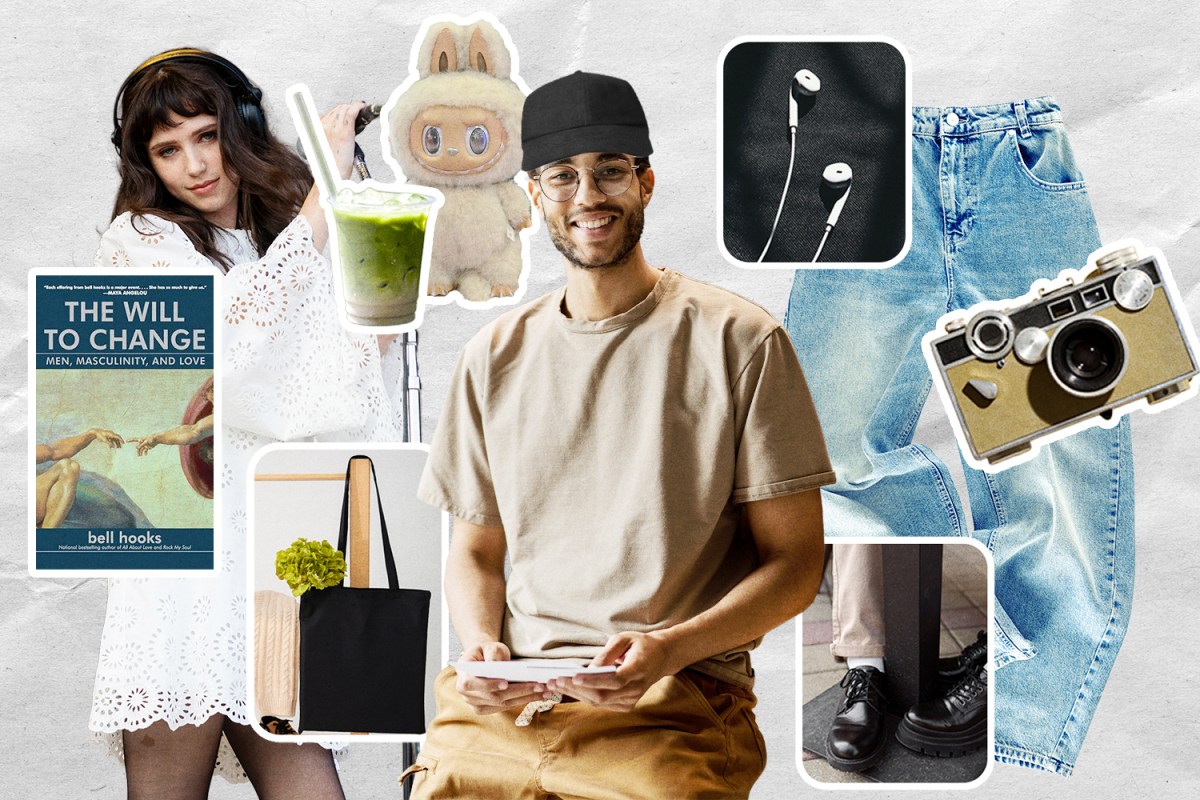
He’s in his early to mid-20s. He might carry a canvas tote bag, a book that women love — like feminist literature, modern-day classics or “romantasy” — and a bright green matcha latte. He might be wearing a Labubu, baggy pants and weirdly shaped headphones. His nails might be painted. He also might be carrying around vinyl, CDs, disposable cameras and maybe even tampons.
Enter: The “performative male,” an inauthentic male persona that makes him appear softer and sensitive, and therefore theoretically more desirable, compared to his other male counterparts.
The trope, which has proliferated on TikTok, has become so well-defined and well-known that there have been “performative male” contests across the country. Even Canada is getting in on the game.
Obviously, there’s a lot of fun being poked at here, hence the lookalike gatherings where everyone can lightheartedly laugh at this archetype. It’s clearly garnered enough popularity to deserve such a contest, considering the crowds and number of participants. But the thing about the real-life performative male is that he’s exactly that: performative.
It’s true that a lot of social media is inherently performative. We curate profiles and feeds and timelines so we can look a certain way and be fed images and videos that reinforces the image we give off, or at least the one we hope to give off. In a dissection of the performative male archetype in The New York Times, the paper noted how the word “performative” was specifically used during the Black Lives Matter movement during the pandemic. People were posting pictures of black squares to show their allegiance, but that trend also received a lot of criticism for lacking substance. The posts didn’t have any deeper, actionable meaning outside of making a statement for Instagram followers to see, showing how social media can be used to merely just, well, perform.
And for a performative male, he wants to seem stylish, trendy and completely unlike his other male counterparts. He’s not drinking beer or watching sports with his guy friends. He’s sensitive and vulnerable, masquerading as what he thinks will make him stand out among women.
There’s absolutely nothing wrong with loving these things in a genuine way. I love a man who’s excitedly reading Joan Didion as much as any other woman. Traditionally, women’s hobbies are often seen as “less than” compared to men’s, so it’s interesting to see the shift in the way men engaging in this trend are utilizing them now. It’s funny, sure, but it’s also strategic.
Some men are truly relying on all these preferences to appeal to women, and they’re doing it without the intention of enjoying it, which is where it starts becoming questionable. Isn’t it manipulative to lure women in by faking interests they don’t truly care about? I can’t think of a worse way to start a relationship than by lying about your style, interests and preferences.
It’s also a complete generalization to think these traits are the keys to getting a woman. It feels more like a collection of concepts that’ve gone viral. No one is foaming at the mouth for a man who wears Labubus.

More Like This


This article appeared in an InsideHook newsletter. Sign up for free to get more on travel, wellness, style, drinking, and culture..