I used to loiter at Eddie Huang’s Baohaus location on 14th Street, between 2nd and 3rd Avenue, as a high schooler with nowhere to go and little money to spend. My friends and I would crowd several people to a hightop table meant for two, stuffing our faces with fried chicken and pork belly baos to quell our drunchies, and pour a handle of Svedka into our sippy cups in the bathroom. It was cramped, and we were far from respectable customers, but we were never treated with any kind of disdain, and it sure as hell beat hanging out in the IHOP across the street.
It was the kind of place that wore the personality of its owner on its sleeve, from the hip-hop blaring on the speakers to the cracked-out menu items that might seem like anathema to an old culinary head who worships at the feet of Georges Auguste Escoffier. While the idea of the “cool” and “hip” Asian-American restaurant seems so common these days, before the cultural dominance of Win Son, Wenwen, Bonnie’s, Bistrot Ha, Potluck Club and so many more, it was Eddie’s restaurants that carried that torch. That unique sense of perspective is something he’s carried into everything he’s done, from his bestselling memoir Fresh Off the Boat, Viceland travel show Huang’s World, directorial debut Boogie to his debut novel Come Undone, published earlier this year.
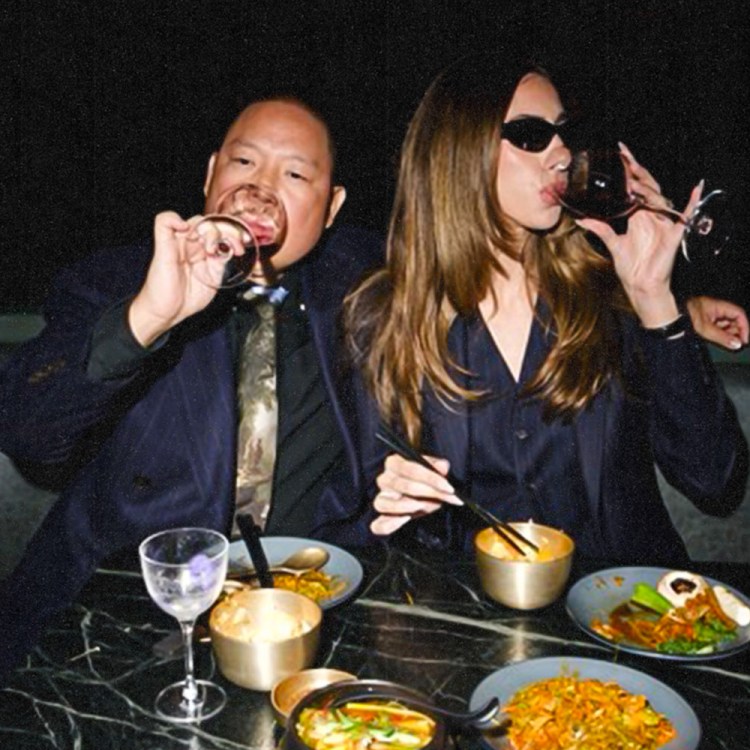
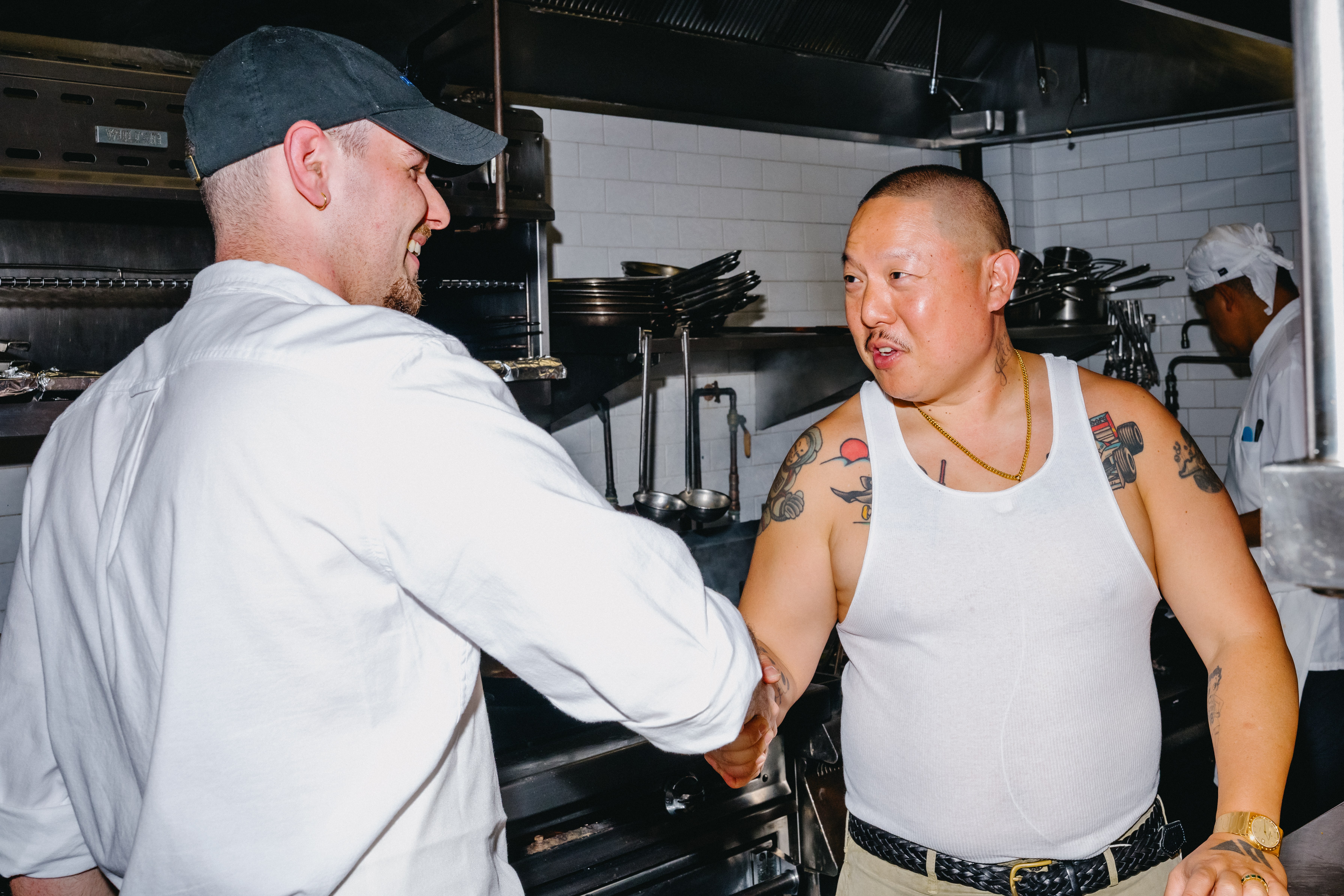
Amid what already feels like a busy year for Huang, with the publication of his novel, the return of Baohaus and consistent releases of the Canal Street Dreams podcast he hosts with his wife Natashia Perrotti, he’s decided to bring back Huang’s World, this time with Complex Family Style. Co-hosted by him and his wife, the first season of the revival takes them to restaurants around New York, featuring food and chat with friends of their universe, with the kind of idiosyncratic flair that’s characteristic of all his past work. It’s somewhat refreshing to see a food show inextricable from the identity and perspective of its creator, in contrast to the deluge of short-form food videos where the creators are often interchangeable. In an episode set at Altro Paradiso, Huang is in every shot in the back of the kitchen, asking questions and providing commentary while a steak gets beautifully seasoned and seared. Tons of people go to Altro Paradiso with a camera and a dream, but no one does it his way.
To commemorate the show’s return, I caught up with Eddie Huang and Natashia Perrotti to hear more about the experience of bringing an old show back to life, the lessons of aging and the power of co-hosting a show with your life partner.
Minh Tran: It’s been a wild year, from the return of Baohaus on St. Mark’s, to the publication of your novel Come Undone, to hosting readings of your screenplay Tuna Melt in partnership with Substack all while continuing to co-host Canal Street Dreams with your wife Natashia. Why add another piece to your overflowing plate?
Eddie Huang: I think the truth is that my interests oscillate. For about 10 years, all I wanted to do was write. I didn’t want to cook. I didn’t want to travel. I just wanted to hike, box and write. I was working through a lot of personal issues I’d neglected, and I couldn’t do anything until I exorcised that. Putting out Come Undone was the final act of that arc, and I’m honestly not writing much now. I want to cook, I want to travel, I want to move around and that’s what Huang’s World allows me to do.
MT: For our readers who might be unaware, Huang’s World was a travel show that originally aired on Viceland in 2016. For your return, you’ve partnered with Complex Family Style. How important was it for you to retain the name, as well as your backlog of episodes?
EH: Well, the original name of the show was Fresh Off the Boat and it began as an internet travel show on Vice Munchies. Then Shane [Smith] and I sold the name Fresh Off the Boat to ABC for the sitcom and went with Huang’s World for the hour-long cable version on Viceland. This time with Complex Family Style, I chose to return to my internet roots where I originally had the most fun making the show. Keeping the name wasn’t important to me, that’s important to the market and it enabled me to make the deal. What’s important to me was that I got creative freedom to make the show in my vision, and that’s what Marc Fernandez at Complex has afforded me.
MT: The previous iteration of this show got kind of wild. There was plenty of travel, physical activity and drugs involved, in the vein of a Taiwanese Hunter S. Thompson. Ten years later, you’re older, (hopefully) wiser, a father and co-hosting this show with your life partner. How has aging altered your approach? And are you still interested in giving this run of episodes a punch of that older flavor?
EH: This show was NR for most of its run on the internet. There were insane episodes where I did nitrous in China, lost my mind in Russia, did a food tour of Miami on the Bang Bus, ended up fighting white supremacists in Italy, etc. Like Blake Lively said in The Town, “We really smoked it to the filter, didn’t we, Dougie?” It would be dishonest to pinpoint in retrospect exactly why I was so wild, but what I can say with a lot of truth is that I like myself now. I think that has a lot to do with change, and of course a lot of that happened through my relationship with Natashia. I won’t be doing nitrous or anything I’d be embarrassed for my kid to see. Which means it’s probably still fine to fight white supremacists.
MT: According to a print interview in Complex, this batch of episodes hit buzzy restaurants in New York, from the Russian Tea Room to Bistrot Ha to Altro Paradiso. Very different from eating Trini doubles in the barber shop and Tostilocos in San Diego. As you’ve gotten older, and as your bags have gotten bigger, have your tastes changed as well?
EH: No. This is a trap question and you know it, but I’m gonna answer it extremely honestly and clearly. I have always pushed to highlight immigrant restaurants and working-class establishments. This season we go to Kisa, which is a taxi cab driver restaurant. We also go to Phoenix Palace, opened by Cory Ng, a Chinatown native who I met when he was still working at the Kam Ya Jan warehouse. But it’s very narrow and limiting to think the reason I’m going to The Russian Tea Room or Altro Paradiso is because “my bags have gotten bigger.” What I’ve realized with age is that immigrants have something similar to what people refer to as “punk damage,” this idea that you have to limit yourself and remain averse to growth or change because you came up in a subculture or immigrant community. I was curious about these places and want the show to be a vehicle for people who perhaps feel out of place at a restaurant like the Russian Tea Room. Maybe they see us there and give it a shot. It’s also important to highlight chefs like Anthony Ha who came up from being a dishwasher to taking over the downtown New York food scene. Sure, he serves food that could be considered high-end or for the nouveau riche, but I think it’s extremely limiting to expect me to only eat trini doubles and tostilocos. I sold a sitcom about my family at the age of 30, I been had money, this is nothing new, my g. I think what’s changed is that I’m not embarrassed about it and want other immigrants to want more for themselves as well.
MT: How does co-hosting this show with Natashia affect the way you might’ve done things in the past?
EH: I’m a lot more at ease. When there’s goofy shit happening on set, she sees it, I see it and we can laugh about it. It’s incredible how therapeutic a simple, “You’re not crazy” from Natashia can be for me.
MT: How does hosting this show with Eddie differ from co-hosting the podcast you do together? What roles do you guys play on set for each other?
Natashia Perrotti: I don’t think hosting Huang’s World feels distinctly different from hosting the podcast. Hosting Separate Bedrooms, which eventually evolved into Canal Street Dreams, gave me the foundation and confidence to step into a role where I’m not just alongside Eddie but actively co-hosting and contributing to the conversation.
In earlier episodes, I was much more shy and reserved. I was often smiling, giggling and letting Eddie take the lead rather than really inserting myself into the conversation. Over the last six months, though, I’ve found my voice. I’ve become more comfortable taking up space, challenging Eddie, bringing my own perspective and trusting that I have something meaningful to contribute. I think that’s been a really natural but important evolution for me, both personally and professionally.
With Huang’s World, there was an added layer of responsibility because I understand how beloved this show is to so many people. I felt a real responsibility not to disappoint the audience, Eddie or myself, but I also didn’t want to come in trying to recreate something or fit myself into a version of the show that already existed.
I wanted to bring my own personality and perspective while also giving the audience an opportunity to see Eddie in a different light. I think there’s something really interesting about seeing him in conversation with his wife, seeing the dynamic between us and getting a glimpse of the person behind the public persona. We have a relationship that is funny, complicated sometimes challenging and full of its own history, and I think that naturally brings another dimension to the show.
MT: Has he made you do anything crazy so far?
NP: Having me co-host a travel food show with him. Going to work with my husband and having to perform on camera with very little notice is probably top three craziest things I’ve ever done in my life. Maybe next season he’ll up the ante.
MT: Based on an episode I saw of you guys at the Russian Tea Room, this run feels more stylized, with an emphasis on visuals that stand in contrast to the more verite, documentarian approach to the original Huang’s World. Since the show’s original run, you’ve gotten a fair share of directorial work under your belt. Is this the way you always envisioned it to be?
EH: For sure. I’ve directed two full-length features (Boogie and the 2024 documentary Vice Is Broke since the last time I endeavored to make Huang’s World. I didn’t go to film school, so I’ve grown up as a director in public on each project, and getting to take that toolbox back to the format I started with was really exciting. It’s still verite; we don’t stop rolling, we break the fourth wall, but it’s intentional. I think the difference is that it’s controlled. I’m layering the image, we’re mixing media with the Arri Alexa, still photography, Super 8 footage, and we trust the audience by breaking away from faces. That was the biggest thing I wanted to change from the original Huang’s World and most other food shows. When people are talking, the camera is almost always either archival or on their face. I told the DP to shoot away from action by focusing on hands, feet and static objects during conversation, and I think it adds a layer to the storytelling.
NP: The original Huang’s World had such an incredible rawness to it. It felt like you were being dropped into someone’s world without a lot of interference, and I think that was part of its magic. There was something really beautiful about that documentary approach. But I’ve always been interested in the intersection of culture, fashion, food, art and the environment. I love when a place has a very specific feeling, and I think the visuals can communicate something that dialogue sometimes can’t.
MT: What’s a dream spot you’d like to explore around the world? What’s a dream spot you’d like to explore in New York?
EH: I’d like to go to Morocco. For some reason it’s just always been the dream. In New York it was The Russian Tea Room.
MT: What’s next? Or more aptly, what’s left to do?
EH: Ha. I want to direct the adaptation of Come Undone. I get that done, I’m going to take a very, VERY long break.
More Like This
We're always on the scene eating, drinking and traveling near and far to bring you the best of what's happening out in the real world. Sign up for IRL now.