Dealing with guest expectation versus volume reality when it comes to pricey beverages is a challenge that bartenders often have to manage. Glassware plays a significant part in the look of a particular serve, but the more generous the vessel, the more paltry the drink may seem by comparison. According to Piaget’s theory of conservation, we should understand this concept from about the age of seven. But in the context of making sure we get what we pay for, we often don’t.
“I had many instances of customers complaining that Manhattans were being poured short when I was bartending at an upscale restaurant that had decided to buy a larger-format cocktail glass because it ‘looked nicer,’” says William A. Santiago, brand ambassador for Ron del Barrilito, who eventually had to walk a manager through the specs and demonstrate the excessive lip that remained when the proper proportions were poured in the huge glass.
“We often have people complain that they paid a certain amount for a half-full glass when they order an Old Fashioned or a neat pour,” says Caley Shoemaker, founder of Santa Fe, New Mexico’s As Above, So Below Distillery. “Even with proper glass choice and sexy ice, two to two-and-a-half ounces just doesn’t compute with some.”
TikTok and Reddit are also littered with ways that bar staff can tease a “stronger” drink for patrons who protest. These include miming that a drink has been re-made, including a new glass and ostentatious garnish, to filling a cocktail straw with a tiny amount of spirit so that the initial sip smacks of booze.
“People are very concerned about what they’re getting for the money spent,” says Adrienne Cooper, sommelier consultant for A Barrel Above. But there’s always been a disconnect between what people pour for themselves at home versus what they’re served when they’re out.” This is especially true following the pandemic, when at-home bartending became the necessary norm. Just because a wine glass can easily accommodate half a bottle doesn’t make it one drink.
Value is one issue, but when it comes to helping people understand how much alcohol they’re actually consuming, there’s also a disconnect between perception and reality in terms of what qualifies as a single drink. Data shared on Understand the Standard, an initiative recently launched by Responsibility.org, reveals that while nearly 85% of consumers believe they drink responsibly, only about 25% can accurately identify what qualifies as a unit of alcohol.
What’s in a Drink and Why It Matters
Individual alcohol tolerance is highly subjective based on several internal or external factors. But understanding what holds up in court, so to speak, is important. According to the National Institutes of Health, one unit of alcohol includes 12 ounces of beer at 5% alcohol by volume, five ounces of wine at 12% ABV, or 1.5 ounces of spirit at 80 proof, or 40% ABV. What this means is, within a single glass — and lately within a single can — we are often consuming more than a single drink.
Consider that most beer served on draft comes as a pint, which is 33% more than a 12-ounce bottle or can (and 66% more in the case of an imperial pint, which is 20 ounces.) Many cocktails begin with 1.5 to two ounces of a base spirit before additional spirits or liqueurs are added. Never mind that IPAs and beers labeled as double or triple often skew much higher than 5% ABV and barrel-strength or navy-strength spirits can go as high as 130 proof. We’re also in a bona fide Martini renaissance, a cocktail whose basic specs often translate to two drinks for the price of one. In the wine camp, most reds clock in higher than the 12% ABV standard — a glass of Cabernet Sauvignon will basically always pack a larger alcoholic punch than a glass of Sauvignon Blanc. Plus, depending on the venue, a house pour may begin at six ounces, with a nine-ounce option available. Again, this doesn’t mean it’s one drink in the eyes of the law.
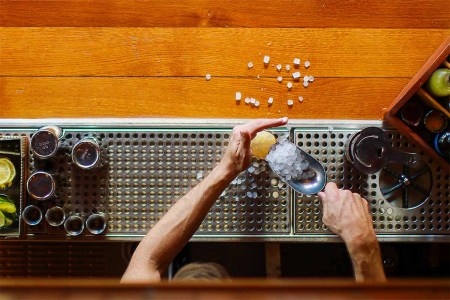
Why “Less Ice” Doesn’t Equal More Booze
The amount of alcohol and ice in your drink is there for a reasonIn an era of people generally drinking less, we may pay attention to the ABV of a given alcoholic beverage, but how often do we actually pay attention to how that ABV, combined with serving size, translates into actual alcohol consumption?
“It’s a math problem,” says Erin Hildreth, vice president of communications at Responsibility.org. “Drinking responsibly could mean so many things to people, so getting them to start thinking not only about how many cocktails they’ve decided to drink tonight but actually how many drinks that is, has to do with safety. It has to do with education and people being able to make educated decisions.”
Understanding the Standard
To that end, Responsibility.org recently launched Understand the Standard, which invites people to do the math for themselves and “pour” a beverage to see how many drinks it actually qualifies as.
The interactive module is equal parts simple graphics and basic algebra, with information given about the kind of drink you’re pouring and its ABV. You click to virtually pour out the beverage, with timings that amount to about a second per ounce, which feels pretty comparable to the real time it takes to actually pour liquid from a bottle or can. “The impetus was giving people a piece of education that maybe they had never thought about before,” Hildreth says. The module is specifically targeted for bartender education and drunk driving prevention but is available to anyone curious.
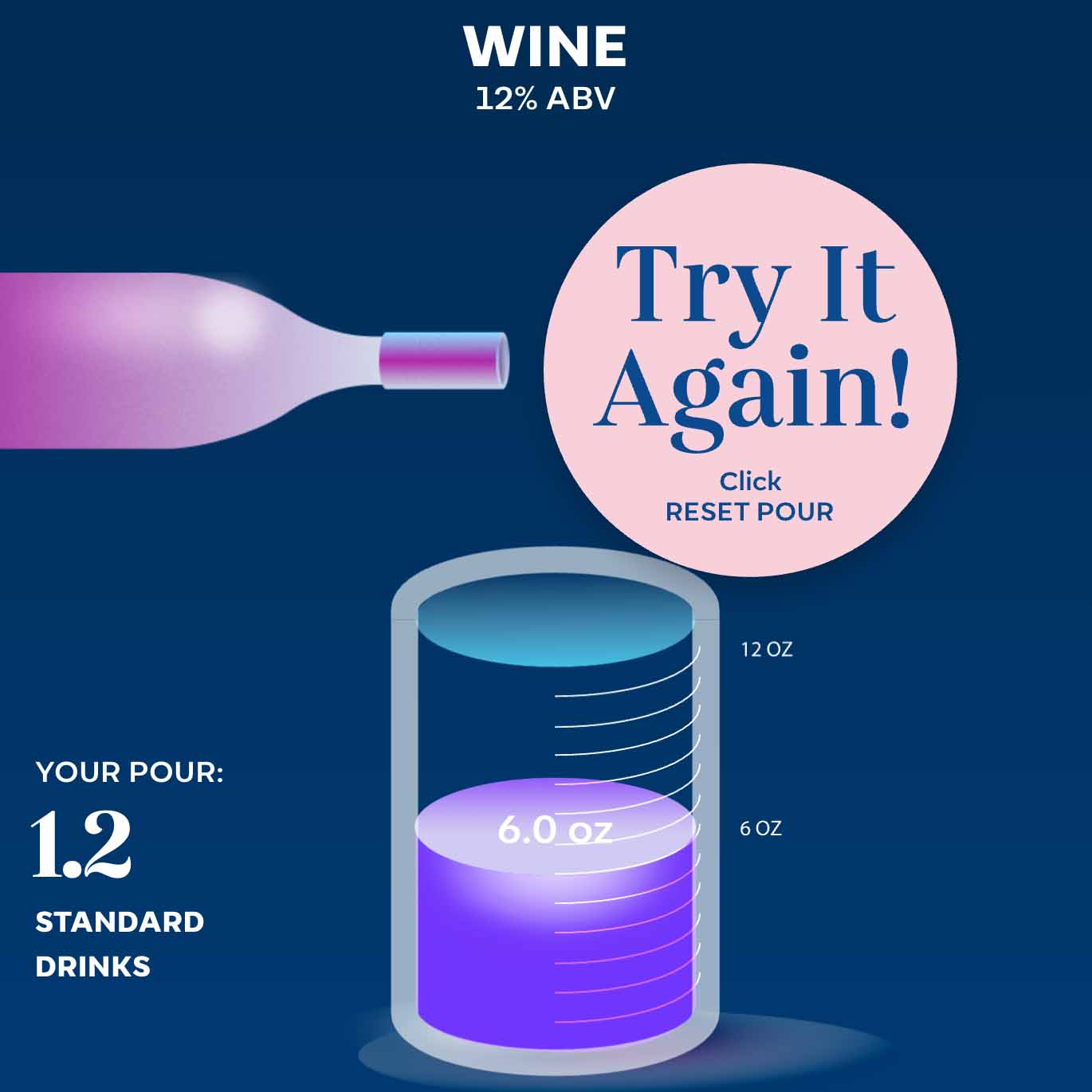
Most of the pours the module takes you through adhere to the standard ABVs: 5% for beer, 12% for wine and 80 proof for spirits, but there is one pour that tests participants on their ability to take those standards and apply logic to a product that’s an outlier in terms of its ABV. It’s exactly twice the ABV of the standard for the category, for which consumers would be expected to then pour half the standard amount. Less obvious algebra for a 15% wine versus one that’s 12%, for example, would be potentially useful here, but it’s still a handy tool for bringing attention to the math involved in tallying alcohol consumption. The module also includes a ready-to-drink example, which is especially vital given the fact that the RTD category is trending both boozier and larger-format, where single cans can equate to two or three drinks in one.
The hope is that the thinking is easily applied in real settings. “Most of the time, the information is available to you,” Hildreth says. “A lot of bars are even starting to put that information on cocktail menus because it’s something that resonates with younger drinkers who are trying to drink a little bit less and are more interested in that information.”
What the module doesn’t include is a side of judgment. “There’s nothing wrong with having a lovely cocktail that maybe is more than one standard pour, or a pint of beer, or a second glass of wine,” Hildreth adds. “The important thing is that you know what you’re putting in your body.”
Meet your guide

More Like This


The Charge will help you move better, think clearer and stay in the game longer. Subscribe to our wellness newsletter today.