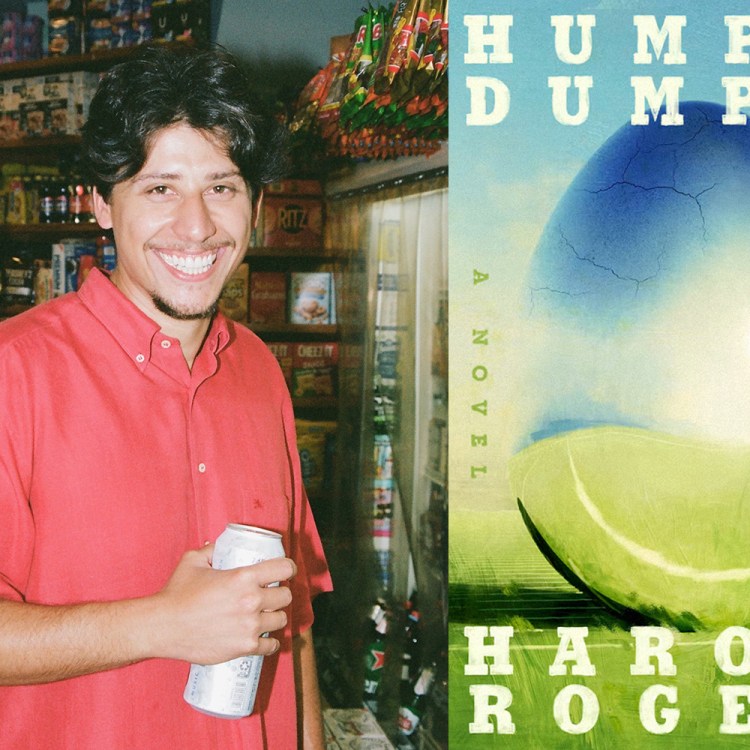
I like the way Harold Rogers speaks. He’s very laid-back, which belies his quite serious preoccupations with ambitious literature and the life of a novelist. His welcoming, lax mood similarly belies the intensity of his writing.
His way with words is far from effortless. The writing on his Substack, The Annals Of Harold, has a forceful quality to it, with all its mouthy alliterations, Joycean compounds and occasional “ALL CAPS” haymakers that have the mark of someone who refuses to hold punches and believes that the only way out is through. And yet I think that’s exactly why I’m drawn to his work. It’s full of life, humor and intensity, amounting to a refreshing change of pace from the modest, understated language of a lot of contemporary literature. It’s bullishly alive, whether you like it or not.
On a rainy Thursday afternoon, I met Rogers in the Manhattan boxing gym he coaches at to talk about his second novel, Humpty Dumpty, currently out via Farrar, Straus and Giroux. It’s a fictionalized retelling of a horrific sexual assault that took place in Steubenville, Ohio, in 2012, a case that garnered nationwide attention, particularly around the role social media played in both spreading rumors about the incident as well as leaving a paper trail for the prosecution. Rogers makes use of varying perspectives and forms of text — diaries, memoirs and an omniscient, at times impish narrator whose occasional quips add some levity to an otherwise horrifying cautionary tale about masculinity and the dereliction of small-town America. We got to speak about Rogers’ modernist influences, his woes with the publishing industry after his first novel and applying an athlete’s mindset to a life of writing.
Trigger warning: the following conversation features mentions of sexual assault
This conversation has been significantly edited and condensed for clarity.
Minh Tran: This book is a fictionalized retelling of sexual assault that happened in 2012 in Steubenville, Ohio, where you grew up, but with versions of you and your family at the center. I’m curious as to why you wanted to place yourself in the middle of such a thing.
Harold Rogers: I think they feel more anxious about it than I do. I think with all my fiction, I start from a place of counterfactuals: How would my life be different if this happened? And I think that the seed for the book was: what if my parents separated? What are the factors that would have led up to me being at the center of this? Because I was a young man, right? I’ve gotten into some reckless and dicey situations. I never did anything heinous, but things could have gone differently. So I just wanted to trace the origins of catastrophe and tell the stories of my parents’ history in a way where this crime and this situation could have been involved.
MT: Something I was thinking about as I was reading this is that I think it’s so easy for some of us to view evil people as so distant from ourselves. But you’re willing to dive into that instead of moralizing and casting judgment.
HR: In my mind, there’s gradations of evil too. Sometimes, you’re tied to factors that you can’t control about yourself. I believe in freedom, but there’s also so many things that lead up to what you are and what you do and in taking another person to task, this could have been you if you had the same factors in their life. You could have done that same shit. So to just be like, that person’s evil, I’m good, and I’m gonna laugh at them from my seat in heaven, that just doesn’t seem like the right way to go about life.
MT: I remember this moment in the book from Harry’s perspective (one of the novel’s central characters), the night of the party. He sees these guys dragging the girl to the car, and they ask for his help, and in his mind, he’s like, I want to be friends with these people, I want to be liked, what am I willing to do? And those ideas feel pretty universal.
HR: Just think about all the little things that you overlook when you want to be friends with a person, and how you adjust your morality accordingly. Sometimes I’m almost too unjudgmental, where I let a lot of people get away with things, and I think that’s an attitude that gets explored in the book, this moral laxity around something horrible and how no one does anything about it.
MT: I’m also curious how you feel about your book coming out at this particular moment, especially in the wake of all the conversations around what’s happened at Cornell. There is something about the way social media figures in all of this, how “locker-room chat” has been transported to phones and group chats, giving something that’s as old as time a new dimension.
HR: What I think is most interesting about the Steubenville case is that these people left a paper trail on social media of what they were doing. I saw it live on my Twitter feed, all these people talking about what was going on, and part of the book was just my experience of seeing that there and the trickle down of the rumors, and how everyone was talking about it. I’m really interested in how people tell the story of what happened, and social media really facilitated that in an immediate way.
Alain Delon Played a Killer on Screen. After His Friend Was Murdered, The Police Came Knocking.
An excerpt from “Murder in Paris ‘68” explores how Delon, a French matinee idol, got swept up in a murder investigation at the height of his fameMinh Tran: Let’s talk about literary modernism. I watched a clip online of you talking about Middlemarch being a low key influence, but I also think James Joyce is all over this novel. There’s a way attention is drawn to the nature of the text itself that’s very Joycean, in addition to there being a new compound word every couple of pages. I’m curious how those authors have influenced your writing.
HR: I’m very interested in the whole history of literature, and I want to make a text that connects with that history but is also of and about my own time. I had a beef with an old critic, this guy who’s actually very good, Tom LeClair, but he’s 81. I sent him my book, and we went back and forth over email. He didn’t really like it, and he kind of admonished me for “social media prose,” and basically I told him that “this is not your linguistic world anymore.” I’m writing about my milieu and for my milieu, and this is our language now. Language is a new thing, and this is an experience of the world too. So I’m using these, like, Joycean compounds and these games with language, but I’m also bringing in a different kind of language. In a way, novels are supposed to be news, right? So you have to constantly bring the news of the new language. This is the language we’re using, and we’re going to bring it into literature without forgetting the tradition. And I love Ulysses, Finnegan’s Wake and all that. But they can be daunting to read, and I wanted to make a text that was, while linguistically extravagant and playful and all these things, still very readable. Also, me and the critic are good now.
MT: You know what’s funny? People love to think of Ulysses as this kind of timeless, complicated work, but I think that whoever read it in 1922 would have gotten so many references that we think of as esoteric and academically dense today because they were so commonplace in its time.
HR: What makes a work timeless is drilling it in and making it as contemporary and provincial as possible. All of Joyce’s work is just so specific to his own mind, talking about the street that he’s from in Dublin and putting it all in the book in his own deformed way.
MT: I’d call Humpty Dumpty a “big book.” It takes a lot of big swings with different voices and formal devices, whether it’s a teenager’s diary, the dad’s memoir, so on and so forth. Even if this may not be factually true, it comes at a time when trends lean toward slim novels written solely from and about personal experience.
HR: I wanted to see how all these different types of language mix together. You know, I like autofiction, but I also wanted to write a portrait of a society and see how they interact. I’m reading Dickens now, and the way he’ll write about the fucking shop sweep, where we get a portrait of this kid and his language and what he is and then he’ll never come back, it’s like he’s filling in parts of an entire society. Maybe the reason some people are turned off from contemporary fiction is that I think some American contemporary fiction gets too insular, and not in the ways where I’m speaking about being very provincial and specific. Insular in the sense of: I don’t want to talk about the whole world, I just want to talk about me right now.
MT: I also wonder if people are almost too in their heads about what they can and can’t write about. They almost become afraid to try to render someone else’s experience, so they only feel safe speaking with authority about whatever goes on in their head.
HR: I’m trying to make interesting people, and part of the fun of fiction and what’s so great about it is using your imagination to create people, right? But maybe when you get down to it, all my characters are Harold Rogers.
MT: You put out a viral substack essay earlier this year about how your first novel, Tropicália, was a commercial flop. Did that experience teach you anything about yourself, your writing, your own conception of what it means to be a novelist? The publishing industry writ large?
HR: I was so naive going into the whole process. I expected my novel to be out and then I’d watch myself become a household name. The publishing machinery works for some books, where you become the book du jour or whatever, but in 2026, that’s not the reality for most writers. You got to hustle to get your books into people’s hands, which is what I’m trying to do now. And I feel some anxiety about hustling so much. Is this part of the art? But I think it’s always been part of the art, getting it in people’s hands. Walt Whitman published his own book. He sent it to Emerson, and Emerson wrote him a private letter, and he slapped the letter right on the cover and used it as his blurb. I was glad that it went how it did because it really motivated me in a way that I think it’s going to sustain me for a long time going forward. And the people that readTropicália liked it, but not that many people read it. So I gotta get people to read my fucking book.
MT: Do you think there’s enough transparency about the workings of the business, or do you wish that people were more honest about its inner workings?
HR: You know, I was really nervous to write that piece because when I was on submission, I was trying to find any kind of information anywhere about the whole process. I couldn’t find anything, and it’s because the publishers don’t want you to talk about this shit. That’s the truth. They get upset when you do. I got $125,000 for my first book. That is not a huge advance by any means, but there’s a lot of writers who aren’t getting published and aren’t getting money for their work, and they get upset just at the fact that I got any money. There’s the publishers who want you to be silent, and then there’s all these crab barrel writers who can’t wait to attack you. And so there’s tension on both sides, and it creates a place where I’d rather not say anything. Chad Harbach just dropped The Brightness, and he got a big New York Times profile, and in it, it says “Chad refused to disclose how much he got on his advance,” which I think if you got a New York Times profile, that is some wack shit to not disclose. But at the same time, I wouldn’t want anyone knowing if I got $3 million for this book. They’ll be mad at me.
MT: What pushed you to keep writing?
HR: I think part of it was: I really do feel like writing novels is my purpose, and I just love literature. But also I don’t like to lose, you know? If they’re not gonna read my first novel, they’re gonna fucking read this one.
MT: It’s a little Mamba Mentality-esque.
HR: You know, I was a boxer for a long time. I had an embarrassing loss in the national championship my junior year of college, and I thought about that the whole summer. Next year, I was like, “I gotta win the national championship.” Losing is such a motivator. Just wanting to prove that I’m not a loser, I’m a winner. Reducing it to that is trite, but that is what motivates you and then, as you move on, you find different motivations.
MT: This book is very much about masculinity in many ways — how we perform it, how it consumes us and the failure of living up to the expectations put upon people by masculinity and patriarchal structures. I’m curious if you pay much attention to all this talk around the crisis of the literary male.
Harold Rogers: I see it vaguely. I’m not really interested in writing op-eds about the literary male or anything like that. But I think it’s always been a crisis, quote unquote, for men to find a way to be useful in society because so much of the male energy can turn into a destructive thing. If you can channel that energy into something positive, instead of destroying the people around you and bringing them down, I think that’s the purpose of what men are supposed to do. They got to find a way to be useful, especially now… Soon enough, you might not need men, you know. So you better find a way to fucking fit into this whole thing.
MT: Even though you said you don’t think about it too much, I am curious if you ever feel like there’s anything missing from the discourse?
HR: I think my book is a lot about male dereliction, but I come to it with a place of compassion and sympathy for the problem because I understand it intimately. I think it’s very easy to laugh at these loser men. I’ve heard Humpty Dumpty be called a satirical book. To me, satire is when you’re laughing at people, and there’s a few characters that I laugh at in the book, but sometimes you understand them deeper and get to the source of what makes them risible. So I don’t think it’s a satire. I’m trying to understand people with compassion, and sometimes people are so ridiculous that it’s funny. I’m not trying to make fun of people, especially like Harry Cunha (one of the novel’s central characters). Harry Cunha has my fucking name.
MT: We’re speaking in a boxing gym right now. Do you ever see anything here that informs your writing?
HR: You get a lot from boxing. The only way to get good is to come in every day and repeat the same shit over and over and over again. There’s only six punches. There’s only a few ways to move your head. You’re here at 5 o’clock in the morning, drilling. In some way, that’s the writing life. You just gotta show up every day and repeat the same thing. There’s only so many words, right? There’s only a few punctuation points. But also training clients is a great way to not be writing because you’re standing up and talking the whole time. You’re connecting with real people on a level that I think is essential to literature. I was just talking about Dickens. Bro would just walk 20 miles around London looking at people, trying to understand who he’s around. And that’s as essential to writing literature as reading the canon or anything else, just going outside and looking at other people. If you’re not interested in other people, you can’t be a good writer.
MT: Last question: Have your expectations for this book changed from those of the first?
HR: I would love to tell you that I’ve gotten more realistic, but I don’t think that’s true. Like, on release day, I wanted a New York Times review and that didn’t happen. I’ve been telling everyone I’m prepared for any kind of disappointment, but I was still kind of mad about that. But there’s more enthusiasm, and people are reading it, and that’s what matters. And at some point, I’m gonna do the thing and write a big hit. I think, I hope. I’m consistently over optimistic. It’s a good way to keep going. You need something to keep pushing.

More Like This
This article appeared in an InsideHook newsletter. Sign up for free to get more on travel, wellness, style, drinking, and culture..