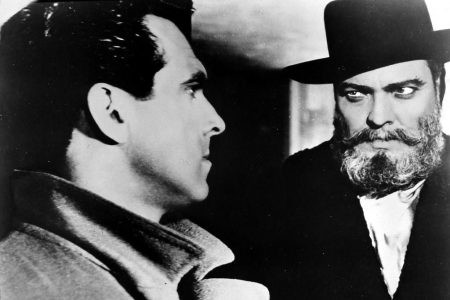
In 2018, Orson Welles’s The Other Side of the Wind was released, 32 years after its writer and director had died. There’s a long history of Welles’s films — many of which were sabotaged by studio interference — being restored to the filmmaker’s original vision, usually with the aid of film scholars and other talented professionals. (This Jonathan Rosenbaum article on the restoration of Touch of Evil is well worth reading.) But now, one of Welles’s most high-profile films is set to get a restoration in the most controversial way imaginable.
The Hollywood Reporter‘s Winston Cho reports that the startup Showrunner is planning to use AI to re-create lost footage from the Orson Welles-directed The Magnificent Ambersons. Said film was Welles’s follow-up to Citizen Kane, and studio RKO infamously snipped over half an hour from Welles’s cut of the film and altered the ending. The lost footage was subsequently destroyed; in a 2018 essay, Jonathan Lethem said of the version of Ambersons that exists, “how can it be that the themes of the film so profoundly conspire with the ache its ruination induces in the viewer?”
As The Hollywood Reporter noted, Showrunner announced that it plans to spend two years using AI to reconstruct the lost footage. However the process goes, the new version of The Magnificent Ambersons will not be commercially released, as Showrunner does not own the rights to the film.
“The goal isn’t to commercialize the 43 minutes, but to see them exist in the world after 80 years of people asking, ‘might this have been the best film ever made in its original form?’” Showrunner’s founder, Edward Saatchi, told The Hollywood Reporter. According to Cho’s reporting, the reconstruction effort will combine “a fusion of AI and traditional film techniques” and make use of archival set photos and grafting the original cast’s faces onto newly filmed scenes.
This isn’t the first case of AI being used for something like this; in 2021, NPR reported on technological efforts to use this software to “complete” an unfinished Beethoven symphony. More recently, an AI user attempted to use software to “finish” a Keith Haring painting — not understanding that the unfinished nature of the work was the point.
Based on the reporting thus far, Showrunner’s efforts sound like they will involve more craft than simply inputting a prompt into software and waiting to see what emerges. The Hollywood Reporter revealed that Brian Rose — a film buff who has spent several years working on a detailed reconstruction of the lost footage — is involved with the project.
Inside the Making of Orson Welles’s Most Underrated Film
Including stolen furniture and a possible KGB connectionBut there’s also a huge difference between the work done on Touch of Evil or The Other Side of the Wind, where there was existing footage to work with, and this, where new footage is being created using a mixture of restaged scenes and generative AI. John Huston’s performance in Wind is absolutely stunning work — and despite the film being released long after Huston’s death, when I watched it I knew that what I was watching was the work of the actual John Huston and not a digital simulacra.
Is it a shame that the footage that could have been used to create a Touch of Evil-like restoration of The Magnificent Ambersons was destroyed? Yes, for cinephiles — myself included — it’s one of the great injustices of film history. But this also downplays the fact that the version of The Magnificent Ambersons that does exist is quite good in its own right. I’ve enjoyed enough restored films over the years that I can understand the impulse behind Showrunner’s efforts. Still, the road to rectifying a cinematic injustice doesn’t run through the uncanny valley.

More Like This


This article appeared in an InsideHook newsletter. Sign up for free to get more on travel, wellness, style, drinking, and culture..