From the moment people misunderstood that “voice of a generation” line from the Girls pilot in 2012, Lena Dunham has been a lightning rod for internet criticism. A lot of it has been deserved; there’s arguably no other celebrity with more of a knack for putting their foot in their mouth than her. But for every legitimate complaint about her, there was another unwarranted jab about the fact that Dunham wasn’t a size two. The internet was aghast that anyone who wasn’t model-thin would dare show her body onscreen. Howard Stern once called her “just a talentless little fat chick.” (Even if you can overlook the fact that “little fat” is an oxymoron, it’s still a disgusting thing to say.)
There was so much discussion about Dunham’s body during the Girls era that when it came time for her to cast her new series Too Much (which is streaming now on Netflix), one that’s based on her own love story with her husband Luis Felber, she opted to cast Megan Stalter of Hacks fame as the lead instead of playing the part herself. As she told The New Yorker, “I was not willing to have another experience like what I’d experienced around Girls at this point in my life. Physically, I was just not up for having my body dissected again.” And yet, despite her best efforts, here we are, still having the same conversations about her character’s body that we were having more than a decade ago.
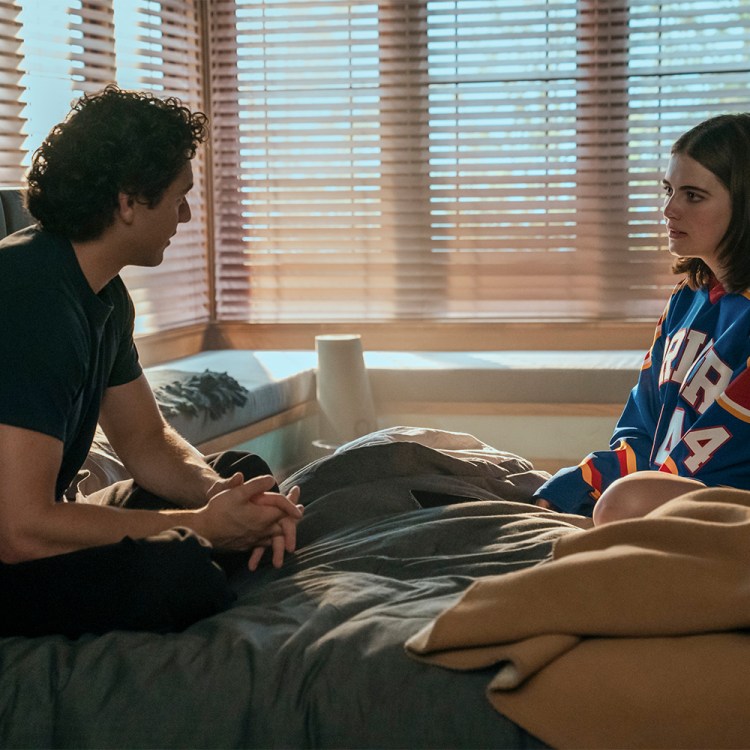
Too Much follows Jessica (Stalter) across the pond to London after she experiences a bad breakup in New York. Once she gets there, she meets an indie rock musician named Felix (played by Will Sharpe), and the two share an instant connection. The 10-episode series chronicles the ups and downs of their relationship as they fall in love. Some critics have praised the fact that the show never mentions Jessica’s weight; it’s a rare instance where an overweight woman on television is simply allowed to live her life without her size or the impact it has on her life being a central storyline. As one review noted, “I feel weird writing about this, but finally, finally, finally we get a lead female character who is fat, but that has nothing to do with the storyline or her identity. Her weight is inconsequential to her professional and personal life…She never once complains about her weight or makes a joke about her appetite. She takes her space. And she takes her boyfriend’s jacket when he offers it, even though he is smaller than she is.”
Other outlets, however, felt that Dunham missed an opportunity for some more overt body positivity. “Perhaps most disappointing to me, as a fan of Girls, is the show’s tenuous grip on the reality of the body,” The Guardian‘s Adrian Horton wrote. “It is refreshing to see Stalter, a plus-size actor, play an unabashed character who generally gets what she wants, and whose romantic rivals are played by [Emily] Ratajkowski, the epitome of conventional hot on Instagram, and the French movie star Adèle Exarchopoulos. It also feels a bit disingenuous to not acknowledge appearances at all, particularly when the culture is regressing back to the eating disorder-riddled ‘thin is in’ of the 2000s. During one early sex scene, Felix lays a hand on Jessica’s bandaged stomach — always hapless, she burned herself — but does not grab her, as if he respects her curves but does not crave her, as if they are beside the point of attraction.”
First of all, that’s a total misreading of that sex scene. It’s not that Felix “does not crave her”: Jessica is recovering from a burn to her stomach that was severe enough to land her in the hospital, and he’s trying not to hurt her by putting too much pressure on her wound. He even says as much, multiple times, asking her if she’s okay and making sure she’s not in any pain from the burn she had suffered less than 24 hours prior. That’s got nothing to do with a lack of passion; it’s a simple courtesy that shows he cares about her well-being. He goes on to do a whole lot more than “grab her” many times in subsequent episodes, and the assumption that his tenderness the first time they have sex is a result of some lack of attraction instead of concern for her physical comfort says more about the writer’s own preconceived notions about fat people’s ability to attract non-fat partners.
What Is Body Neutrality and What Does It Have to Do With You, A Man?
Body neutrality seeks to offer a more realistic, nuanced alternative to the body positive movementIn fact, there’s plenty of chatter online about the fact that it’s “unrealistic” for a woman who looks like Stalter to date a man who looks like Sharpe. What’s most frustrating is that a lot of those complaints are coming from women who share Stalter’s body type, displaying the kind of internalized fatphobia that comes from growing up bombarded with media telling you you’re ugly or lazy. “It’s very unrealistic,” one Redditor wrote. “A fat woman making a super hot indie SINGER go crazy??? Musicians get flirted with all the time, they could have anyone they want, why would he ever choose her? Cuz she’s funny? That’s it? It’s very unrealistic. Oh, but they’re SOO progressive for making the main character a fat chick and not mentioning it in the show and for having a guy interested in her. I don’t care. Its so fantastical, I can’t see it.”
Fat women on TV (and in real life) are damned if they do and damned if they don’t. Why can’t they simply exist, like all the schlubby male sitcom characters who married hot, conventionally attractive women? No one bats an eye when a man dates “out of his league,” but when a woman does it, people rush to insist no good-looking man would ever be caught dead with her.
Believe it or not, there are plenty of men who are attracted to bigger women, and there are plenty of women who are both fat and completely confident in their looks. Just think of how many thousands and thousands of thin women get boob jobs or Brazilian butt lifts to attain the curves that come naturally to larger women and make themselves more attractive to men. As Amy Schumer put it back in 2015, “I’m probably like 160 pounds right now, and I can catch a dick whenever I want.” (The average weight for American women, by the way, is 170 pounds.)
The fact that Jessica’s weight never comes up in Too Much is refreshing, but the problem is that here we all are, still talking about her weight. Even if well-intentioned people demand it be addressed on the show in the name of body positivity, that still signals that she’s some sort of “other” — that her weight defines her, that it’s an elephant in the room that needs to be explained somehow. When will we get to a point where a fat woman appearing on a TV show is a total non-issue? I yearn for a day when an overweight female TV character comes along and her weight isn’t even a conversation topic, when people can just see her as a person and focus on her story and zero thinkpieces are written about her size.

More Like This




This article appeared in an InsideHook newsletter. Sign up for free to get more on travel, wellness, style, drinking, and culture..