A couple of things Rolex doesn’t often do: 1) release complicated watches 2) name one after a nickname given to one of its vintage references by the collector community.
Well, the Rolex of the 2020s, we’re learning, is a very different beast than the Rolex of the past few decades. With emoji date wheels and brightly colored lacquer dials now becoming the norm, it was only a matter of time before the Crown took yet another hard left turn and echoed its midcentury catalog with a calendar watch. Here, finally, are the results. (Also — we sort of asked for this one. Check it out.)
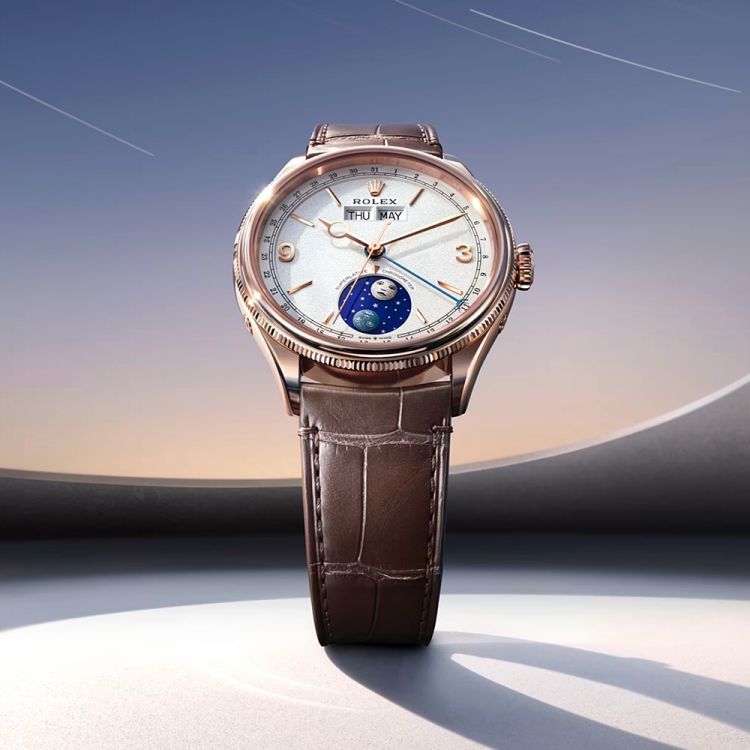
Meet the new Perpetual Padellone, an instantaneous annual calendar available within the Perpetual Collection, where the dressy 1908 can be found. If you recall that collection from 2023, you’ll recognize the new 39mm watch’s domed and fluted bezel, matching crown, and polished finishing. Inspired by classic models from the first half of the 20th century, it’s the dressiest design in the brand’s portfolio, and — like the 1908 — is not an Oyster-cased watch. (Though it does, like the 1908, feature 50m of water resistance.)
What the heck is a “Padellone,” you might ask? Back in the 1950s, Rolex briefly made two full-calendar models that displayed the day, date, month and moonphase. The first of these, the non-Oyster ref. 8171, has since been given the nickname “Padellone” by collectors, meaning “large frying pan.” (The largely flat watch, measuring 38mm in diameter, was decidedly large for the time.) Since the cessation of production of the ref. 6062 — the watch’s Oyster-cased successor — in 1953, Rolex has offered several watches with various calendar complications: the Day-Date from 1956, the Sky-Dweller (an annual calendar) in 2012; the Cellini Moonphase in 2017.
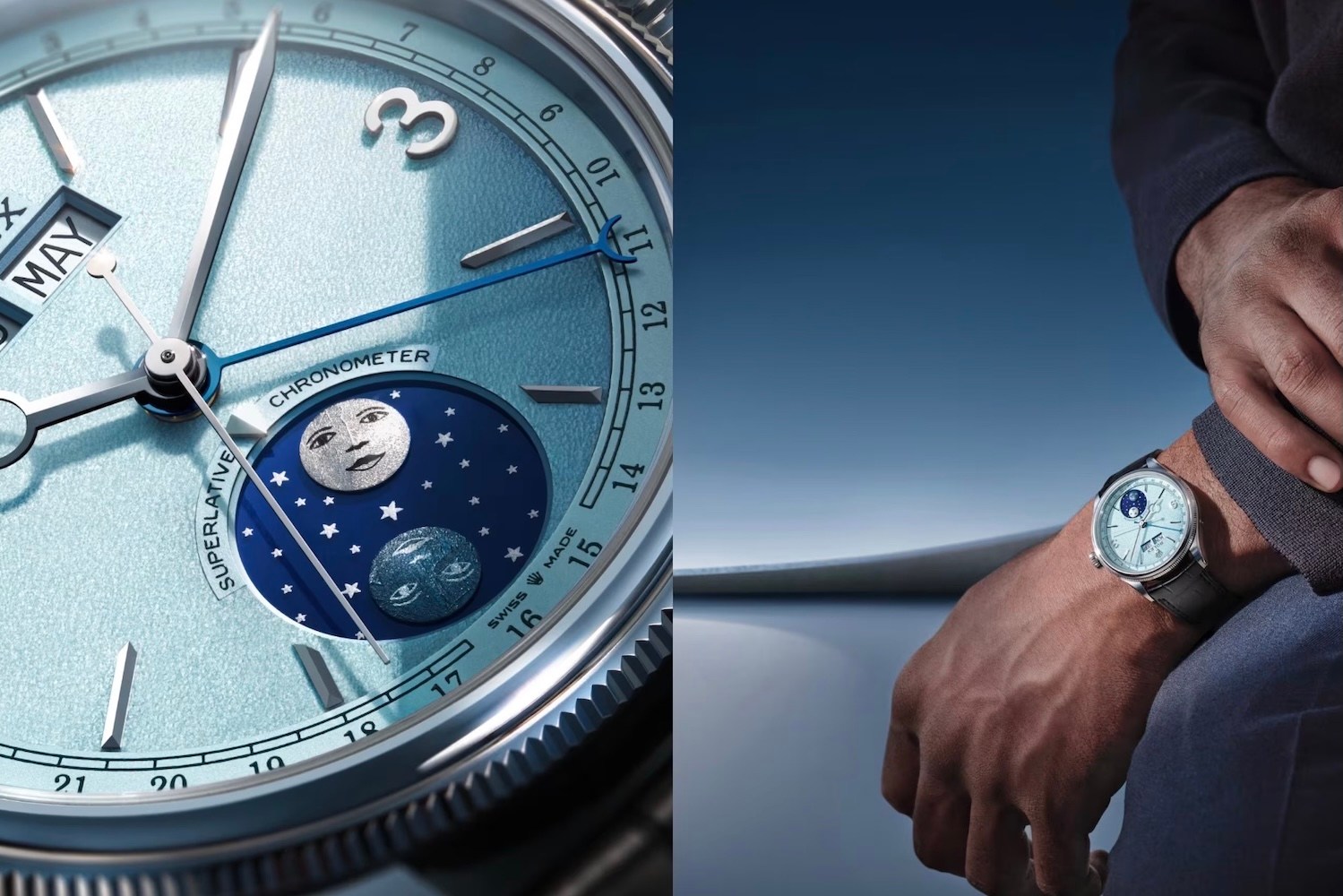
But the Perpetual Padellone represents the first time the brand has offered a traditional annual calendar with day, date and month displays that do not require manual adjustment over the course of a full calendar year, except at the end of February. (The Sky-Dweller, while technically an annual calendar, utilizes a unique indications/correction system that puts it somewhat out of the realm of more traditional annual calendars.) Moreover, the Perpetual Padellone is an instantaneous annual calendar, meaning that all displays change instantly at midnight.
Back in the mid-20th century, full (or “complete”) calendars were rather plentiful, with myriad Swiss brands (including Rolex) offering them in one form or another. Often, the time, day, date, and month displays were joined by a moonphase display, lending these watches a dressy character. Correctors in the side of the case, activated by a sharp tool, were used to advance the various displays at the end of each month. Because perpetual calendars — which effectively adjust themselves throughout the year — were so expensive, these full calendars offered a more affordable entry into complicated watchmaking. Then, in 1996, Patek Philippe introduced the world’s first annual calendar — a kind of “in-between” step along the continuum of complete to perpetual calendars. Since then, numerous watchmakers have offered one.
The Best Watches of August 2026
A surprisingly strong month closes out the summerThe Perpetual Padellone combines several exciting features in a single model: 1) the still-recent Perpetual case; 2) an annual calendar complication 3) a whimsical dial design that serves as a departure from more typically utilitarian Rolex fare 4) a fresh movement based upon technology found within the Land-Dweller collection 5) aesthetics and naming convention inspired by vintage midcentury references. Having established what an annual calendar is, let’s concentrate for a moment on the model’s dial:
Available in 18K Everose gold with a white dial or 950 platinum with an ice-blue dial — Rolex’s signature indication of platinum-cased construction — each features a grained finish that offers a sense of depth and dynamism missing from midcentury full-calendar watches. Beginning around the periphery, an elevated ring features indices 1-31 for the date indication in black, which is furnished via a crescent moon-tipped blued pointer hand. Within this, the grained section is fitted with applied and faceted baton and Arabic indices in gold, with the Rolex coronet serving as the 12 o’clock marker. Beneath the Rolex wordmark, dual apertures show the day of the week and the month in English, while a large double-moonphase indicator above 6 o’clock — featuring moons crafted from meteorite with pad-printed faces — completes a rotation once every lunar month. Finally, a Perpetual Collection handset with an open hour hand and sword-shaped minute hand completes the picture.
This is a decidedly handsome watch. At 38mm in diameter by roughly 12.2mm tall, it’s compact by early-2000s standards, oversized by midcentury standards, and — perhaps most importantly — right on the money in accordance with 2020s trends. No doubt some will have wished for an even smaller-cased annual calendar, but while case sizes are often trending downward these days, the larger high-end Swiss maisons haven’t necessarily adopted this downsizing the way that microbrands and smaller outfits have. Still, 38mm is welcome, and there’s little doubt that the Padellone will be welcomed as a unisex model by those smitten by its good looks and compelling dial.
The Calibre 7190 movement is no slouch, either: based upon the Calibre 7135 from the Land-Dweller, it features a 5-Hz beat rate, a Syloxi silicon hairspring, and a ceramic balance staff. In addition to its high-frequency whirring, it notably includes the Dynapulse escapement, offering strong magnetic resistance, increased accuracy, and a power reserve of 66 hours. Furthermore, it uses a system that Rolex calls “Haplos” to differentiate between months of 30 and 31 days. Visible via a sapphire caseback, it’s powered by a yellow-gold oscillating weight and features Rolex Côtes de Genève finishing.

The Perpetual Padellone is available at launch in three guises: 18K Everose gold with a white dial on a matte-brown alligator leather strap with a Dualclasp; 950 platinum with an ice-blue dial on a black version of the aforementioned strap; and 18K Everose gold with a white dial on a matching Everose seven-link Settimo bracelet fitted with a hidden Crownclasp. While the leather-clad options are perhaps the dressier choices in the classic horological sense, the latter version is no doubt the standout. Ever since its rollout as an option on the 1908, the Settimo has captured collectors’ hearts, functioning as a sort of modern-day President bracelet and sprucing up the watch head to which it’s paired.
Retailing for $59,000 in Everose on leather; $66,200 on platinum on leather; and $72,800 on Everose on the Settimo bracelet, the new Perpetual Padellone is far removed, price-wise, from its Oyster-cased, Professional Collection cousins. Competing with models from the likes of Patek Philippe, A. Lange & Söhne, and others, it offers something that has long been missing from the modern Rolex catalog: a complicated, classically-inspired calendar watch with a distinctly dressy appeal.

More Like This

The world of men’s style, from the streets of NYC to the showrooms of Milan, run down weekly by writer and photographer Christopher Fenimore.