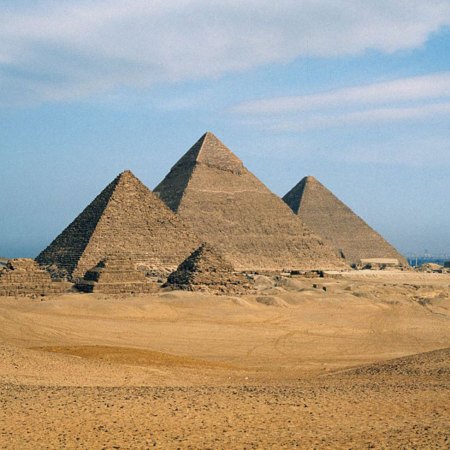
You might think that a structure that’s more than 4,000 years old would hold no secrets at this point in history. And yet, when it comes to the pyramids built by ancient Egyptians at Giza, it turns out there are still some secrets left to uncover. In a paper published in the journal NDT & E International, researchers conclude that there is a room within the Menkaure Pyramid that has eluded previous groups of scientists and explorers.
The paper’s authors stress early on that the methods that they used to locate this space had no physical effect on the pyramid; instead, they used technology like ground-penatrating radar, which has been very useful to archaeologists as they map ancient and historic structures without disrupting the landscape.
As the researchers scanned the pyramid’s eastern face, they noticed something out of the ordinary. In their paper, they described it as “two anomalies directly behind the polished granite blocks, which would indicate the presence of air-filled voids.”
The paper also helps explain why this pyramid may still contain some secrets, as opposed to neighboring structures. The authors note that archaeologist George Reisner explored the pyramid complex in the early 20th century, but that much of the exploration since then has focused on the Khufu Pyramid (also known as the Great Pyramid). “[N]o work has been done on the Menkaure Pyramid since Reisner’s work,” the authors write.
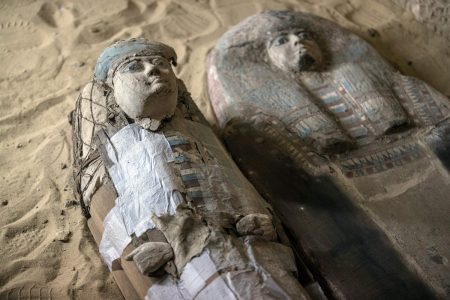
Ancient Egyptian Tombs Found Near Great Pyramids of Giza
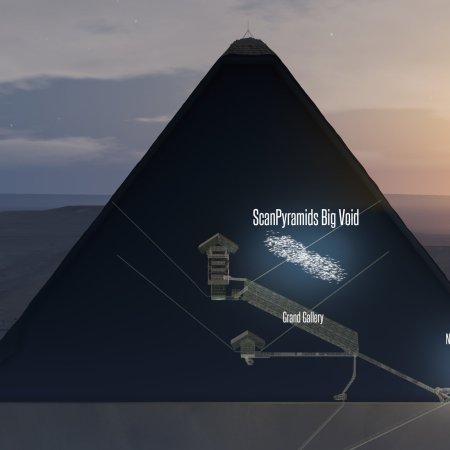
Among the relics and artifacts discovered were the mummies of two high-ranking officialsThis discovery was made as part of the ScanPyramids project, which has made several discoveries in ancient structures, including one in the Great Pyramid, in recent years. In a statement, Christian Grosse of the Technical University of Munich — one of the paper’s authors — pointed to one possible answer to the question of what this new finding could represent.
“The testing methodology we developed allows very precise conclusions to be drawn about the nature of the pyramid’s interior without damaging the valuable structure,” Grosse said. “The hypothesis of another entrance is very plausible, and our results take us a big step closer to confirming it.”

More Like This

This article appeared in an InsideHook newsletter. Sign up for free to get more on travel, wellness, style, drinking, and culture..