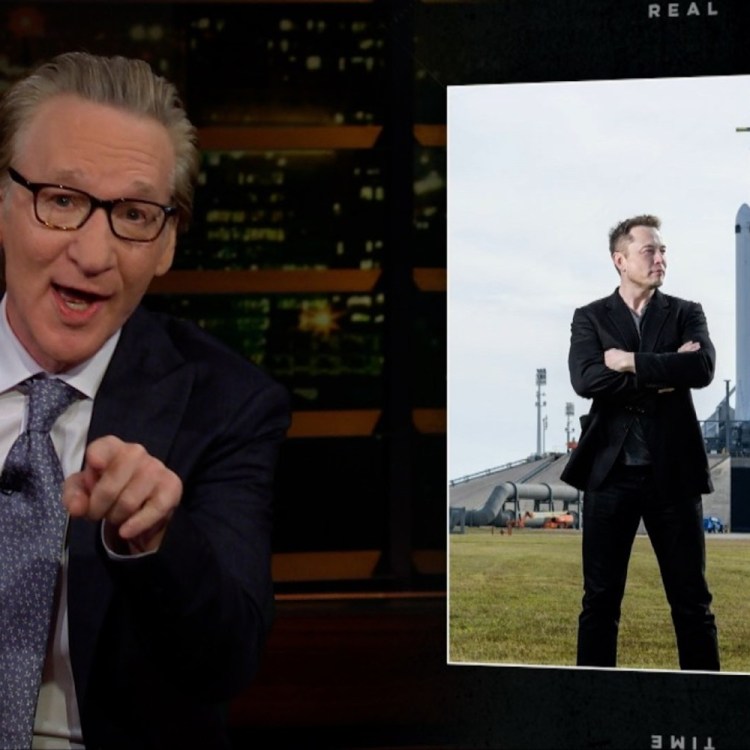
For all that Bill Maher can sound pessimistic about the future of reading in the U.S., the guy does have a lot of writers on his show. It’s one of the more appealing things about watching Real Time on a regular basis; when Maher hosted David Duchovny in 2022 to talk about his new book, it was a pleasant surprise to see a work of literary fiction on an independent press getting such treatment.
All of which is a prelude to a discussion of this week’s Real Time With Bill Maher, in which all three guests were well-known authors of multiple high-profile books. Things kicked off with the night’s first guest, Thomas Chatterton Williams, author of Summer of Our Discontent: The Age of Certainty and the Demise of Discourse. Which has been criticized, sometimes memorably.
Williams explained why he had decided to revisit 2020 in his new book. “I think there’s been a lot of cultural amnesia about this really tumultuous summer,” he explained. And, not long after that, “I think if a plane crashes, you need to examine the black box.”
Both Williams and Maher are critical of wokeness, though the former made one of the stranger claims I’ve heard about it. “There’s this idea that real wokeness hasn’t been tried yet,” Williams said, which sounded like a repurposed version of far-left critiques of the Soviet Union from decades ago. Perhaps the most interesting moment in the interview came when Maher asked Williams what his students thought of him and his ideology. Williams suggested a few possibilities; maybe they aren’t as liberal as they profess to be, or perhaps their impressions are filtered through ChatGPT.
When the interview ended, the panel began; this week, that meant that Molly Jong-Fast (author of How to Lose Your Mother: A Daughter’s Memoir) and writer and publisher Walter Kirn took to the stage. They began by discussing the Trump/Putin summit in Alaska, which was taking place as the episode was recorded. “Has Putin made any peace deals that have worked?” Jong-Fast asked. Both panelists made comments early in the discussion that seemed to annoy Maher.
Maher riffed on the president taking on new duties, including hosting the next Kennedy Center Honors. It was in this context that Maher brought up the presence of federal agents in Washington; why not, Maher asked, send them to one of the places where the crime rate is higher? Kirn argued that the federal government can do so there, as opposed to other places.
“They claim crime is down; well, let’s bring it down further,” Kirn said. Maher seemed skeptical. Jong-Fast also pointed out that the money withheld from D.C. from the federal government would go a long way to alleviate some of the issues Trump has brought up with respect to crime and homelessness.
The mood gradually grew warmer, and near the end of the discussion, the subject moved away from politics entirely. Maher brought up prominent examples of small children showing up in unexpected places; Maher is weirded out by the idea of babies in bars. (He isn’t the only one.)

Bill Maher Returned From Summer Break With AI On His Mind
There’s been a lot of news to catch up onThis week’s episode also included a few moments when the primary subject of Real Time became, well, Real Time. In his opening monologue, Maher mentioned that the federal government was looking into reclassifying weed. “And they say it wasn’t smart to have dinner with [Trump],” he quipped. Maher’s White House dinner has become a regular point of reference this year; this was understandable in the weeks that followed it, but feels increasingly repetitive at this point.
The meta element continued in the final monologue. It began with Maher riffing on how the Coldplay kiss cam saga explains the current state of the Democratic party. It included a few digs at trans people and “kids these days”-esque frustration; neither is all that surprising from Maher these days.
Unlike the reference to his dinner early in the episode, the most interesting aspect of this segment involved Maher talking about Real Time’s unsuccessful efforts to get a number of prominent Democrats on the show for interviews, including Kamala Harris. “These are all people I voted for!” he said. He went on to name Alexandria Ocasio-Cortez, Zohran Mamdani and Elizabeth Warren as prominent Democrats who he’d also be interested in interviewing, but who have presumably shown no interest in appearing on the show.
It was an interesting glimpse of the inner workings of the show. It also echoed the debate from earlier in the year over politicians appearing (or not appearing) on places like Joe Rogan’s podcast. But it also raises more questions about why politicians appear on podcasts or talk shows — are they looking for a friendly reception? To win over their audience? Maher positing himself as someone willing to criticize politicians to their faces, as he did this week, might be good for his own persona, but it might not win over a skeptical potential guest.
Other notable moments from this week’s episode:
- Maher made a Mountainhead reference in his opening monologue. Synergy!
- Maher on the federal government’s sweeps of homeless encampments in D.C.: “We’re going to get them off the streets and into the programs he just cut.”
- Maher on inflation: “Ground beef is the new eggs.”

More Like This



This article appeared in an InsideHook newsletter. Sign up for free to get more on travel, wellness, style, drinking, and culture..