What does the future of trucking look like? According to recent New York Times reporting, autonomous semis are starting to make their way across the nation’s roads. But there’s another possible answer to consider as well, one that’s less focused on who or what is driving the big rig and more on what might be powering it.
As Autoblog’s Yash Bajaj wrote this week, Toyota and Isuzu recently announced a partnership to use the former’s hydrogen fuel-cell technology in an Isuzu-designed light-duty truck. Toyota has been backing hydrogen technology for a while, including in its Mirai sedan; now, the company is working on expanding into the commercial market.
Among the advantages of hydrogen power is “the rapid refueling and energy density of traditional diesel” compared to the slower charging times associated with battery-powered electric vehicles. Bajaj also notes that the partnership involves a modular system; presumably, this means the same fuel-cell technology could be used for a larger long-haul truck down the line.
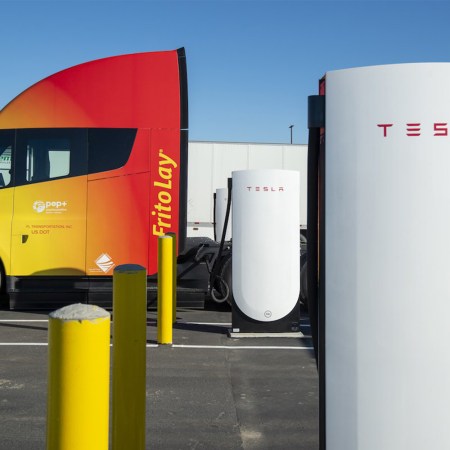
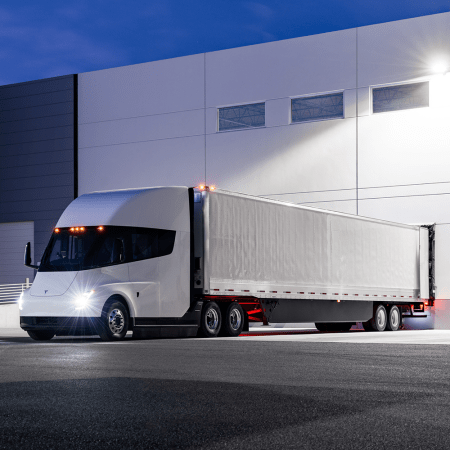
For trucking companies looking to get out of fossil fuels while also being mindful of charging speeds, another recent development could make a separate industry player more enticing. That would be Tesla, whose Semi model has been used for some soda and snack deliveries since late in 2022. In February, InsideEVs’ Andrei Nedelea reported that the company was looking to expand its network of Megachargers which power up these electrified big rigs. At the time that the article was published, only two were in operation, but dozens of sites across the U.S. were listed as “coming soon” on Tesla’s website.
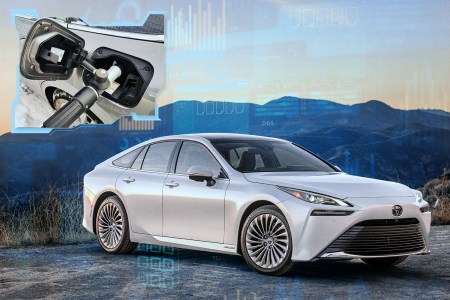
Review: Toyota Mirai Proves Hydrogen Is the Fuel of the Future — And Always Will Be
A real-world test of the sedan reveals holes in the claim that fuel cells trump batteriesMore recently, Tesla announced ambitious plans to begin making far more Tesla Semis. Inc. reported that the Semi will be available with both a 325-mile range and a 500-mile range. The cost is said to be around $300,000, with savings relative to diesel trucks coming in when fuel costs over time are factored in, a major pain point in the industry right now thanks to the war in Iran.
Will that be enough to entice commercial buyers? That will almost certainly depend on whether the charging network can come online quickly enough — but if it does, we could see the industry begin to part ways with diesel fuel.
Meet your guide

More Like This

This article appeared in an InsideHook newsletter. Sign up for free to get more on travel, wellness, style, drinking, and culture..