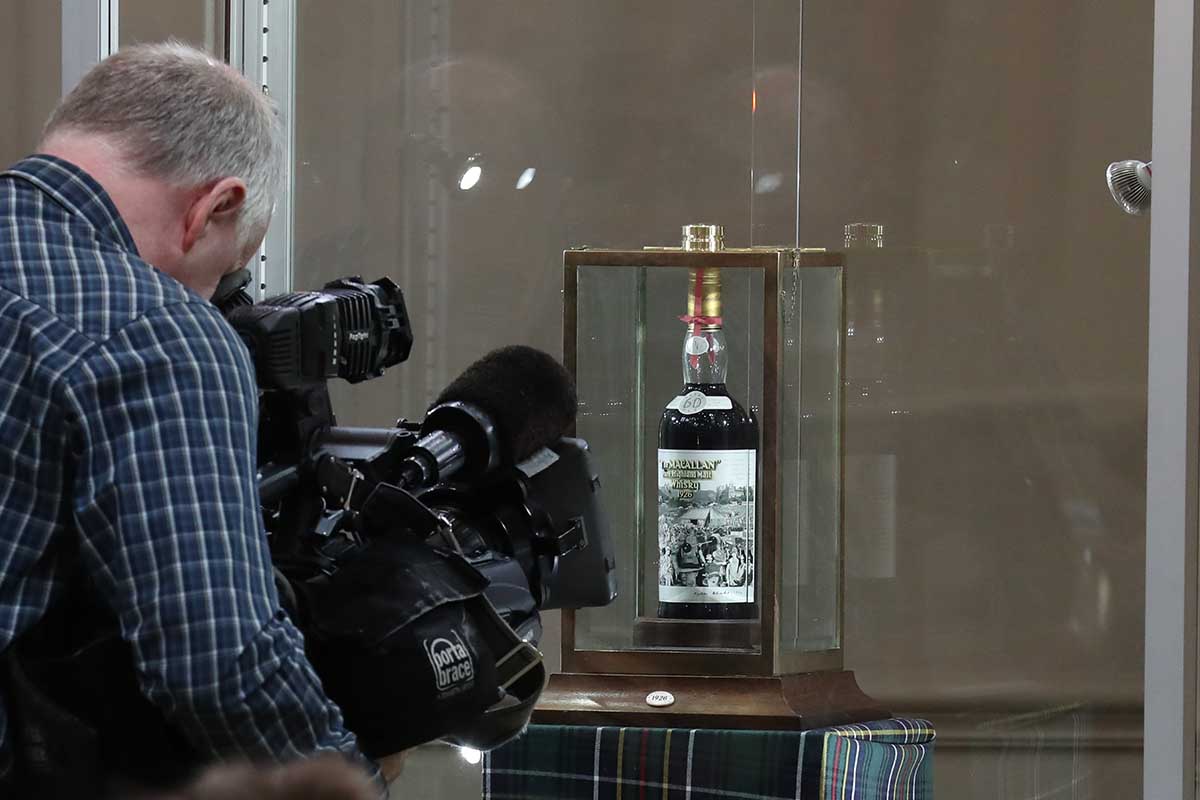
Pandemic be damned, rare whisky is still a hot commodity and breaking records on the auction market.
But counterfeit hooch is still an issue. As Ars Technica reports, physicists at the University of St. Andrews in Scotland have figured out how to test the authenticity of bottles of Scotch using lasers … and they don’t even have to open them up.
A report from 2018 suggested that up to a third of rare whisky might be fake, so any methods to counteract forgeries or improperly labeled bottles should be considered (and that includes artificial tongues and, yes, blockchain).
It’s possible to use spectroscopy to identify chemical compounds inside a bottle; the laser light is scattered into a “spectrum of wavelengths” of light that correspond to specific chemical compounds — the liquid’s unique fingerprint, as Ars Technica points out. The St. Andrews team solved the problem of the bottle altering those lasers via a cone-shaped lens; this method also works on other liquids besides whisky.
“This technique provides a way of non-destructive and non-contact detection to precisely analyse [sic] the contents without the requirement to open the bottle,” as the researchers note.

More Like This

We're always on the scene eating, drinking and traveling near and far to bring you the best of what's happening out in the real world. Sign up for IRL now.