As the lights dimmed on I Play Rocky, a new biopic about Sylvester Stallone’s struggle to write and star in Rocky, the beloved 1976 boxing crowd-pleaser, I wondered if there was someone sitting in the dark theater with me who had never seen the source material and was about to learn about it right then and there.
It’s a plausible “what if?” Not everyone has seen everything. And it’s not like the original is some forgotten masterpiece: whether or not you’ve sat through it, you know all the cliché images from the movie, like sleepy-eyed Sly Stallone with his fist in the air. Rocky is baked into the culture. Superficially, it’s the quintessential meathead movie. A dude with muscles punches his way to the top.
And yet, it’s more than that. It’s sweeter. Sadder. Some people have no choice but to fight for what matters.
Later that night, after the screening, I rewatched Rocky on Amazon Prime. It had been a minute. The music! That ending! There’s a reason it was a massive commercial and critical hit, winning Oscars for Best Picture and Best Director. It fucking rules.
As for the new biopic, I Play Rocky is a modestly budgeted, fast-paced Hollywood rags-to-riches story, as comforting as a plate of spaghetti and meatballs. Follow your dreams, you know? If it inspires one person to stream Rocky for the first time (or, in my case, the nth time), then it was worth it.
Directed by Peter Farrelly, whose career includes bodily-fluid-forward comedies like There’s Something About Mary and Oscar-winning hokum like Green Book, I Play Rocky finds drama in Sly’s journey from homeless nobody to unlikely leading man. Much of the second act revolves around exasperated producers offering Stallone more and more money for his screenplay, only for the relative unknown to dig in his heels: “I play Rocky.”
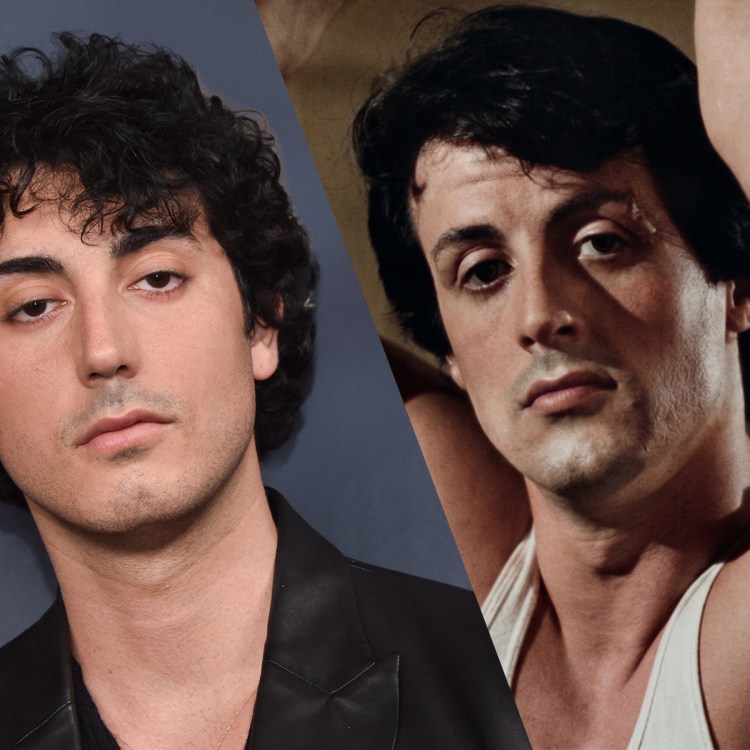
Anthony Ippolito is compelling as 26-year-old Stallone, delivering a performance somewhere between an SNL impersonation and an eerily lifelike deepfake. This is Ippolito’s second turn playing a famous Italian-American actor during the ‘70s: he was Al Pacino in Paramount+’s The Offer, about the making of The Godfather. The movie doesn’t work without him. He’s backed by AnnaSophia Robb as his wife, Sasha Czak; Jay Duplass as director John G. Avildsen; and Tracy Letts as studio exec Sandy Maddox, who begrudgingly greenlights Rocky for pennies and hates the idea of Stallone playing the title character.
Stephan James is so good, so cocky and so charismatic as then-unknown Carl Weathers, who plays Rocky’s opponent, Apollo Creed, that I sort of want him to play Weathers in movies about the making of Predator and Happy Gilmore.
The scenes where the filmmakers find creative ways to realize Stallone’s vision on a shoestring budget are fun in a “Hey, kids, let’s put on a show!” way. I Play Rocky deftly recreates iconic moments from Rocky, and watching Ippolito punch sides of beef and sprint up the Philadelphia Museum of Art’s famous steps made me long to revisit Stallone’s 50-year-old vision of positive masculinity.
When Farrelly teases Bill Conti’s epic Rocky theme, a triumphant, disco-kissed fist-pumper that builds to the musical equivalent of a transcendent runner’s high, I was floating like a butterfly.
For those of us who already know what happens to Rocky Balboa (the vast majority of humanity), I Play Rocky still offers a few surprising fun facts. Rocky, the quintessential Philly movie, was shot there because unions would have made filming in New York City too expensive. I also liked learning that Sasha was Stallone’s writing partner, typing up scripts and offering notes. Early drafts made Rocky less sympathetic, more of a brute.
Rocky is an all-timer, and its sequels, while mostly rousing, never quite match the first one’s grit. Then there’s director Ryan Coogler’s 2015 opus, Creed, starring Michael B. Jordan as Apollo Creed’s son. It’s the best Rocky sequel, hands down. I Play Rocky is part of the Rocky Cinematic Universe. I don’t know if I will ever watch it a second time, but it’s not like I’ll ever watch the legendarily bad Rocky V again.
Sylvester Stallone is 80 years old now, and still going at it. His hit Taylor Sheridan-created mob show Tulsa King is in its fourth season. He recently sat down with The New York Times’ Lulu Garcia-Navarro and talked candidly about his long career and personal struggles. He’s been such a fixture of the pop culture firmament for so long, his hangdog look and marble-mouthed cadence so easily mocked, that it’s easy to forget how authentic he is in Rocky, how comfortable he is in his own skin. He balanced toughness with tenderness in a way few actors ever had.
Consider a return to the source material
I Play Rocky’s greatest value is as a long-form advertisement for the original, and I don’t mind that. Everyone should watch it. But if you have to choose between the two, c’mon.
Honest question: have you seen Rocky? Recently? At all? Maybe it’s been a minute. Maybe you only know Stallone’s Rocky from Creed, as an old man who steps into the role of mentor (Sly, if you don’t remember, actually scored Best Supporting Actor Oscar nom for that turn). Maybe you’re a Gen-Z cinephile addicted to Criterion or a Gen-X edgelord proud of having avoided the normie-est blockbuster ever. Regardless, it’s worth revisiting today. I think newcomers and repeat viewers will be equally surprised by what they find.
To recap: Rocky is the story of a small-time prizefighter moonlighting as the world’s nicest loan shark debt collector. He’s got a crush on Adrian, a painfully shy pet store clerk and the sister of his best friend, Paulie, a drunk with dreams trapped in a dead-end job at a meatpacking factory.
Then, one day, like out of a fairy tale, Rocky gets a shot at a title fight; a stroke of dumb luck. The charismatic, business-minded heavyweight champ Apollo Creed decides to turn a fight canceled because of a contender’s injury into a schlocky spectacle-slash-cash grab: what if the champ takes on a hometown boy?
The movie remains a gritty portrait of working-class strivers trapped in dead-end jobs in crumbling neighborhoods.
Talia Shire’s Adrian is the movie’s secret engine, a quiet, insecure woman who the local men think is mentally unstable (the “r-word” is cruelly used). Shire plays Adrian as layered, with a rich inner life. There’s an awkward seduction scene after a charming date at an ice rink where Rocky backs Adrian against a wall and removes her glasses and says, “I always knew you was pretty,” a dirtbag move that is both uncomfortable and dated, but the chemistry between Stallone and Shire is so palpable, so clearly defined, that they come across as a pair of misfits struggling to connect.
Rocky makes many questionable decisions — like choosing a profession that requires him to get his brain beat in. But his patient pursuit of Adrian (telling dumb jokes is the most reliable pickup line known to man) and his immediate commitment to her and their relationship save him; it proves he’s more than just a brawler. Rocky is a hero with heart.
Shire steals every scene she’s in, but so does Carl Weathers, who is electric as Creed. Burgess Meredith, who some Gen-Xers know as the Penguin from Adam West’s campy 1960s Batman show, is also a stick of dynamite as Mickey, a cranky, no-bullshit trainer who’s the closest thing to a father Rocky has.
Meredith is in just a handful of scenes, including a heartbreaking one where two men who struggle to share their emotions do it through doors. He has a couple of immortal one-liners, including this one: “You’re gonna eat lightning, and you’re gonna crap thunder!”
Two of the most memorable scenes, for me at least, are when Rocky wakes up at the crack of dawn and eats raw eggs, a gastronomical stunt Sly does for real. That’s commitment. The other is during the final rounds of his fight with Creed, as Rocky is defying expectations, he begs Mickey to let the cut man slice open his swollen eye so he can keep landing body blows on his increasingly exasperated opponent, who didn’t know the “Italian Stallion” was showing up to fight.
Rocky Balboa is one of the most enduring and relatable symbols of 20th-century machismo, a roll call that includes John Wayne, Humphrey Bogart and Sean Connery’s James Bond. These men were strong and tight-lipped. Cowboys and detectives and action heroes. They endure, along with Indiana Jones, Michael Corleone and Tyler Durden.
But Rocky cuts a unique figure in pop culture, a brawny, mumbly, lovable hunk of meat who beats the odds for a few beautiful moments. He’s an athlete with dreams, with a partner who loves him. Life goals. In a way, Rocky is a mirror anyone can see themselves in, even though he’s a swaggering Italian-American knucklehead who dresses like a hobo and wears reading glasses. Rocky isn’t a power fantasy like Arnold Schwarzenegger’s most famous one-man armies, or Bruce Willis’s ass-kicking everyman John McClane. Rocky is instructive. Everyone should nurture his inner Rocky. He believes in himself, but he doesn’t take himself seriously. He fights the good fight, even if he knows he’s going to lose. Take notes.
The late 1970s were a time of great national insecurity; the disastrous war in Vietnam and Richard Nixon’s corrosive administration were still visible in the rearview mirror. Cultural and political wounds were healing, but the country was still divided.
The Bicentennial lifted Americans’ spirits in 1976; unlike the largely subdued 250th birthday in the summer of 2026, the U.S. was eager to celebrate the republic back then, even as unemployment and inflation bedeviled a country that felt like it had seen better days. The big cities in the Northeast were especially bleak, broke and crime-ridden. Stallone tapped into a very human emotion: hope. Rocky Balboa is an underdog, and underdogs don’t give up.
In I Play Rocky, Duplass’s Avildsen insists he isn’t making a “boxing movie” but a character study that happens to be about boxing. This bit of lore nails the core charm of Rocky, but it isn’t completely right. Rocky is a love story. A romance.
Rocky goes the distance against Creed, but he doesn’t win. The iconic final moments take place in the post-fight chaos inside the ring. As Creed is declared the winner, our hero is shouting for his girlfriend — for Adrian, who pushes her way through the crowd, shouting his name back. It is a clichéd, sentimental moment, yet it still hits. It may be even more potent today, as an antidote to our current culture’s obsession with success and winning, a repudiation of all the grindset attention goblins shouting “Hustle! Hustle!” at all costs. Rocky loses the fight, but he wins because he gets the girl. Anyone who is loved, and loves in return, wins. That may seem corny, but it’s the only way to play the game.

More Like This
This article appeared in an InsideHook newsletter. Sign up for free to get more on travel, wellness, style, drinking, and culture..