When developers add public space to a city like New York, they do so with reasonable expectations of how it will be used. They add ballfields and amphitheaters and running loops, and life fills in as expected. Trees shade lunchers. Benches host breakups. The years pass and our behavior mimics the renderings until the calendar flips to the future, and what we’re used to gives way. To my knowledge, Frederick Law Olmsted never anticipated tourists with homes 10,000 miles across the planet AirDropping photos to each other in Sheep Meadow. But here we are.
Little Island rises from the Hudson riverbed on more than 100 striking “concrete tulips.” It’s a detour from the West Side Highway, but it rewards a rambler’s spirit. If you cross the footbridge, enter the park and climb the stairs to one of its grassy knolls, you’ll earn a unique 360-degree view: Hoboken, Jersey City, One World Trade Center the Hudson Yards skyline. I normally pop through on a long run, one of the millions of anonymous visitors the park welcomes each year.
This week, my presence was more significant: I played the role of harbinger. Strapped into two different AI-powered exoskeletons from a Shenzhen-based company called Hypershell, I zipped up and down Little Island’s inclines with minimal effort. How long until the tourists who gawked at me are wearing their own? Five years? Ten?
“I’ve never felt anything like this,” I said. I’m smiling but also shaking my head, like someone who’s seen a magic trick from inches away and can’t figure it out. “Very few people in America have,” replied Brody Gordon of FINN Partners, a marketing agency that reps the Chinese company.

When we think of exoskeletons (if you’ve ever thought about exoskeletons), we tend to imagine clunky, impossibly expensive units geared toward disabilities, injury recovery or otherwise impossible factory tasks. But Hypershell, launched in 2021, is a consumer-facing outdoor brand with sexy, charcoal-shaded tackle that you can imagine pulling from the trunk of the Batmobile.
It’s the leading manufacturer in an explosive market, and it’s starting to get its flowers: the Hypershell Ultra X S, released this past spring, was named a Time Best Invention 2026 in the sports and fitness category. Over the summer, Fast Company awarded the fledgling tech a slot on its list of World Changing Ideas.
Going to Little Island was Leo Lei’s idea. A PR manager for Hypershell, he flies from China to New York every now and again and is fond of the park. I met him there on a chilly but clear Tuesday morning. The Ultra S X sat in a shell no bigger than a trumpet case, alongside the company’s latest offering, the Halo, which officially launches in 2027. While the Ultra S X straps at the hips and knees, the Halo runs all the way down to your calves. Hypershell’s marketing it as the “flagship full-leg exoskeleton for all-terrain mobility.” It’s clear they’re hoping it’s a world-beater. After a half hour of testing, I can’t imagine betting against them.
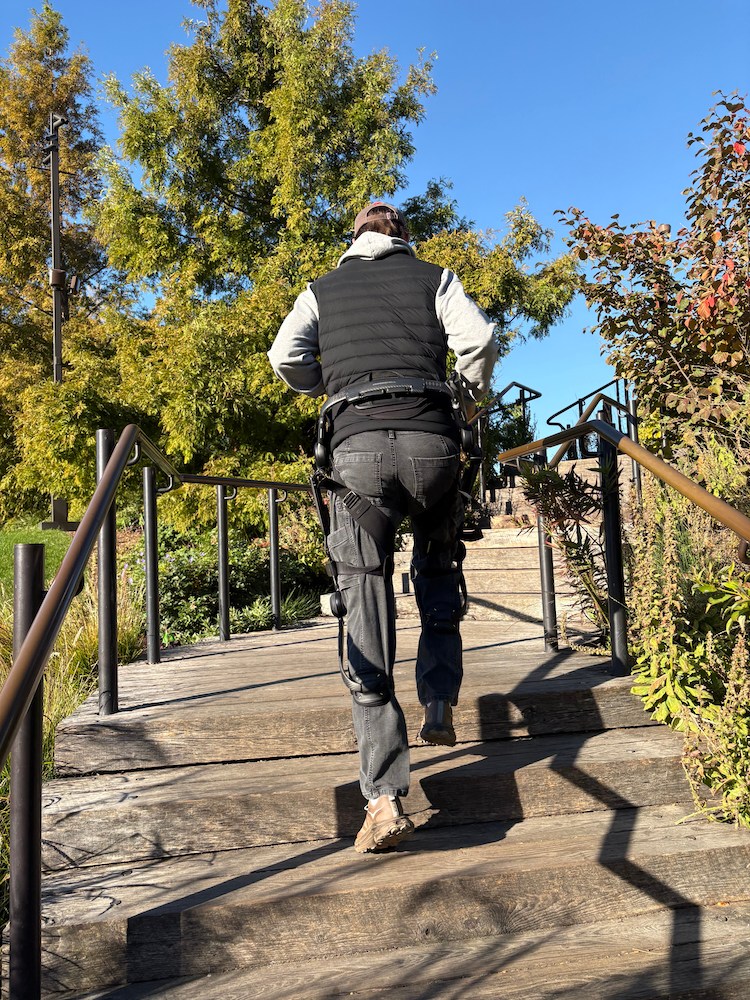
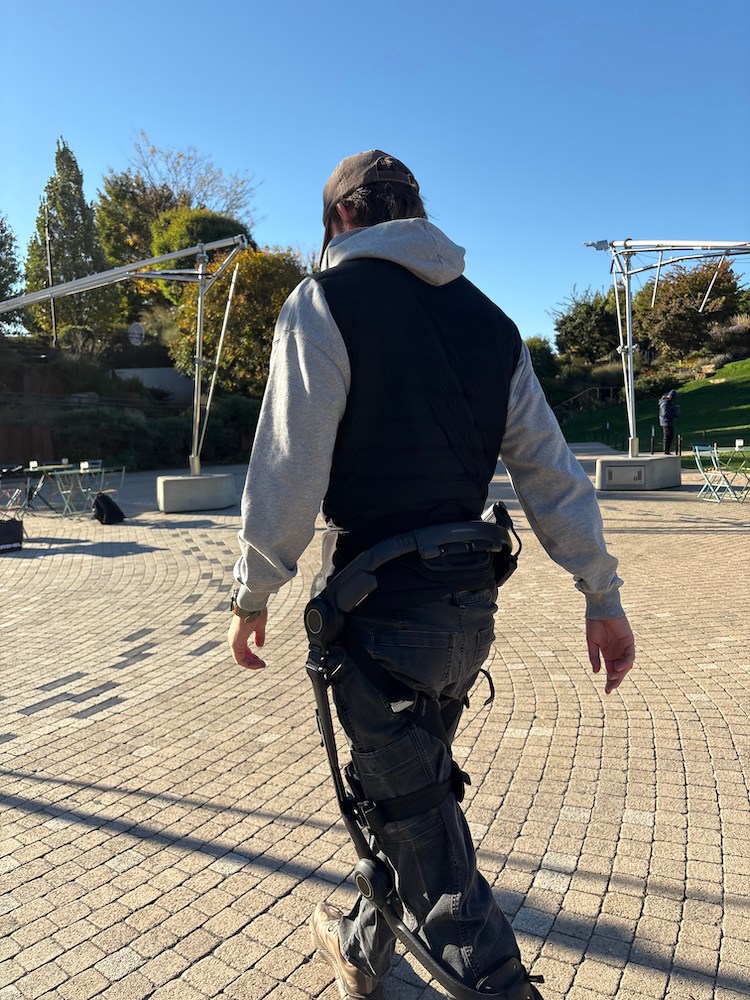
For starters, these units are surprisingly easy to put on. I’ve seen my brother and sister-in-law fumble with a car seat longer than it took Lei to suit me up. There’s a belt that buckles around the waist, plus pads that conform to your knees and straps that tighten around your thighs. The finished product was snug and ergonomic, which actually didn’t surprise me. Exercisers won’t even tolerate running shorts that chafe these days.
“You’re at 35% of Eco mode right now,” Lei told me, sharing a look at his iPhone, which was open to Hypershell’s app. “You can toggle it up if you want.”
I started roaming around. Wildest feeling. It’s one thing to read Hypershell’s promotional materials (their newest model promises a 40% reduction in knee-muscle fatigue and a 42% reduction in heart rate). It’s quite another to cede physical exertion to an AI-powered proprietary motor. My movements were controlled and convincing, like those of a jungle cat that’s spotted dinner and isn’t worried about it getting away. The usual spasm of labor I feel on a set of stairs wasn’t there — not quite gone, just muted. Lei had turned me into a demigod.
I finished a happy circuit of the artificial island, then upped the power to 75% of Eco. I thought that was a boost. But Eco mode, Lei explained to me, is intended for endurance efforts: hikes, runs and cycles. Hyper mode is for all intense efforts, powering users through sprints and steep climbs at the sacrifice of battery power. At this point, the sensation (and one’s gait) loses all subtlety. When I tried the brand-new set, Halo, in Hyper mode, my legs immediately started swinging up and down, practically against my will, like a parading soldier.
I can’t say too much about this unit because of information embargoes. But suffice to say, I was literally throwing myself off flights of stairs with it on. It connected to an iPad (Hypershell has an AI program called Shelly, which memorizes a user’s stride and offers real-time adjustments), and it had ridiculous range of motion at the hip socket, thanks to a new adaptive joint structure they call “Fish-Spine.”
For my final few minutes in the suit, I asked Lei to put me in Fitness mode. It’s the opposite: resistance. Like dragging yourself across the ocean floor. I gritted my teeth and drove my knees high, determined to remind the machine who was boss.

I should point out that researchers and content creators have put Hypershell’s claims under the microscope. They’re interested in that 40% figure: can this tech really pick up that much slack? Over a sustained effort, does the exoskeleton save more energy than its added weight costs? Others, meanwhile, are looking at Hypershell through a medical lens. Could it salvage their compromised mobility? Extend their retirement walks?
Hype, hope, suspicions and identity crises dog any promising technology. Because few people have experienced this tech, and no one really knows what to believe on the internet anymore, consumer exoskeletons will probably remain an enigma for the next few years. For now, it’s clear Hypershell considers itself a performance brand, not a medical company.
Still, fascinating real-world test cases are already emerging. After a fire in a Hong Kong building, elderly residents walked up the stairs back to their apartments with Hypershell’s robotic legs. Seattle Mountain Rescue started testing exoskeleton tech this summer, and SAR teams around the world are following suit (Chamonix, Donegal, Cape Town).
For many buyers, it might just remain a performance toy, something to add stakes and stoke to outdoor adventures. (You can ski in these things!) How long until you can rent a pair at a national park visitor center? How long until New York City tourists start walking an extra 10,000 steps a day, fatigued joints be damned? I’m sure, some year soon, I’ll spot a group following in my motorized footsteps, scrambling Little Island in their carbon-fiber exoskeletons. I won’t gawk.

More Like This


Twice a week, you'll find proven advice and tips, expert interviews, deeply reported features and personal essays on living better — for however long you’re here. Subscribe to Champ now.