The following piece contains heavy spoilers on the film, You Can See Everything.
There’s a workout montage near the beginning of Nathan Fielder and Lance Oppenheim’s documentary You Can See Everything, about disgraced Theranos founder Elizabeth Holmes. In it, Holmes’ life and business partner Billy Evans is getting a serious pump at the gym. At one point, the camera is angled upward while Billy bangs out pull-ups over us, the faintest signs of a half-chub peaking through his athletic shorts. Billy is a beast, or at least he wants us to believe he is. And if that wasn’t enough to convince you, the following scene opens with him nude in the shower, fully exposed, suggesting he, and by extension Holmes, has nothing to hide.
Billy and his midwit tendencies, like watching Khan Academy videos on molecular biology on 2x speed, appear to be the only things Fielder and Oppenheim’s film portray with any clarity. Everything else — the psychology behind Holmes’ decision-making, whether she’s controlling or being manipulated by Evans and even Fielder’s own reliability as a raconteur of his time with her — remains a mystery. As the film progresses, each revelation further obfuscates what initially appears to be a straightforward cinema verite account of a criminal’s final days in prison.
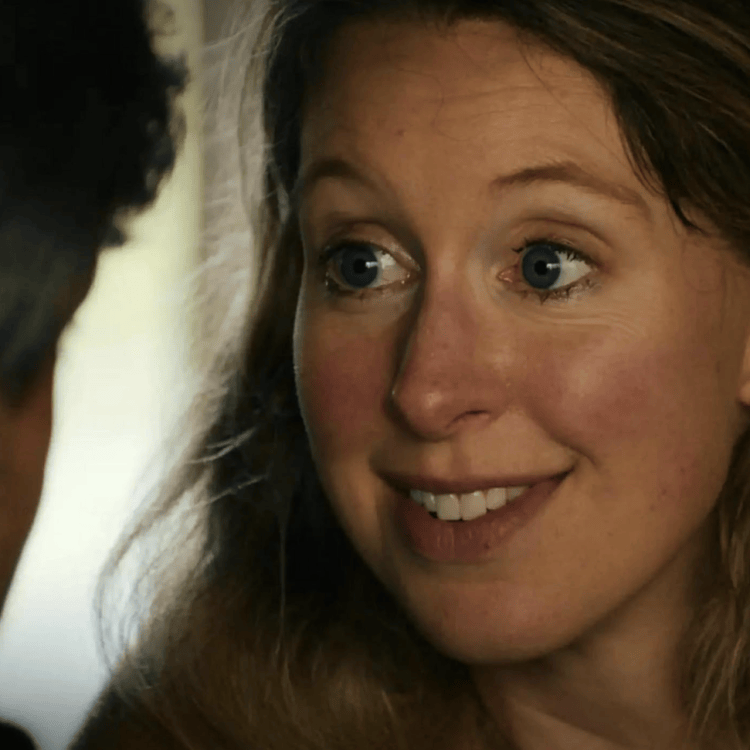
The initial set-up is easy to understand. With 34 days left before her sentence is set to begin, Elizabeth Holmes invites a camera crew to film her and her family in their Del Mar, California, beach house. Even Fielder, a comedian and provocateur mostly known for his quasi-autistic methods of communication and monastic commitment to the bit, plays the straight man, taking on the role of audience proxy and pushing back against Holmes and Evans’ various lies, while occasionally examining how something like who beats the eggs speaks volumes about relationship dynamics. About halfway through the film, when Holmes is shipped off to prison, Fielder and Oppenheim must find a way to go on, to make sense of whatever they just experienced. From then on, You Can See Everything becomes the meditation on truth, memory and representation that has generated endless conversation since its wide release in mid-October of this year. Among its many twists (read: spoilers ahead) are extensive use of Fielder’s Synecdoche-like recreations that were popularized in his HBO show The Rehearsal, to metacommentary from Amanda Seyfried, who played Holmes in the Hulu series The Dropout, all in the hopes of understanding who Holmes really is.
You Can See Everything exists in a long lineage of self-reflexive nonfiction works about truth, memory and representation, from Abbas Kiarostami’s Close-Up to Joshua Oppenheimer’s The Act of Killing, down to the seminal book of this ruminative genre, Janet Malcolm’s The Journalist and the Murderer. While metatextual discussions around documentary filmmaking are nothing new, Fielder and Oppenheim’s film has brought discussions around the truth to the forefront of everyone’s minds. It’s the film everyone has to have an opinion on, because no one can seem to agree on what it is. In thinking about the film’s second half, you start to feel like the directors don’t even trust themselves either.
The movie comes at a time when our collective relationship to the truth has been made tenuous by technological advancements that have corroded our sense of reality. While some have addressed the film’s relation to our exhaustion with the smarmy lies of tech founders, it’s worth considering how generative AI has broken all of our brains at warp speed over the last few years. We’re suffering from an ever-present paranoia that we cannot trust anything we’re seeing, that there will always be the possibility that anything on our screen could be AI. That seems to have primed us for this current moment: to discuss a film most primarily concerned with questions about what’s real and what isn’t. To feed on our contemporary anxiety around the real, the film gives us plenty of reasons to question its own authority on anything that’s happening on screen.
Midway through the film, it’s revealed that prior to the start of shooting, Evans had brokered a deal with A24 to profit off the sales of the film — an unusual arrangement for a documentary film with purported journalistic intent, but it wouldn’t be the first time this has happened. In order to write his 1983 true crime book Fatal Vision, Joe McGinniss struck a deal with his subject that in exchange for unfettered access, Dr. Jeffrey MacDonald would receive a share of the profits from the book to cover his legal costs. MacDonald was on trial for the murder of his pregnant wife and two daughters, in a heavily litigated case that dominated headlines in the 1970s, with many writers and journalists itching for access to the man at the center of it all. In order to secure exclusivity, McGinniss agreed to share the profits and got closer to MacDonald under the guise of humanizing him to prove his innocence, only to write a damning account that accuses MacDonald of being a pathological narcissist that was driven to murder his family in a fit of psychotic rage induced by amphetamines. This betrayal, and ensuing feud and lawsuit between McGinniss and MacDonald, is the subject of The Journalist and the Murderer. Through her own research and interviews, Malcolm examines the conniving nature of journalism, encapsulated by her now-famous opening line: “Every journalist who is not too stupid or too full of himself to notice what is going on knows that what he does is morally indefensible.”
In the case of You Can See Everything, the issue of profit is clear: If Evans is set to gain from the film’s success, what’s to stop him from sensationalizing every interaction, performing the most ridiculous version of himself to drive up sales? By the film’s end, we learn that Evans had given up his profit-sharing agreement prior to release, but by then we have already sat through an hour of wondering whether we’ve been fooled this whole time.
The use of fictionalized reenactments in documentary filmmaking has a long history, despite what the current glut of streaming service true crime slop and puff pieces would have you believe. One of the great works of docufiction, Close-Up recreates a real-life scandal involving Hossain Sabzian, a cinephile who impersonates his idol, the Iranian filmmaker Mohsen Makhmalbaf, and deceives a family into thinking they will star in his next movie. Everybody plays fictionalized versions of themselves, blurring the distinction between performance and reality. A more recent example, Joshua Oppenheimer’s The Act of Killing takes a more harrowing approach, asking gangsters and paramilitary officials who carried out the Indonesian Genocide of 1965 to reenact their killings in order to understand why they thought of themselves as heroes. What ensues is at times a darkly comic “making of the movie”-esque farce and a deeply disturbing portrait of the psychology of murderers.
Though they may appear similar, the recreations of You Can See Everything are working in different ways with different implications. When Fielder is asked by Amanda Seyfried to recount interactions with Holmes he wasn’t able to film, he occasionally questions his own memory of events. Some are innocuous, like what snacks were in the vending machine of the correctional facility he visits Holmes in, but others feel more damning, from her tone and exact phrasing in their unrecorded interactions. In a film that obsesses over small gestures, the fact that minute details are called into question compromises Nathan Fielder as our guide through this web of lies. How are we supposed to trust our only guide if he can barely trust himself? In the film’s final moments, Amanda Seyfried asks Fielder if he’s biased toward Holmes because of the time they spent together, and the ensuing shot of the two of them swimming on the beach together suggests to us that he’s been got.
The longer I sat with the film, the more I became frustrated with the way Oppenheim and Fielder absolve themselves of the responsibility to glean any kind of insight from their experience with Holmes and her family. In interviews, Fielder frequently says that he’s still not sure what he experienced, but even still, he’s in a better position to make sense of it all than we are. I wish it had more to say, whether about her or its philosophical questions about the truth and subjectivity, because it feels cynical to leave us with nothing, to insinuate that after all this time, the best they could come up with was that Holmes was unknowable and that documentary is a subjective form. These aren’t exactly new revelations, and it’d be braver of them to push this idea a little further, to tell us what they think, even at the risk of being wrong. Tasking the least-informed people with the job of piecing the mystery together is an intellectually cowardly approach. After all, we weren’t there. We can’t make sense of all the footage that never made it into the final cut and the interactions you had to be in the room for. Who got to see everything? Surely, not us.

More Like This
This article appeared in an InsideHook newsletter. Sign up for free to get more on travel, wellness, style, drinking, and culture..