In November, the hospitality space witnessed an especially high-profile implosion — Marriott’s partnership with Sonder ended abruptly, leaving travelers who thought their lodging was secure in a much more precarious place. While this particular business arrangement did not pan out as expected, it’s worth considering what it reflected: a moment for the hospitality industry where hotels and residential options — think Airbnb and Vrbo — began to converge.
As it turns out, that larger trend is still in play. This month, Skift’s Dennis Schaal reported that Airbnb is expanding its presence in an unlikely direction: getting a foothold in the world of hotels. Schaal cites a recent post on LinkedIn from Airbnb’s Jesse Stein in which Stein announced he was expanding his duties (he’s already the company’s global head of real estate) to encompass hotels as well.
“[E]xpanding and optimizing the hotel experience on Airbnb is a key growth lever, and one I’m especially excited to help lead,” Stein wrote. “Hotels have been a pivotal part of my career, and I believe there’s a meaningful opportunity to bring the best of boutique and independent hospitality to a global audience.” His resume includes four years at Kimpton Hotels as vice president for acquisitions and development.
As Skift’s reporting points out, Airbnb has hired several other industry professionals with experience in hotels, including alumni of companies like Booking.com and Radisson.

Airbnb Is Pushing for a Return to New York City
A proposed law could make it easier to book a short-term rental in NYCLast year, Airbnb’s CEO hinted that the company might implement a loyalty program. So it isn’t especially shocking to see that the platform becoming more similar to its competitors in the hospitality space in other ways. As Schaal points out at Skift, there is also a pragmatic reason for Airbnb to explore allowing customers to book hotel rooms: More local governments are now regulating short-term rentals.
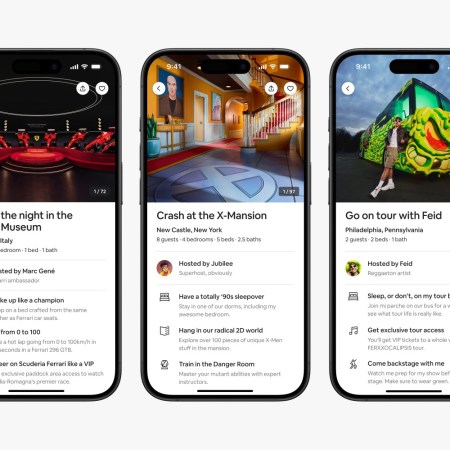
Airbnb’s Experiences launch was one of the first signs the company had bigger plans than allowing travelers to book residential spaces while on the road. But this expansion into the hotel space directly takes that up a notch and feels like a reflection of an industry that’s converging somewhere unexpected.

More Like This


We're always on the scene eating, drinking and traveling near and far to bring you the best of what's happening out in the real world. Sign up for IRL now.