You can indirectly thank the British for our country’s love affair with whiskey.
“There was a movement or pride in drinking American whiskey [during the Revolutionary War],” says Trey Zoeller, founder and chief strategist of Jefferson’s Bourbon. “It was kind of a quick switch because before that moment, everybody drank rum. We had the Boston Tea Party, but we did the same thing with rum. They taxed the hell out of it, so it was unpopular to drink rum and more popular to drink whiskey because that was our spirit. If you were drinking rum, you were supporting the British.”
The history of American whiskey is expansive and would take a book or two (or 10) to cover — in fact, there’s an entire book about George Washington’s massive but relatively unknown influence on American whiskey, and that only covers a few years. But my focus is narrower. Before America celebrates its 250th birthday, I wanted to get a better sense of the flavor of whiskey in our country’s early days and how it was consumed.
Admittedly, no one today could really tell us what whiskey tasted like in the late 1700s or 1800s. But after a little time with Zoeller (whose dad, Chet Zoeller, was a well-regarded whiskey historian), spirits writer Noah Rothbaum (author of The Whiskey Bible: A Complete Guide to the World’s Greatest Spirit) and Max Miller (historian and host of YouTube’s Tasting History), I’ve formed a better picture of what sipping a little rye or corn whiskey would have been like in the early years of American independence.
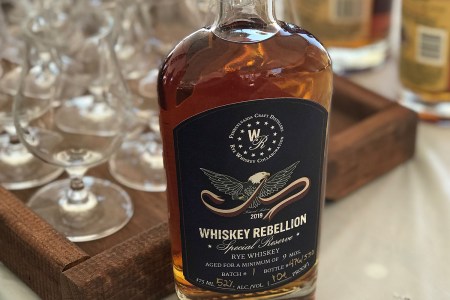
The Whiskey Rebellion Trail Is the Best American History Class, Uh, Ever
A craft booze-inspired tour highlights the country’s first civil unrest, from back in 1791It Was Unaged
“You were drinking it right off the still,” says Zoeller, who notes that ceramic jugs were the early drinking vessels of choice. “Back then, when you got married, you’d give somebody a pig, three sheep and two barrels, and they were all about equal value, so you wouldn’t tie-up a barrel aging whiskey. It took a lot of time and labor to make those barrels. Nobody had excess ones lying around.”
It took a post-Revolutionary War whiskey tax, an actual Whiskey Rebellion to said tax and then a population expansion across the country for the idea of placing whiskey in a barrel to take hold. “A lot of distillers started distilling on the western slope of the Appalachians,” Zoeller says. “The whiskey was put into barrels for the first time and floated down the rivers on boats back up to your neck of the woods. Once that happened, the whiskey really transformed, in my mind, to what we know as bourbon because it was its first time it spent a long amount of time in a barrel and started picking up color, flavor and taking out that astringency.”
Those Early Whiskeys Were Usually Ryes
Though Zoeller mentions bourbon, he notes that the first whiskeys here were primarily made from rye. Miller expanded on that history during a recent WhistlePig tasting in New York, where the Vermont rye whiskey distillery was showcasing its semiquincentennial-themed Rye, White and Blue PiggyBank and Declaration Wheat Whiskey.
“In 1624, a young Dutch settler comes to New Amsterdam with a tree in his cart and a pocket full of rye,” Miller recounts. “He plants that rye, and the next year the first rye crop in the new world sprouts and he makes bread. How disappointing! Unfortunately, he did not know how to make whiskey. That would not happen for quite some time, as the rye spread to the other colonies, namely Maryland and Pennsylvania. People from Ireland and Scotland began to settle, and they knew how to make whiskey, but they made their whiskey out of mostly barley, which did not grow terribly well in the rocky soil. But rye was very hearty.”
While corn whiskey was a thing early on (and grew as farmers faced a surplus), the popularity of bourbon over rye came after Prohibition, when most rye-based distilleries had closed, particularly outside of Kentucky, the home of bourbon. Consumer tastes soon changed to a lighter and sweeter profile.
The Whiskeys Were Originally Made on Pot Stills
With the influence of European settlers, the use of alembic or copper pot stills in our country’s early whiskey history was a given. Continuous column stills weren’t invented until the mid-1820s. That’s also about the time another major distillation change happened, which indirectly led to a very American style of whiskey: Tennessee Whiskey.
“The log still or the chamber still was the technology that allowed American distillers to finally make a whiskey separate and distinct from what was being produced in Scotland and Ireland,” Rothbaum says. “It used the new-fangled technology of steam, which allowed distillers to essentially cook the grain in the still without burning it. The chamber still works with high pressure and high heat, which creates an incredible range of aromas and flavors. The whiskey would then be distilled a second time in a copper pot still. But the chamber still made such a big and bold flavor that some distillers started to filter it through charcoal before aging, which would become known as the Lincoln County Process. Both Jack Daniel’s and George Dickel were originally made on a chamber still.”
And this forgotten still is now making a welcome comeback.
If You Were Drinking Whiskey, It Was Probably Diluted
“My understanding was that it was rough,” Zoeller says. “Remember, it started as just white dog [unaged]. People were cutting it with beer, bitters or water. There were a lot of whiskey punches. You just wanted to make it palatable.”
In other words, respect your history — but be thankful for the 250+ years of advances in American whiskey know-how.

More Like This
We're always on the scene eating, drinking and traveling near and far to bring you the best of what's happening out in the real world. Sign up for IRL now.