There is no car more important for Aston Martin’s future than the new Valhalla. Produced in numbers but as powerful as the company’s small-batch hypercars, its radical styling charts a new attention-seeking course for the British automotive powerhouse.
For decades, Aston Martin has produced a unique breed of grown-up supercars that demanded its own lane amongst the competition. Rolls-Royce stays in the clouds with a total focus on luxury and comfort. Lamborghini frolics with Italian passion, preferring eye-catching aggression at the risk of immaturity. Bugatti opts for opulent brutalism, unleashing limited runs of record-setting speed experiments to haunt the streets of Dubai. But none of them have managed to blend all-around style and civilized ferocity like the cars coming out of Graydon, U.K.
It’s clear Aston Martin doesn’t shy away from power and on-track performance, but whether you get behind the wheel of its DB12, Vantage or Vanquish, its cars all rely on an aesthetic of smooth sophistication. With lines that please the eye without resorting to fins, oversized splitters or gaping air intakes, every Aston so far has spoken the same refrain: “Enjoy the view before I bellow and leave you behind.”
It’s that reputation that’s helped the marque remain James Bond’s preferred car over the years. They look the part of a star alongside 007 in a tuxedo, but can outrun the villains’ Land Rovers when trouble starts. The problem is, today’s young buyers with money — the millennial and post-millennial nouveau riche — aren’t as enamored with tuxedos and dry Martinis. They grew up in the age of social media, where subtlety and sophistication aren’t the top priority.
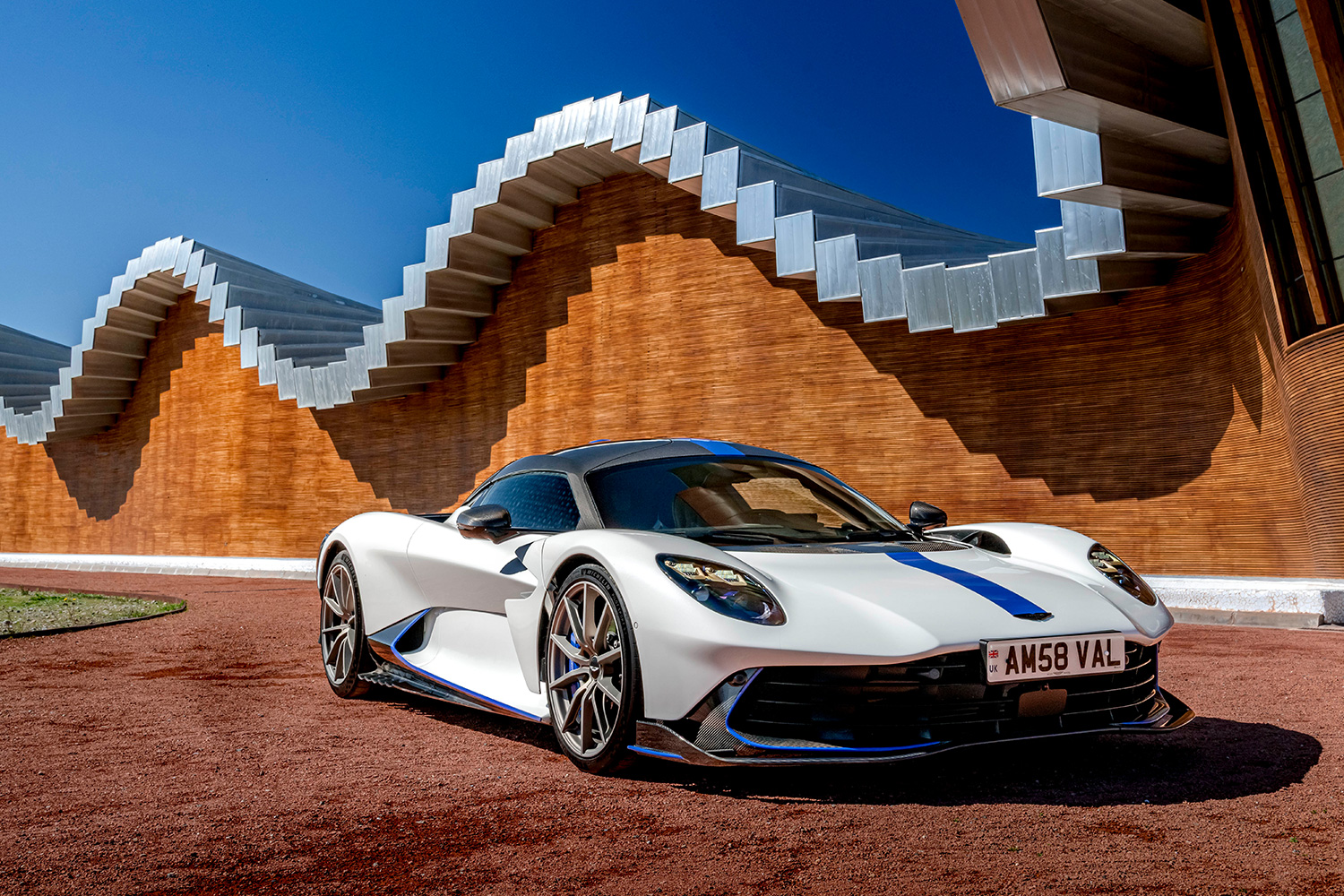
With this in mind, Aston Martin introduces the Valhalla. Limited to 999 units, the $1 million supercar is now available for bespoke orders. Upping the ante on both track and road-going abilities, the Valhalla sheds an exterior of understated elegance for flashier, racing-inspired bodywork. It’s a car the greener well-heeled buyer will snag as much for the selfie as the speed.
As for said speed, the plug-in hybrid vehicle harnesses a twin-turbo, 4.0-liter V8 engine with three electric motors to produce the equivalent of more than 1,064 horsepower. That startling powerplant combination is electronically limited to 217 mph with a 0-62 mph time of just 2.5 seconds.
“A Supercar of Purity”
According to Simon Newton, Aston Martin’s director of vehicle performance, ongoing advancements gained by the Aston Martin Aramco Formula 1 team and the Aston Martin Performance Technologies division bled into the Valhalla’s DNA.
“Our challenge [on the engineering and vehicle-dynamics teams] was to get the most out of the first-of-its-kind hybrid powertrain,” Newton says. “In addition to developing the engine and the motors, we worked extensively on aerodynamics and dynamic control systems.”
Newton compared the Valhalla to other Aston Martin models rolled out over the last year. The Vanquish produces 824 horsepower and a 0-62 time of 3.3 seconds. The Vantage puts out up to 670 horsepower and manages a 0-60 mph time of 3.4 seconds. The DBX SUV releases up to 717 horsepower with a 0-60 mph time of 3.1 seconds. Across all significant performance statistics, the Valhalla reaches well beyond these recent family members. Only the track-centric Valkyrie slightly outclasses the Valhalla with its 1,160 horsepower and 250 mph top speed without limiters, though that one will also cost you three times as much.
Where the million-dollar Valhalla truly challenges the bloodline is in the aesthetics. Marek Reichman, Aston Martin’s executive vice president and chief creative officer, acknowledged the deliberate departure that the Valhalla represents for the automaker.
“As with all Aston Martin designs, beauty and performance have to work together while we embed the cues you would recognize,” Reichman says. “But, we start from a very, very exciting base point for the first [vehicle] with a Formula 1 seated driver’s position.”
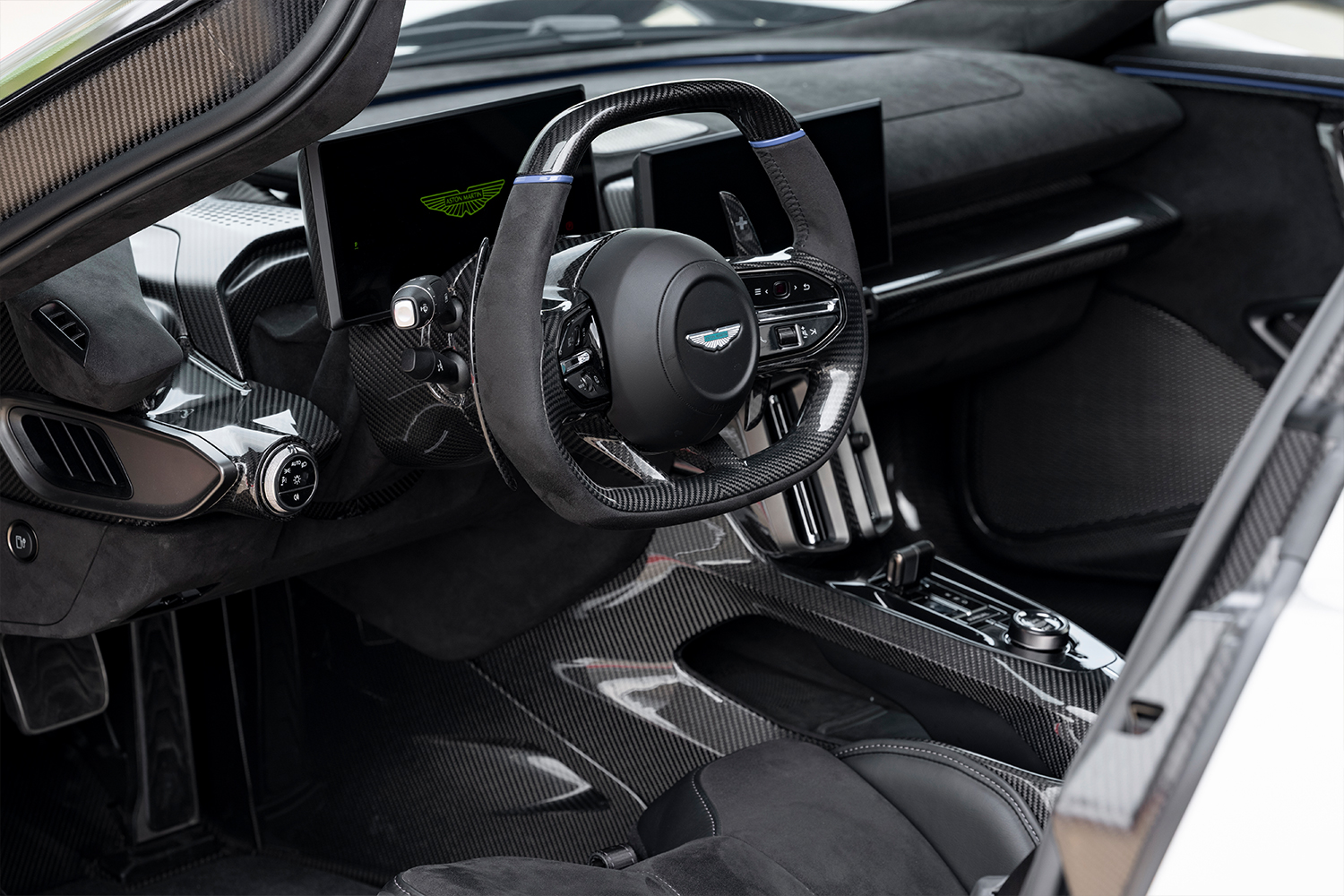
Reichman insists that the Valhalla — as Aston Martin’s first series production mid-engine supercar — presented an opportunity for him to create a car of “beauty and purpose” unlike anything else his employers have attempted in their dignified history.
“It’s a new aesthetic and a new way of conceiving a car, reflecting the cooperation of the design team and Aston Martin Performance Technologies,” he said. “[Valhalla] is a supercar of purity…in this new age of ultra-performance.”

What Do Aston Martin Buyers Want? Convertibles, More Cylinders, No Charging.
The new 2025 Vantage Roadster is everything brand loyalists say they crave: uncompromising engineering, athletic styling and a loud V8Like a true racing machine, a carbon-fiber “tub” lives at the center of the car with its engine, motors and wheels surrounding it. That’s entirely different from the more traditional chassis and passenger compartments of the DB12, Vanquish or Vantage. To guarantee material strength and assembly efficiency, the car’s monocoque is made from just two individual carbon-fiber pieces.
“The beauty and the language of the car has to be both aggressive and elegant,” Reichman adds. “We achieve that by removing a lot of the excessive venting and holes. Every line is consequential in terms of its delivery of shape or form, so that you have that golden ratio in every part of the car.”
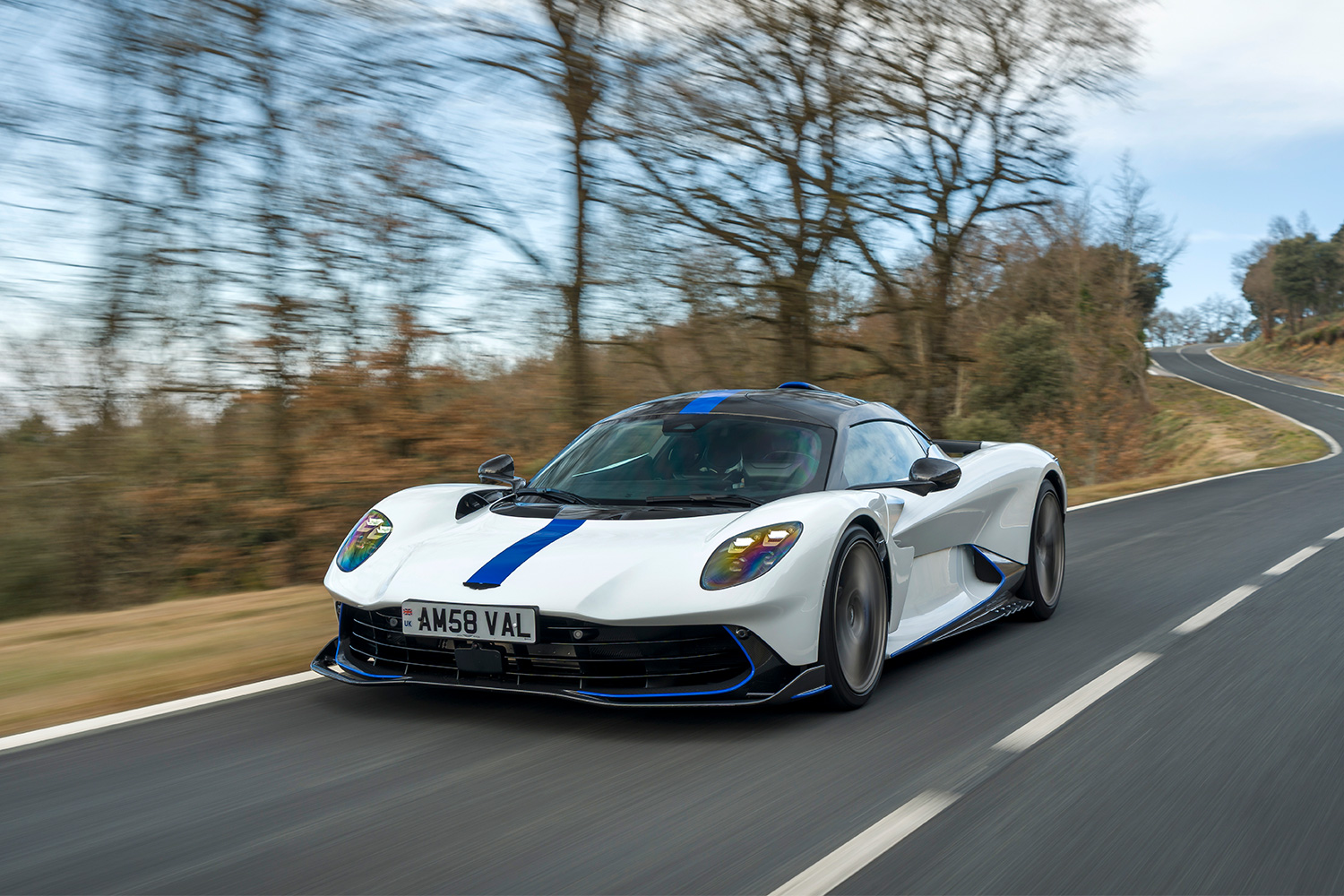
Behind the Wheel of the Valhalla
Though the blisteringly fast and surgically precise Valhalla proved its credentials during my time testing it on a track, its visual impact hit home during the public portion of my one-day drive.
The quiet, lolling and bobbing byways of northern Spain offered me ample opportunity to test the Valhalla’s sudden acceleration and steering accuracy as a road car. For a vehicle aimed squarely at track-day challenges with the added capability of on-street performance, the bespoke racing seats also proved surprisingly comfortable.
After settling in, I passed a late-model, sport-tuned BMW driven by someone who, unfortunately, seemed intent on confirming the stereotypes of “Beemer” drivers everywhere. Racer X apparently saw my Valhalla fly by and decided he couldn’t ignore the challenge.
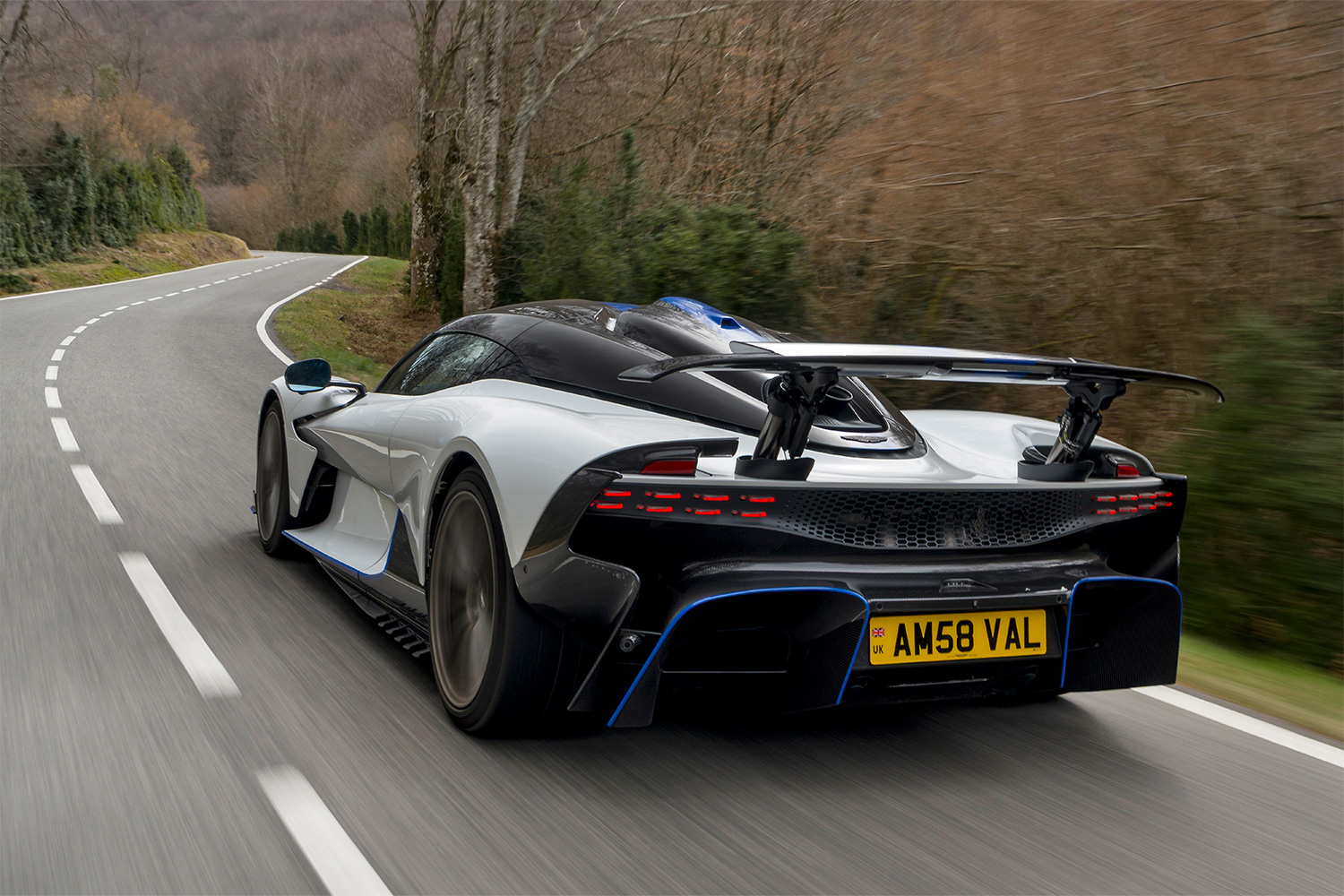
The driver pushed his BMW to its limit to maneuver around other cars and get right up on my tail. With an urgent, F1-forged roar, my supercar uncoiled more of its power and left the lesser German machine far in the rearview. The M-badged BMW made a couple other attempts to pass, each met with similar failure. By the time he prepared to make one last desperate overtake, I returned the Valhalla to our home base at the track — undefeated.
In some ways, that brief episode proves the success of Aston Martin’s styling jumpstart. The racing lines and bold colors of the Valhalla catch the eye and ramp up the adrenaline for younger and, in this particular case, less responsible drivers. Even if people can’t afford to own one, it seems they’ll gladly lust after or envy it.
But time will tell if the more attention-grabbing, rambunctious supercar will accomplish its mission and get more of those younger and crazier buyers to skip over other automakers and throw their lot in with Aston Martin.

More Like This


This article appeared in an InsideHook newsletter. Sign up for free to get more on travel, wellness, style, drinking, and culture..