The Mercedes-Benz Geländewagen is a rare automotive strain, one that transcends the usual rules of engagement. Though quintessentially functional, G-Class SUVs are more commonly associated with celebrity and status than approach angles or wading depths. New models can easily transact for $200,000, but they barely depreciate. And while the vast majority of modern SUVs disappear into anonymity, the G-Class cuts a boxy silhouette that’s among the most unmistakable of automotive designs.
Rishav Kanoria has long appreciated G-Wagens, but he saw a different side of the truck when he moved from New York to London.
“They were always my favorite 4x4s,” he tells InsideHook, “but I began noticing older G-Wagens I didn’t see in the U.S. like soft-top NATO force models from the 1980s. Nobody [in the aftermarket business] was really doing anything interesting with them.”
While exploring the idea of launching a business that restored and upgraded classic G-Wagens, Kanoria was put in touch with Felix Timmer, an Austrian who was doing long-term consulting work for Audi Sport. Together they founded Arcade Cars, which aims to celebrate classic G-Class models with the vigor so many restomod companies have famously expended toward Ford Broncos and Land Rover Defenders. An early partnership with Everrati saw their first big debut — an all-electric model based on the GE 230 — make waves at Monterey Car Week in 2024, and they’ve been steadily building their presence since.
Rethinking the Restomod Formula
Modern day restomod trucks often follow a familiar formula: paint the exterior a fashion-forward hue, line the lifted cabin in quilted leather, drop an LS engine under the hood and call it a day.
Arcade does a fair amount of sprucing to workaday, military-sourced G-Wagens, but they also depart from the status quo by not defaulting to ubiquitous General Motors-built LS V8 motors, which deliver hot-roddy growls and copious power. Arcade currently offers two considerably milder packages: Heritage, motivated by a bone stock 2.3-liter, four-cylinder powerplant producing 126 horsepower; and Sport, which incorporates a modified version of that engine bored out to 2.8 liters that produces 151 horsepower. The latter includes a stiffer suspension and six individual seats instead of rear bench seats. My loaner was actually a hybrid of these two approaches: Heritage styling and seating bundled with the more powerful Sport engine and suspension.
I’ve driven a variety of modern Mercedes-Benz G-Class SUVs both on and off-road, and they tend to give off the same general vibe: a monolithic, go-anwhere presence that signals inherent wealth and power, or to cop a term I find hopelessly dated: bling. It certainly has its place if you’re into that kind of thing, but I also tend to feel like that guy whenever I’m behind the wheel — fun in a perverse kind of way, but not exactly the demographic I aspire toward.
Can an Electric G-Wagen Match the Icon? We Went Way Off-Road to Find Out.
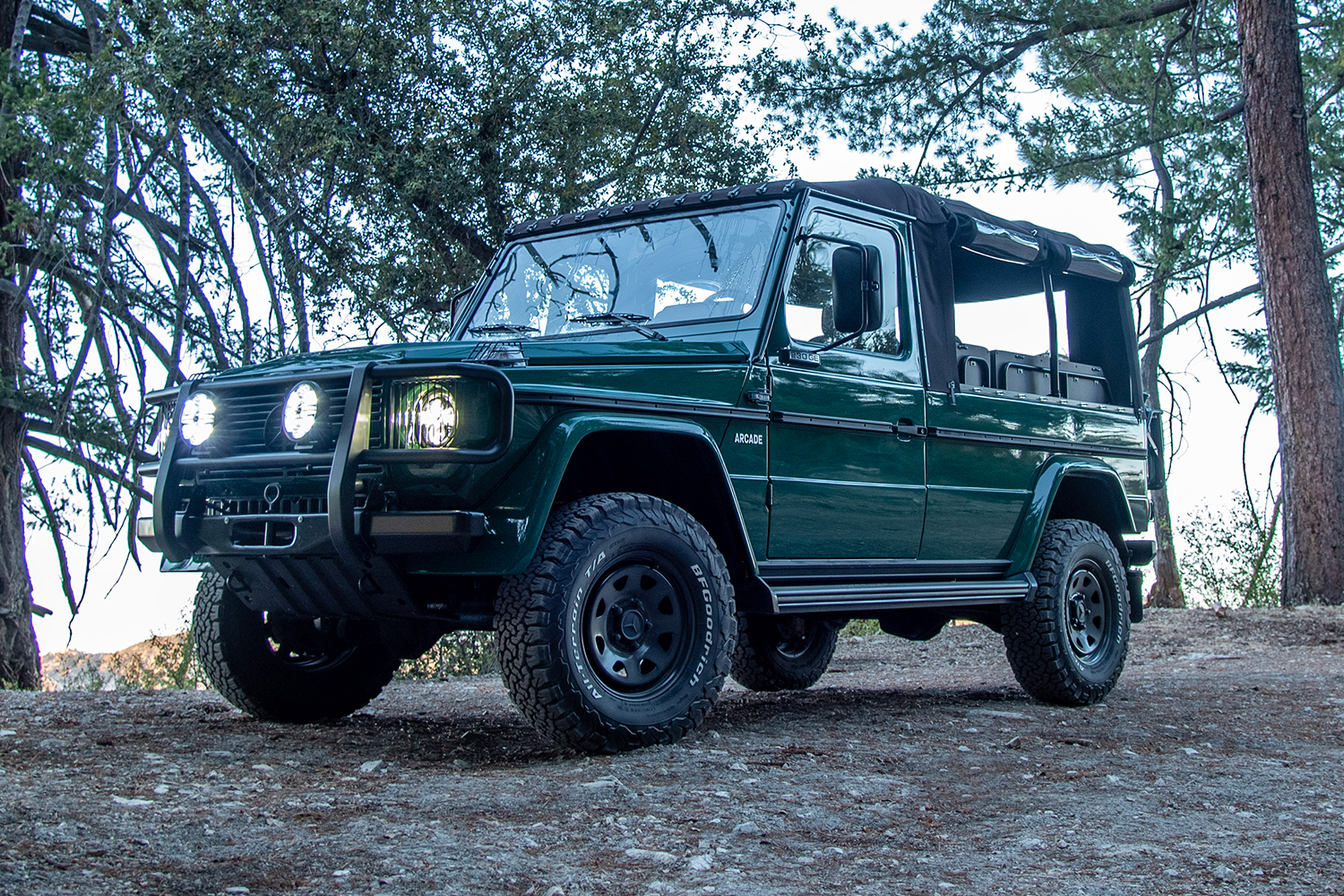
The only way to test the first electrified G-Class is to tackle inhospitable terrain, so our correspondent flew to the south of France to do just thatThe Arcade G-Wagen cuts a different jib. Sitting in my driveway, it gives off a subdued air thanks to its steel wheels, skinnier tires and soft top that swaps a blocky roofline for a friendlier open-air configuration. Finished in Irish green with black trim, it wears its utility with a certain earnest stylishness and sparingly tapered body panels that preceded the chunkier, more imposing iterations that followed. Incidentally, the example I’m testing saw Swiss military usage before it was retired and became road registered in 1996.
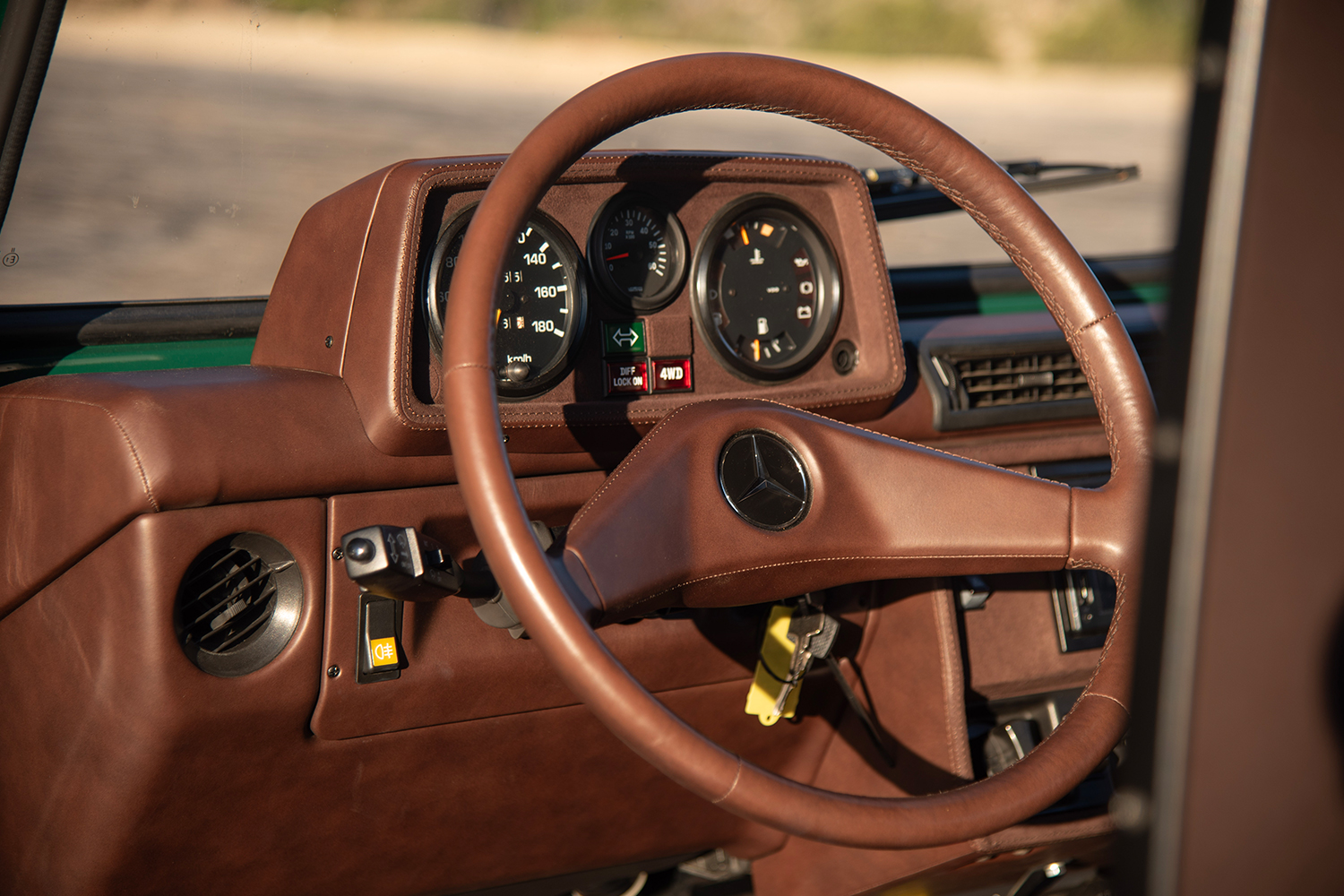
Inside, the supple Napa leather in a warm shade called “nougat” wraps around nearly every surface, with seats finished in a delightful interlocking weave pattern that flies in the face of the diamond quilting that has spread among off-road restomods like a virus. From the hand window cranks to the old-school white-on-black Mercedes instrumentation, there are no out-of-place modern bits in here.
Taking the Arcade G-Class Off-Road
Wrapping most things in leather, including those manual window levers, does make the interior seem a bit too dear for dusty off-roading. Regardless, I set out to venture up California’s Angeles Crest Highway and onto a dirt trail so I can at least experience it away from the trappings of banal suburbia. This GE 230’s upgraded powerplant has been massaged by AMG race mechanics and incorporates go-fast goodies like forged pistons and a larger throttle body. However, there’s no danger of feeling like there’s excess power lurking beneath that rectilinear hood. Equipped with a four-speed automatic gearbox, this G-Wagen accelerates moderately but assuredly, with just enough power to keep up with traffic — nothing more. It feels a bit odd to wind its small tachometer to the upper reaches, as Mercedes-Benz’s M102 donor engine is a stodgy cast-iron-block eight-valve reputed for durability and claims of “million-mile” longevity, not an inherent spunkiness.
The Arcade feels solidly planted on the road, with its sportier suspension encouraging flat-pedal driving on the winding highway that snakes through the Angeles National Forest. The wind noise through the open windows is a commitment, as is the general lack of creature comforts save a modern stereo. This example has rear opposing bench seats from a Heritage model (bringing total passenger capacity to eight), which would make it one heck of a fun family hauler, so long as you’re not too worried about safety, considering the lack of airbags.
At the same time, it feels overqualified for the light trails I take it on, its solid axle suspension managing the loose terrain below with ease. Though equipped with a low 4×4 reduction gear, I stick with the standard configuration which works fine for my purposes. At one point while driving on the road, the 4×4 light came on; it extinguished after a while then blinked on again before returning to normal. Arcade tested the car afterwards and didn’t find any faults, so I chalked it up to classic car quirks.

Old-School Charm, New-School Price
I tend not to get too attached to media loans of modern cars, but the Arcade endeared me with its old-school charm, affluent-adjacent heritage and pleasantly outfitted interior. It doesn’t go crazy with the ultra-premium details like, say, a Porsche 911 Reimagined by Singer, but then again we wouldn’t expect that from a rugged 4×4 like a G-Wagen. Stray too far from its purposeful roots, and it would become a bit too posh for its own good, a victim of its own vanity — even though the latest and greatest models are still brilliant off-roaders.
Arcade has seen price increases since I tested their truck last year, and until outstanding issues and clarifications on potential exemptions with U.S. Customs & Border Protection are clear, the current starting price is estimated at around $175,000. For reference, a brand-new G-Class which starts at $155,050, and can climb well past the $200,000 mark for an AMG version.
But Arcade presents an entirely different value proposition that opts for vintage character over advanced engineering and, yes, a highfalutin air. Outfits like Arcade are also operating under more headwinds than behemoth brands like Mercedes-Benz. Boutique firms building and importing classic restomods have far more limited audiences than mainstream manufacturers, and are subject to quirkier operation due to the inherent vagaries of re-engineering a decades-old platform.
“We try to keep as much of it original without compromising safety or reliability,” Kanoria says. “There’s definitely going to be some minor kinks here and there, but I think that also adds to the experience of owning a classic car as opposed to having every piece be completely perfect.”
Arcade expects to build around 20 cars this year at their facility in Stuttgart, Germany, and they recently unveiled a beach runner-style model based on a Singaporean military spec G-Wagen with a fold-down windscreen and minimalist doors.
Kanoria says that because there are only so many early G-Wagens from retired military stock around, the company will inevitably broaden their portfolio with later platforms, possibly a V8-powered G500 model from the W463 generation which was produced from 1990 to 2018. Here’s hoping the newer models keep just enough early G-Class weirdness to be cool, not contemptible.

More Like This
This article appeared in an InsideHook newsletter. Sign up for free to get more on travel, wellness, style, drinking, and culture..