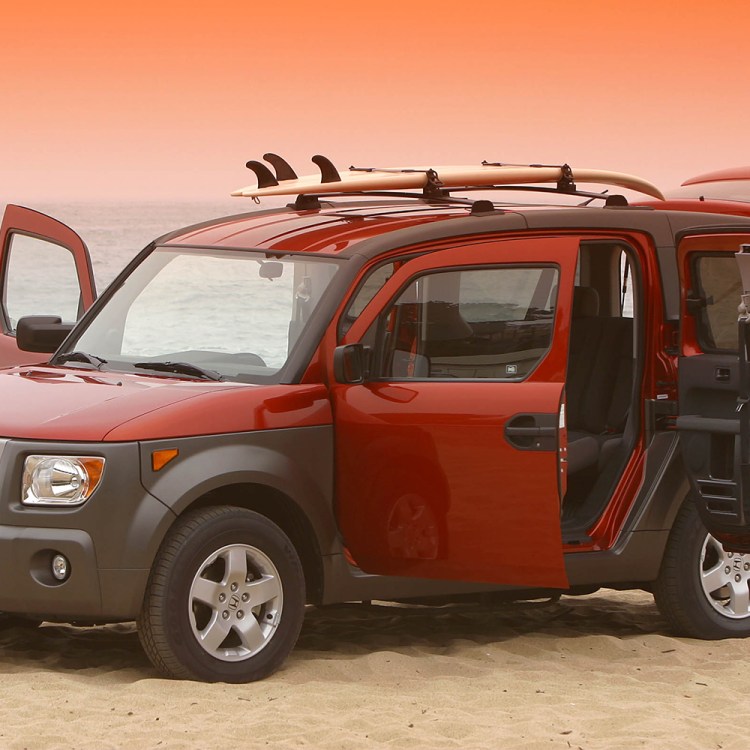
Over the summer, The New York Times ran a feature about a very particular automotive subculture. With an eye-catching headline — “They’re Tiny. They’re Slow. And People Are Obsessed.” — the article, by Scott Cacciola, discussed the small but dedicated community of Kei car aficionados in the United States. Months after its publication, the article seems a lot more prescient than anyone would have expected.
Earlier this week, President Trump made an unexpected announcement that could have big implications on the future of Kei cars in the United States. Right now — as the Times article made clear — the Kei cars available here are largely models that are more than 25 years old. As Motor1 reported earlier this week, Trump found the cars appealing on a recent visit to Japan and has asked Secretary of Transportation Sean Duffy to clear the way for the production and sale of Kei cars in the United States.
In a statement to Motor1, the Department of Transportation clarified that “manufacturers must certify that they meet U.S. Federal Motor Vehicle Safety Standards, including for crashworthiness and passenger protection.” But there’s arguably a bigger obstacle to seeing very small production cars on the nation’s roads: the nation’s last few decades of vehicle sales.
Look, I love the idea of more small, fuel-efficient vehicles being sold in the United States. I am also a writer who lives in a city, so I do not need a massive pickup or SUV for my daily transportation needs. A Honda Fit currently meets all of my needs, but Honda stopped selling the Fit in the U.S. market in 2020 because of a lack of demand. Arguably, the closest thing to a Kei car that was once sold in the United States — the Smart FourTwo — also exited the market a few years ago. As of 2023, if you were looking to spend less than $20,000 for a new car in the United States, you had exactly one option.
There are some promising signs for affordable vehicles, notably the Jeff Bezos-backed Slate (but Slate, it’s worth noting, makes pickups rather than Kei cars, subcompacts or “city cars”). A startup dedicated to making no-frills pickup trucks has, pardon the metaphor, a clear lane in the U.S. auto market. Is there a similar space available for a class of cars that make the Mini Cooper look like a full-sized SUV by comparison?
Tesla’s Affordable EV Might Look a Little Familiar
An earnings call provided more information on their plansIn a 2024 article for Vox, MIT Mobility Initiative senior fellow David Zipper explored the phenomenon he dubbed “car bloat.” Among the factors he cited was a 2019 study showing “that compared to a smaller vehicle, an SUV or a pickup colliding with a smaller car was 28% and 159%, respectively, more likely to kill that car’s driver.”
Informally, I’ve had conversations with people buying new vehicles who’ve opted for something bigger, partly because of the abundance of large vehicles already on the road. A would-be car buyer already concerned about surviving a collision with a massive SUV is probably not going to think smaller. In an interview with CNBC, Secretary Duffy addressed this question obliquely, saying of Kei cars, “Are they going to work on the freeways? Probably not. But again, vehicles that work in cities, and if that’s where you drive, it could be a great solution for you.”
Duffy went on to note that very small cars would be more affordable than many of the new models currently available in the United States. But he also said, “If there’s a market for those vehicles, I want to give our manufacturers the opportunity to build those cars.” This could be a big step forward, but that’s also a big “if.” And based on the current U.S. automotive market, there isn’t a lot of evidence that that market exists, as frustrating as it might be.

More Like This

We're always on the scene eating, drinking and traveling near and far to bring you the best of what's happening out in the real world. Sign up for IRL now.