Kelsey Cook Expands Her Territory
Stand-up comedy came naturally to the daughter of a foosball champion, but as Cook prepares for her most consequential special yet, she’s “constantly morphing into something better”
Want to know what the future holds? You need to meet the people building it. In our series Who’s Next, we profile rising stars of culture, tech, style, wellness and beyond.
Sitting in her Minnesota home, Kelsey Cook is framed by a windowed backdrop of trees, the shade of their leaves so cartoonishly green in the sunlight you’d think some new Zoom feature was manipulating the color saturation of our video call in real time. “It’s the one benefit of the region’s insane weather,” she says. “In the summer it is really green and beautiful, but you have to survive nine months of shit to get here. It’s a real bitch because it is so beautiful. You’re like, ‘This is really worth it,’ and then it’s -25 in January and you’re just dying.”
Fortunately for Cook, the life of a touring stand-up comic offers plenty of opportunities to skip town during the months when home becomes a stand-in for the planet Hoth. This year, she has been traveling across the country on what she’s dubbed “The Happy Hour Tour,” workshopping material for what will become a new stand-up special, which she’s filming in her home state in October.
Much like the independent recordings of a band before they’re scooped up by a proper label, Cook already has two such specials under her belt, 2023’s The Hustler and Mark Your Territory, the latter of which saw its release in February on Hulu and YouTube. While Hulu doesn’t share its viewing stats, last month the two sets respectively crossed four million and one million views on YouTube. Like her friend and colleague Taylor Tomlinson back in 2020, Cook is on the cusp of a breakout moment.
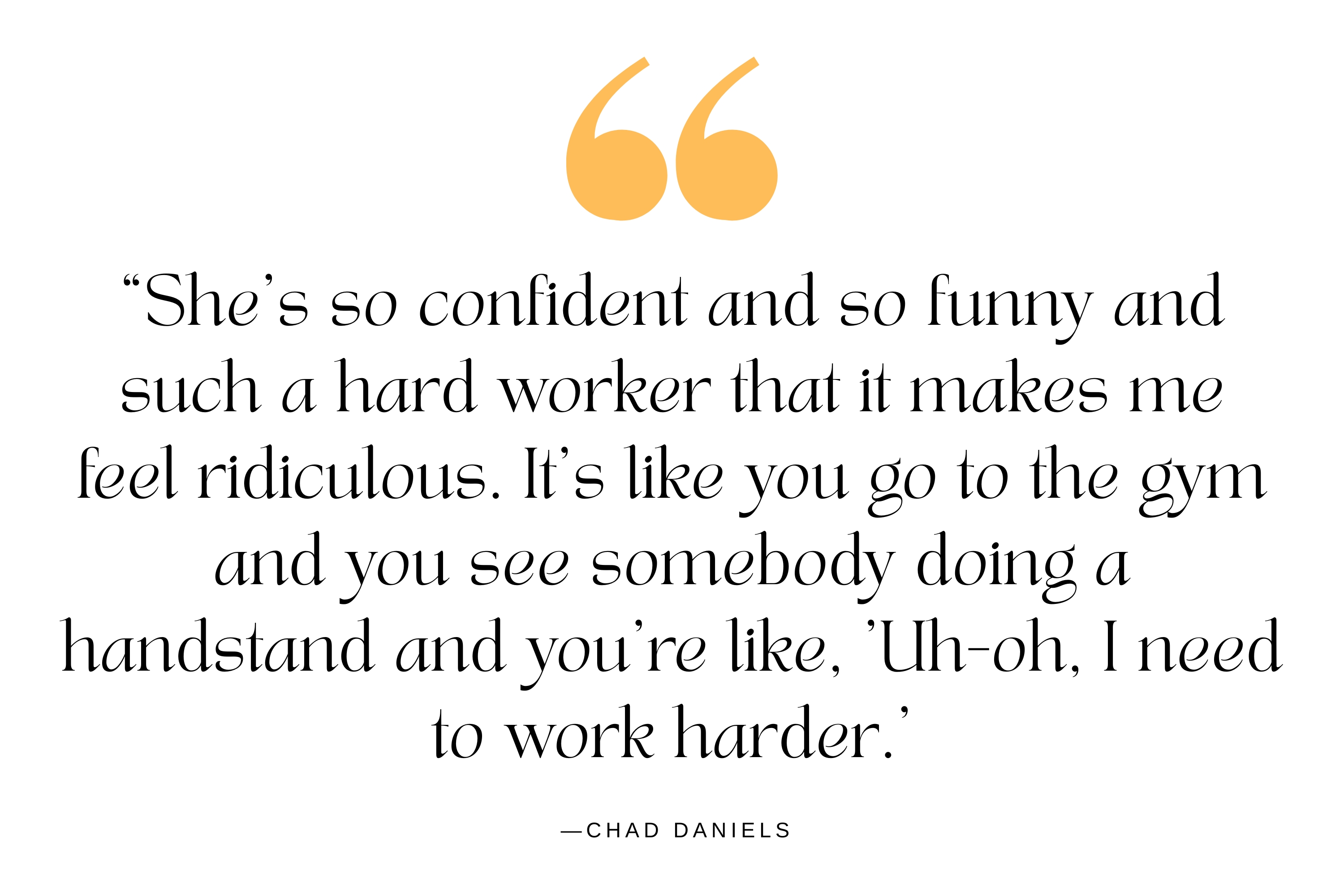
“She’s so confident and so funny and such a hard worker that it makes me feel ridiculous,” says comedian Chad Daniels, who also happens to also be Cook’s partner. “It’s like you go to the gym and you see somebody doing a handstand and you’re like, ‘Uh-oh, I need to work harder.’ It feels a lot like that when I’m watching her work. She’s constantly rewriting her jokes to make them as smart as they could be.”

Cook was born and raised in Spokane, Washington. When her mother Kathy wasn’t teaching high school French, she was a professional foosball player; she’s even in the U.S. Table Soccer Hall of Fame. Cook herself is also a world champion foosball player, and when her dad wasn’t working as a professional trumpet player, among other assorted jobs, he was an international yo-yo competitor.
Though her parents divorced when she was six years old, resulting in her being shuttled between two households, Cook says, “I watched two people who did what they loved for a living, and I think that really shaped me.”
“I didn’t grow up with parents who hated what they did for work or just did it for a paycheck,” she adds. “Both of my parents knew what they wanted to do, and they did that. I think the thing that was hard is neither of the passions that they followed necessarily made the most money in the world. That was kind of the trade-off. I feel very lucky that my parents seemed so fulfilled by their work and that meant more to them than being extremely wealthy. I feel very lucky that I do what I love for a living and feel comfortable financially, which you know, when I got into comedy, I didn’t know if that would ever happen.”
Like a lot of comics, Cook fell into performing a bit by accident. While pursuing a degree in broadcast production, she was required to take an introductory course in public speaking. Aside from a few other students who were just looking to get their credit and move on, the majority of the class consisted of foreign exchange students who were looking to improve their English. This hodgepodge of classmates became Cook’s first audience, as she would regularly turn her assignments into comedy sketches.
“One assignment you had to give a eulogy, and so I did it of myself but performed as a crazy aunt,” Cook recalls. “I came to class in costume and had never been happier in my life because I felt like all of a sudden I found my true calling, but also looked completely unhinged. I’m not sure the foreign exchange students totally got what I was doing. I’m sure they all thought I was fucking insane.”

Connections Editor Wyna Liu Can Make or Break Your Day
The exasperating “New York Times” puzzle has become a sensation. Liu is just as surprised as anyone.At some point her professor pulled her aside and informed her of the university’s monthly open-mic nights on campus. After Cook turned 21, she approached a nearby bar and asked if she could start a weekly show.
“It was hugely helpful for me to [have the weekly show] at the start because for a long time kind of the same 30 people would show up and so I had to have a different 10 minutes every week,” she says. “Most of it was terrible, but it was a good muscle to start to work, to be like, ‘Okay, I have to figure out more material quickly.’”
After graduating, she moved to Seattle and then Los Angeles, working simple admin or receptionist jobs so she could easily clock out and go right to working the local comedy clubs, sometimes filling the role of a house MC and sometimes even getting a featured slot on the night’s bill.
Cook also hosted her own small podcast called Cookd, where she would interview other comedians. One day listeners of the podcast found out on social media that veteran comic Jim Norton was asking if there were any podcasts he should guest on to promote his upcoming special. Cook’s small fanbase encouraged her to reach out and invite him on her show. Taking a shot in the dark, she sent the invite request and actually got an answer that he’d love to be a guest. After the taping, Cook took another shot, telling Norton that if he ever needed an opener, she’d be up for the gig.
“He let me open for him one weekend and it went well enough,” says Cook. “I went back to my day job the next week. [Out of the blue] Norton’s manager sent me an email with the rest of the tour dates of the year to open for him. I started crying at my receptionist desk. It’s the thing you dream of, that something like that will happen. And so I got to quit my day job, and that was that.”
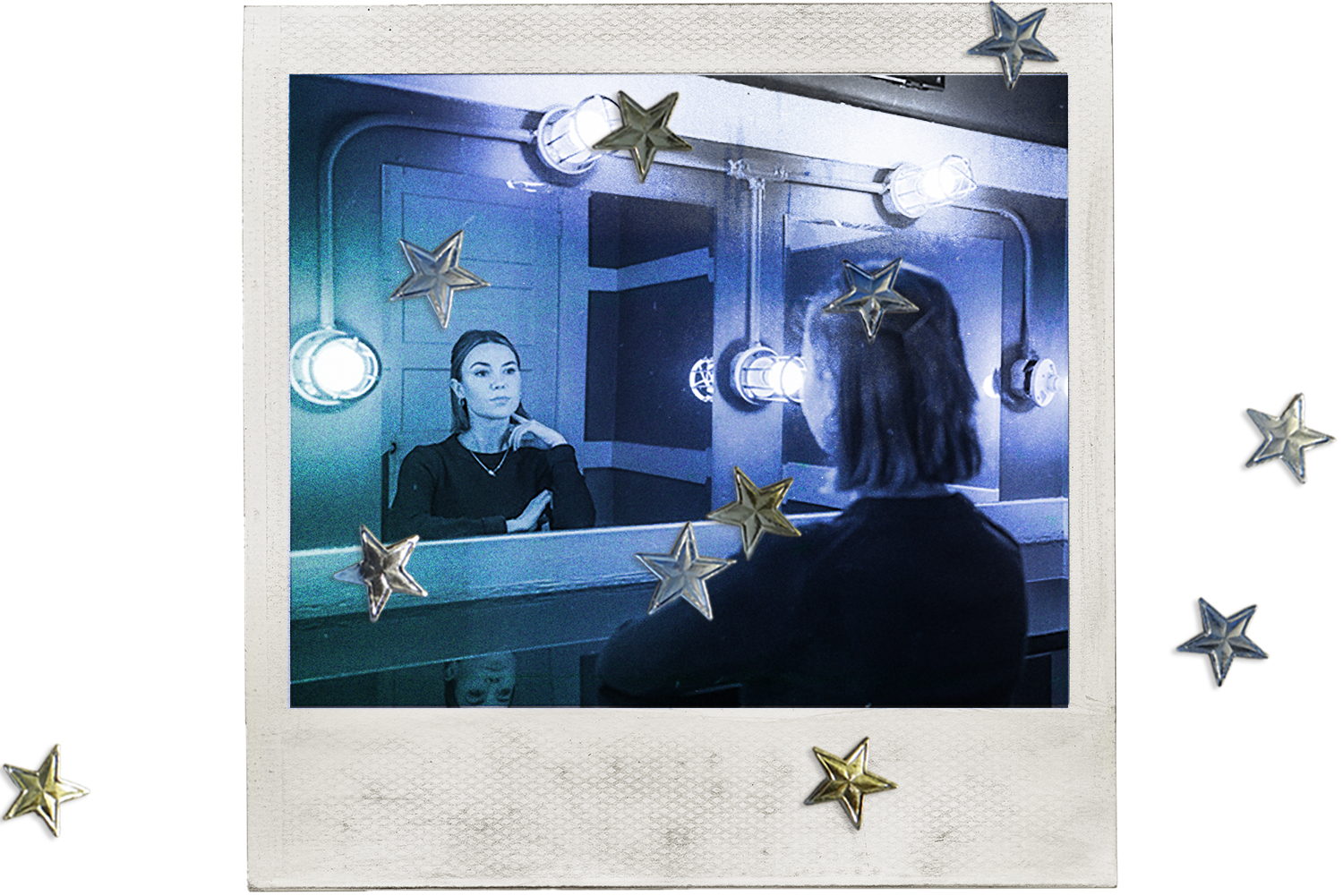
Over the following years, Cook lived true to the life of a professional stand-up comic, performing in all manner of clubs across the country. Unlike many older comics who prohibit the use of phones during sets and only post official clips of their latest specials on social media, Cook and others like her — Tomlinson, Dustin Nickerson, Josh Johnson — have utilized their online accounts to deliberately share bits from their shows. Each garnering tens of thousands of views, these short bursts of humor often come from an unplanned aside that landed or some very fruitful crowd work, the latter of which Cook used to be terrified of opening a door to.
“I had started touring as a headliner for the first time, doing actual full-year tours, and I just so happened to have these crowd-work interactions come up naturally where people were so drunk and shouting things that it would have been insane of me to act like it wasn’t happening,” she says. “And kind of like walking the plank, I was forced into some of these situations where I had to interact with these people and I realized it was going better than I thought it would for me because I’m very type A.”
“I generally want to go out and just tell my jokes that I wrote because that’s what I worked on,” she adds. “But again, I just realized that the crowd work was actually going pretty well, so I started posting them, which started to get some traction online. Now it’s become this massive thing for comics to do because we don’t want to burn our current material.”
In addition to building her comedic muscles for on-the-fly quips and improv, Cook’s prepared material also started to come from a much more defined perspective. Sure, it’s pretty easy to make fun of the fact that your parents met while competing at a foosball tournament, or the multitude of things you’re allergic to. It’s another thing entirely to turn those personal points into a narrative that surprises the audience. “I think that’s when I started to find my voice the most, incorporating more stories into my act,” says Cook. “Because nobody will have a joke about this. This is my own very unique story that I’m telling.”
Daniels says he’s had the privilege of watching this growth in real-time. “I always say this to her, ‘Oh, man, I can’t wait to see what you do next,’” he says. “Because you can see that it is constantly morphing into something better. And this not to take away from two specials that have got millions of views. I don’t know if people really know how special that is, but that’s pretty crazy. But I can’t wait to see what’s going to happen.”
“This happens with comedians in general, you find your voice a little more,” he adds. “You find your confidence a little more. I think she has a unique take. A lot of times — and this is something that I haven’t been able to master or even try because I’m not good at it — but she will give an eyebrow raise or a quick turn to the crowd with a disappointed look on her face or something and just get a huge laugh just off of that. I’ve never been able to do that.”
Cook has gotten particularly good at spinning concentrated yarns of embarrassment that simultaneously make her out to be both the fool and hero of the story. Let her tell you about the time she got drunk in Vegas and woke up with a strange powder in her belly button. Instead of being some rock star substance like cocaine, it turned out to be the leftovers from a quarter cup of parmesan cheese she dumped down her shirt after downing seven slices of pizza “like a wild boar.” Let her tell you about how she unknowingly installed a window curtain instead of a shower curtain in her bathroom after getting a little high smelling scented candles too long at Target. (“It only stretched half the length of my shower and it was so long — five extra feet of fabric coming off the bottom of this thing.”) Best of all, let her tell you the dire moment her IBS forced her to shit in an empty Amazon box because her ex-husband was already occupying the only bathroom they had in their apartment. (“I was just squatting — and crying. Our cats walked up to me. We booped noses.”)
Cook, from her perspective, calls comedy “the best therapy.” “It’s so cathartic to talk about and joke about because almost every embarrassing story I’ve ever told I have people come up to me after shows and go, ‘Oh my God, I did that too!’” she says. “I love to connect with people in that way.”
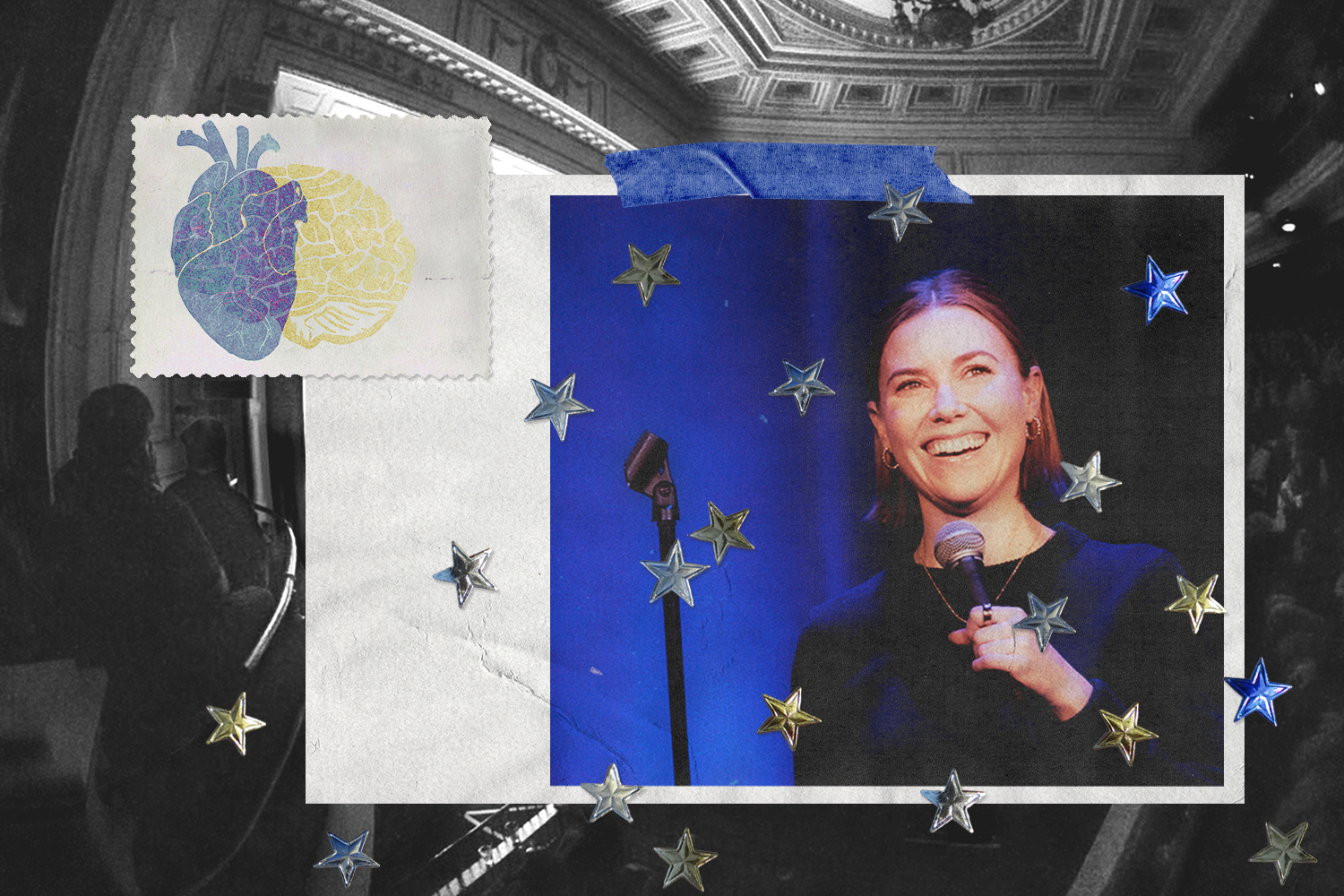
The catharsis is also helpful for when the stories aren’t embarrassing at all — but downright painful. Touching on it briefly in Mark Your Territory, Cook says she’s been making the experience of her mother’s dementia a much bigger part of her new material.
“Watching my mom go through dementia has completely changed me as a person,” she says. “I think if you were to have a brain scan of mine from before she had dementia to now, it would actually show a wildly different brain. I think it’s changed me on that level. It is so difficult to have what they call ‘complicated grief.’ You’re in this purgatory because you’ve lost the version of the person that you’ve known your whole life, and yet there’s still this version that you can hug and talk to.”
Going through this difficult emotional period, Cook actually says she feels fortunate in a twisted kind of way. “I feel lucky that my job is to make people laugh,” she explains. “I think if I didn’t try to find any levity in some of these moments, I would only just cry forever and ever. And that’s not what she would like. Recently I was in the hospital with her because she had a very sudden decline. She’s better now, but when we were in the hospital, she pointed to me and she said, ‘I like this girl.’ And I was like, ‘Yeah, I’m your daughter.’ And she goes, ‘Hmm. I don’t know about that.’ And I’m thinking to myself, we’re literally in the hospital where you gave birth to me. Of all the places to be like, ‘I don’t think so,’ I was like, ‘Oh my god, the irony.’”
“When she talks about her mom, she’s sharing the love she has for her,” says Daniels. “She’s been receiving all of these messages from people who are dealing with the same thing, and saying, ‘Hey, thank you so much. I feel seen because you did this.’”
Between the podcast Pretend Problems that she co-hosts with Daniels and an approach to comedy that has only become more and more personal, Cook lays a lot about herself quite bare. Compartmentalizing aspects of herself isn’t something that comes naturally to her. She has an innate need to share, and to do so in a way that feels funny.
“I just feel it,” says Cook. “If something feels ready, then my brain starts to almost naturally work, ‘Oh, okay, what if I were to talk about this on stage? What would that sound like? How would I say that?’”
Photography: Images of Kelsey by Bryan Lasky
All other photos via Getty