
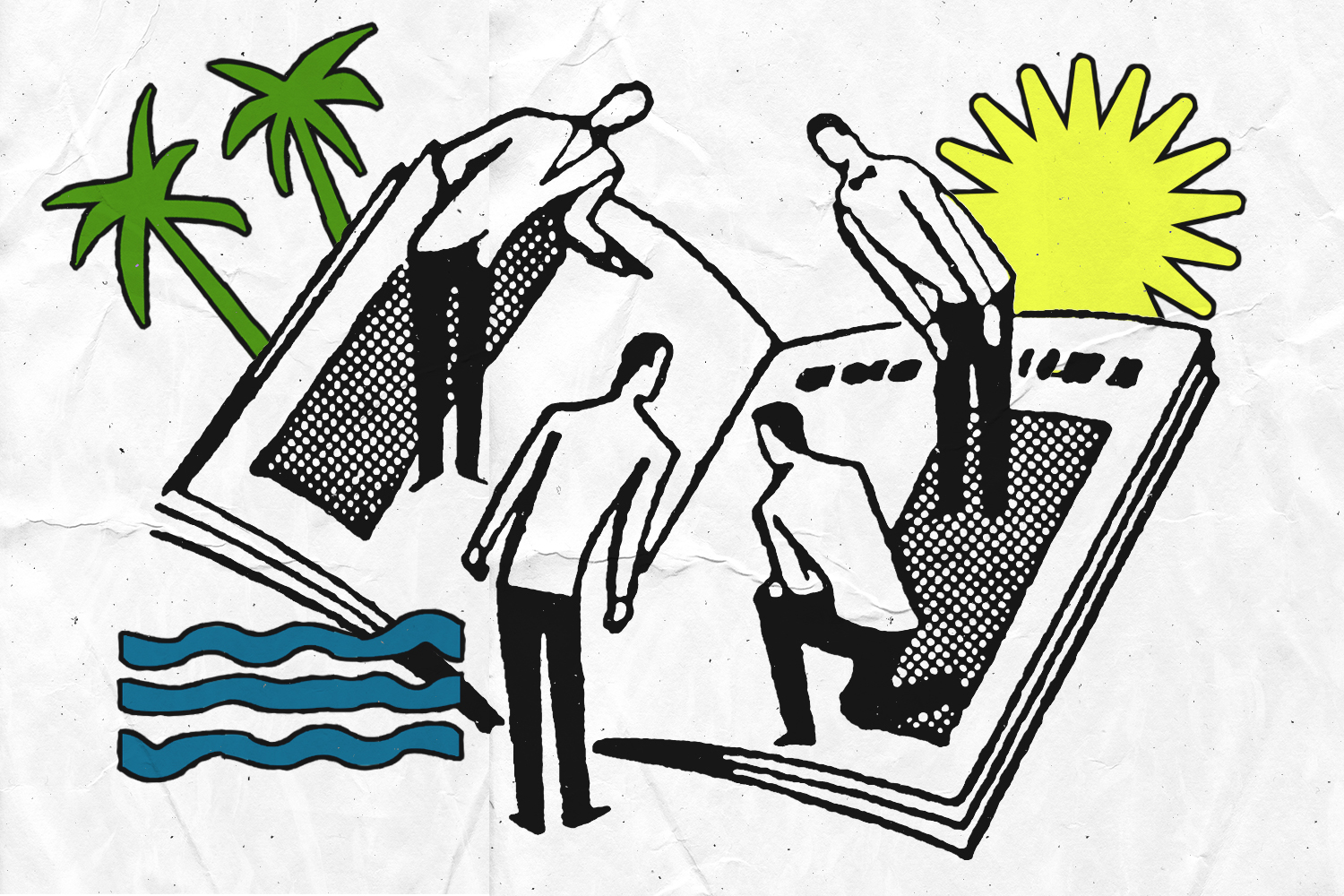
America’s literacy crisis is, well, still a crisis. Recent studies have found that four in 10 Americans didn’t pick up a single book last year, and even counting those who did, a majority of reading totals clocked in at fewer than four books. I won’t sugarcoat it: Those statistics are bleak and are constantly getting bleaker, even for readers across the country. Yet looking at travel trends may tell us a different story.
Set-jetting, or planning one’s travel based on locations that have been featured in film, television or other pieces of popular culture, only continues to surge in popularity. According to an October report by Expedia, 81% of Gen Z and Millennial travelers are now planning their vacations around TV and film locations. Just this year, marquee television shows like The White Lotus and Downton Abbey have inspired pilgrimages across the globe to filming locations, landmarks and communities.
Chalk it up to art’s mobilizing effect, our desire to get so close to the thing that we’re practically of it. Maybe it’s hive mind, groupthink and pop culture-mediated celebrity brainwashing. I’d say we just love it when a piece of media can make us feel something, so we want to chase that feeling as far as we can — even if it means jumping on a plane for it.

A Film and TV Buff’s Guide to Exploring North East England
The idea of set-jetting allowed me to experience my home country in a totally new wayI haven’t done much set-jetting myself, but even when I’m not flying around the globe, I’ve made it a point to see some of my favorite pop cultural touchstones during my travels. Whether I was taking a picture walking across Abbey Road or opening the door to Los Angeles’s Pink’s Hot Dogs bathroom just like the assassins did in David Lynch’s Mulholland Drive, I’ve found an inimitable type of gratification, a puckish joy that comes from recognizing the locales of your favorite movie or show. I think it has something to do with entering into a community of people who can say, “I was there, too, and I got it.”
Yet literature, possibly for its lack of concrete, universal imagery, would seem a less likely impetus to jet off, not to mention that the stereotypical “escapism” associated with reading often doesn’t require leaving the house. But according to Condé Nast Traveler, thanks to BookTok romantasies and Elena Ferrante’s Neapolitan novels alike, we’re entering into a new era of literary-inspired travel. Our own travel editor, Lindsay Rogers, predicted it: In 2026, men will plan a vacation based on a book.
I’m all for it, in the way that I’m all for anything that’s getting more people to read or excited about reading in new ways. But as much fun as set-jetting and its associated series of recognitions can be, there’s still something missing from simply visiting a locale or stopping for that perfect picture, even when it’s from our favorite books.
But Brooklyn-based Mikey Friedman has a different idea for literary travel, one that foregrounds the experience of reading itself. It starts, he tells me, with reading out loud. He founded his literary retreat company, PAGE BREAK, in 2024, though the idea had long been brewing in his iPhone notes app and populating his barstool conversations. The conceit is simple: About once a month, 15 strangers leave their busy lives behind for a weekend getaway. During the course of three days, they read a book together — out loud — switching between readers every two pages. Local chefs dream up menus themed around scenes, quotes and characters from the books. Sommeliers and other wine pros host pop-ups and arrange pairings.
Take their July 2025 retreat as a case study. Stephanie Wambugu’s widely acclaimed Lonely Crowds instituted a three-day glamping trip to the Adirondacks with kayaking and canoeing as part of a partnership with Treetop Journeys. In October, critic Grace Byron’s debut horror novel Herculine was the centerpiece of a Halloween-themed trip to a cozy cabin in Cold Spring, with chef Lana Lagomarsini “cooking the books” and preparing two themed dinners. PAGE BREAK has teamed up with brands including The North Face and Hinge, brought readers to the Catskills’ Starlight Motel, and orchestrated day trips in the heart of Soho. January 2026 marks PAGE BREAK’s 18th retreat, the first one on the West Coast. On January 23, fifteen lucky readers set off for The Joshua Tree to read Vigil, the phantasmagoric latest novel by #1 New York Times bestselling and Booker Prize–winning author George Saunders.
Somewhere between kayaking in the Adirondacks and hiking through Joshua Tree National Park, attendees participate in formal and informal discussions about the book. “I try to think of a book that’s gonna be a little bit provocative,” Friedman says. “It might make people uncomfortable and force us to reckon with big ideas and have more substantive conversations.”
Even if the books they read do, at times, force attendees to consider difficult, uncomfortable ideas, the atmosphere Friedman creates is built on comfort, community and shared humanity. This is especially the case for people who find it difficult to devote the time to reading outside of their busy schedules. “I came up with the idea in 2019, talking to a friend about book clubs,” Friedman says. “Book clubs are great, but also for busy New Yorkers, it’s hard to commit to a book club, and a lot of book clubs don’t survive for that reason, because I think people are pulled in lots of different directions. They’re traveling. They’re working.”
The original vision for PAGE BREAK wasn’t unlike a compressed book club, but it’s since grown into something much bigger. Much of that starts with something as simple as reading aloud. Friedman tells me about coming across an organization called The Reader, a NHS funded U.K. charity using reading aloud as group therapy at places like prisons and nursing homes. “It helps you feel more connected to other people,” he says. “It helps you feel less alone in the world. I think that’s the thing that surprised me most: How reading aloud is like a really beautiful shortcut to intimacy and vulnerability.”
This intimacy is at the heart of PAGE BREAK’s mission and what separates them from other trends and movements in book-related travel. “It’s, like, Team Building 101,” he says. “By the time we sit down for dinner on the first night, everyone’s already fast friends and really comfortable with each other. And by the time we leave on Sunday after a weekend together, everyone has these really beautiful new friendships.” Trust, according to Friedman, is the fortress of these connections. It begins in a PAGE BREAK reading circle, sentence by sentence, two pages at a time. Everyone is all in.
Friedman’s integrity in his organization’s mission is certainly not to be confused with a lack of ambition for PAGE BREAK’s future. Their recent California event is just the beginning. The model, he explains, can be easily recreated in other cities. In the future, he hopes to institute flagship locations in other major cities across the nation.
And Friedman is interested in set-jetting, in a way that more closely honors the literary methodologies behind PAGE BREAK. “Let’s just use Italy as the example,” he says, getting increasingly more excited about the ideas he has for the future. “We can go to Italy for close to a week instead of just two nights, and then we read two books: Maybe one book that’s set in Rome in the 1980s and one that’s set in Rome in 2013, and we can do some comparative literature.”
Though his excitement is palpable, Friedman is careful not to get ahead of himself, prioritizing slow growth and the tethers he already has to his communities. “It’s a quality over quantity type of business,” he says. “What makes PAGE BREAK special is it’s a really intimate experience. If you’re one of the 15 people who come on a retreat, you’re one of only 15 people who ever get to experience that thing.” Relationships, acceptance and openness are embedded into the very structure of PAGE BREAK. Intimacy is the payoff of Friedman’s intentionality.
After more than a decade in advertising, Friedman knows the market, as well as its perils. Newer to the publishing world, he was surprised by how difficult it’s become for emerging authors to launch their careers, especially those writing the thorny, boundary-pushing types of books he’s interested in.
“It’s really hard to launch a debut book,” he says. “In my early research of the book industry, I was pretty alarmed at how few people buy literary fiction.”
And so he centered PAGE BREAK around literary fiction in particular, a genre rarely afforded the sort of mainstream playfulness of, say, a themed meal. The authors he selects are often debut novelists. Many have been queer writers, engaged with queer storytelling. Many come from smaller, independent presses and publishers (like July’s pick, Palestinian journalist Yasmin Zaher’s debut novel The Coin, published by Brooklyn’s Catapult Press). All are stories with stakes: for their authors, their readers and the communities they fashion together. Friedman was excited to point out that for 18 retreats so far, 18 of the authors had agreed to participate in a Q&A on the retreat, whether in person or via Zoom.
“There are a lot of different ways to build the world out around the book,” Friedman says when I ask him about his plans to expand. The idea here, of building the world out around the book, seems to be PAGE BREAK’s crux and what separates Friedman’s vision of literary travel from mere set-jetting.
Whether he’s annotating PAGE BREAK books for food references for chefs, meticulously scheduling multi-day itineraries that allow participants to give up their phones or just starting a reading circle in the middle of the grass, Friedman is committed to building a world not just for visitation, but for participation. And with books so visceral, we’d be foolish not to chase their feelings, to delve so far into their worlds that we come out with new understandings and new friends. In other words: to recognize and be recognized by them, two pages at a time.
More Like This



We're always on the scene eating, drinking and traveling near and far to bring you the best of what's happening out in the real world. Sign up for IRL now.