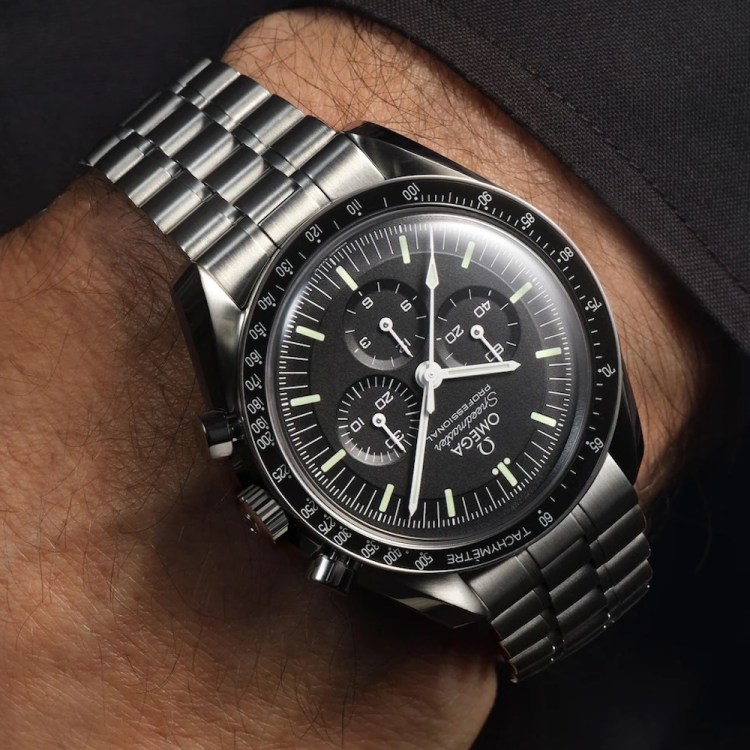
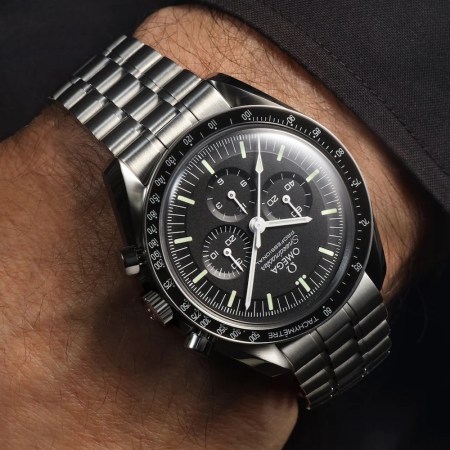
For many, the story of Omega’s chronograph production begins and ends with the Speedmaster, the NASA-approved, hand-wound tool watch introduced in 1957. Of course, the brand’s history in stopwatch technology extends much farther back than that. Having specialized in pocket watches throughout its first six decades, it manufactured an early wrist-worn chronograph in 1913 on the eve of the First World War. From there, it expanded into single- and double-pusher models throughout the 1930s and 1940s. By the time the late 1950s rolled around, the company was well poised to marry its design experience with a workhorse Lemania movement in the creation of a dedicated racing chronograph.
But while the Speedmaster became a central tenet of the Omega story once NASA approved it for manned space flight, the Swiss marque continued to work on other innovative chronograph designs through the late 20th century. Housed within the Seamaster, De Ville and other collections, these watches might not have the cachet of the Moonwatch, but their hardy construction, cool looks and first-rate movements have made them excellent buys on the vintage market, where they continue to fly under the radar. One model in particular that perhaps best exemplifies this confluence of factors is the Chronostop, a unique, pared-down chronograph geared toward a younger buyer.
The Chronograph, Simplified
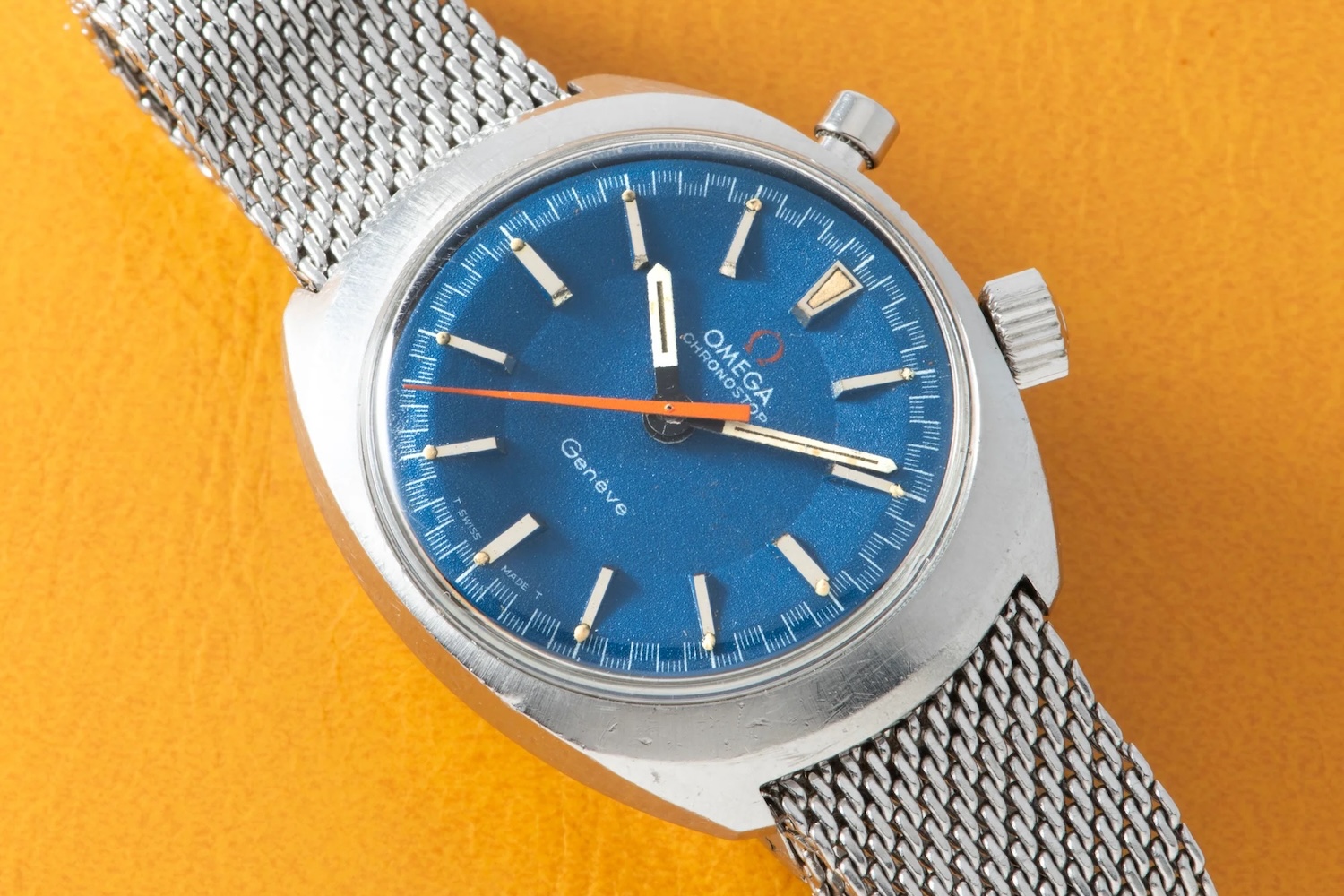
On a typical two-button chronograph, central hour and minute hands are joined by a small running seconds subdial and either one or two totalizers tracking elapsed minutes and hours. Elapsed chronograph seconds, meanwhile, are tracked via a central hand that only runs when the chronograph is engaged. In 1966, Omega debuted a watch that completely stripped down the typical chronograph layout in order to accommodate a more affordable price point. In this layout, the subdials are removed completely. So how does it work, exactly?
When the single chronograph pusher is depressed, the central seconds hand begins its journey around the dial. When the button is re-engaged and held down, the elapsed seconds can be read. Remove one’s finger from the pusher, and the seconds hand snaps back to zero, ready to be redeployed with another button push. Of course because there is no minutes totalizer, elapsed minutes must be memorized if they are to be registered at all, which means the Chronostop is really only useful for measuring short intervals of less than 60 seconds. Use cases for such a chronograph include doctors taking a patient’s pulse or an engineer making a simple output calculation. Despite their limited utility, however, the Chronostop sold well enough for Omega to continue its production for at least four years. (Total production is estimated at roughly 185,000 pieces.)
Housed in either C-shaped cases as part of the Seamaster collection or cushion/oval-shaped or integrated-bracelet cases as part of the Genève/Dynamic line, the Chronostop was produced from 1966 through the early 1970s. While the great majority of the total production was in stainless steel, a limited number were made with gold-capped steel housings. Regardless of orientation (more on this in a moment), the single chronograph pusher was always located at 2 o’clock while the crown was located at 4 o’clock. On certain references, the watch was meant to be worn on the underside of the wrist with the crown and pusher oriented toward the hand. Hence, these had dials rotated 90 degrees to coincide with this orientation.
Funky ‘70s design sensibilities made themselves known, not only in case design, but also in bold use of color on the dials. Many of these are highly-saturated in blue, green, burgundy, grey, black and more, while others featured bright orange and yellow scales and inner bezels in contrasting shades that both increased legibility and also upped the “fun” factor for a younger clientele. 1/5th-seconds tracks were common to the Genève references, while Seamaster references contained one of numerous scales — tachymeter, pulsometer, decimal or telemeter — or even a rotating inner dive bezel. And while date-equipped versions sometimes featured stepped “pie-pan” dials, dateless references featured flat dials. Each date version also featured the “Omega” wordmark and central seconds hand in orange.
Genève References and Japanese Market References
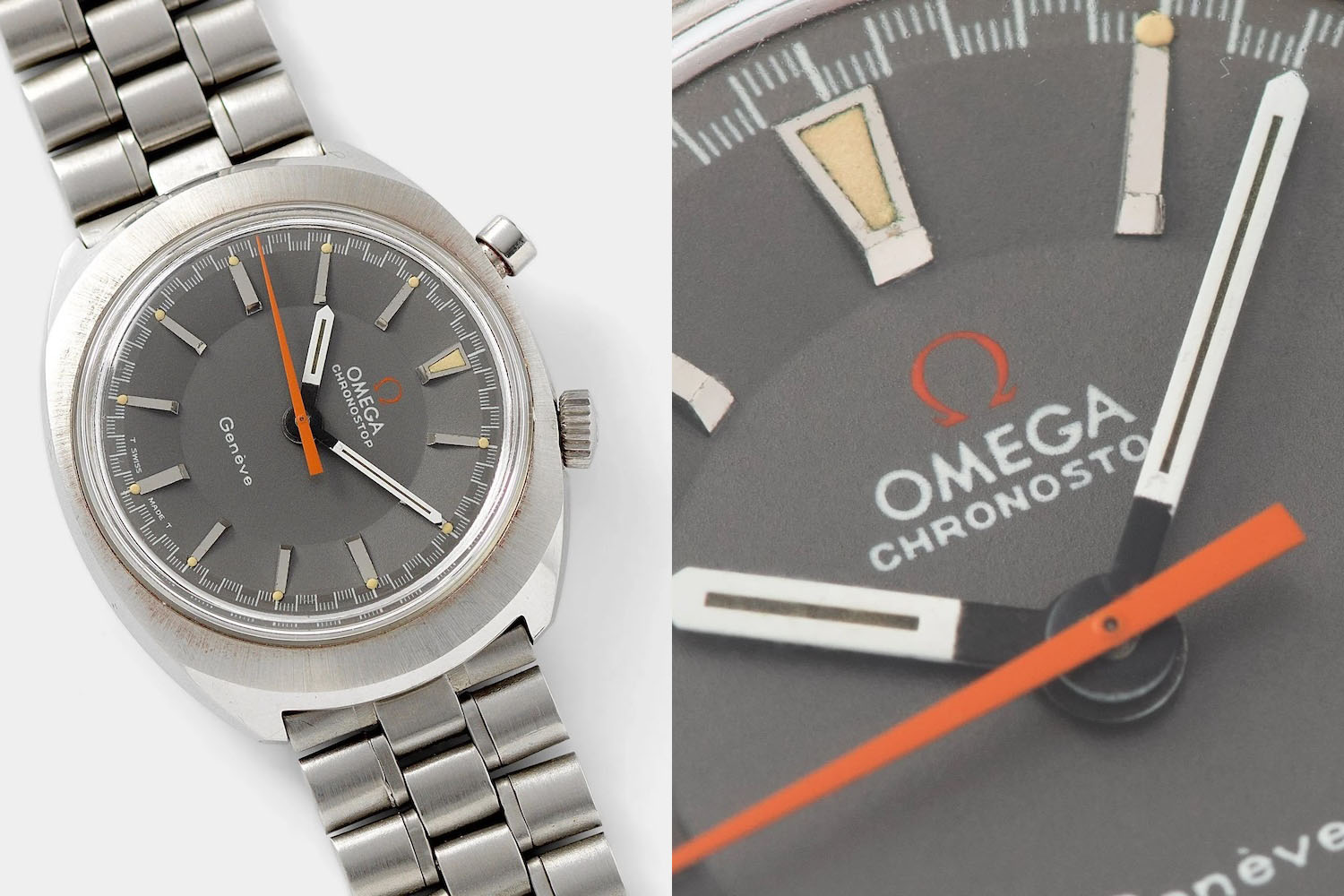
The Chronostop was launched in 1966. Within the Genève collection, it was available as reference 145.009 powered by the no-date Omega cal. 865, a hand-wound, cam-activated movement and a stripped-down version of the brand’s cal. 860 (a precursor to the mythical cal. 861 modified to feature only chronograph seconds). The 90-degree rotated version, the ref. 145.010, was otherwise identical to the ref. 145.009.
Omega also produced a date-equipped version powered by its hand-wound cal. 920 with reference 146.009 as well as a 90-degree version of that watch, the 146.010. Thus any Chronostop carrying a reference beginning with “145” should be a no-date version, while any reference beginning with “146” should be a date version. Likewise, any “009” reference should be in standard orientation while any “010” version should be the “driver’s” version with rotated dial.
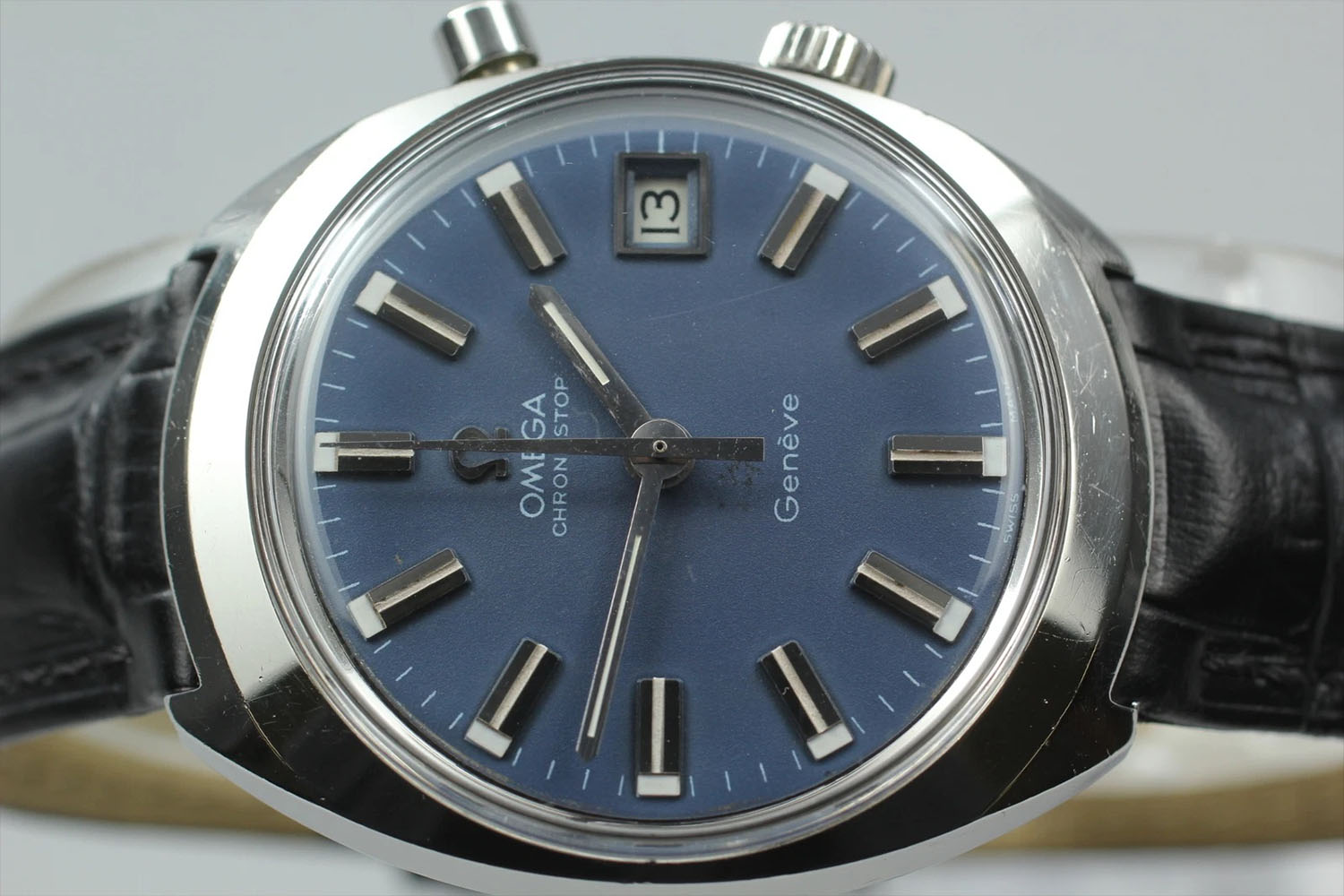
Each Genève Chronostop, regardless of reference number, featured a tonneau-shaped case with a signed, knurled crown without guards; a screw-down caseback; downward-sloping, radially-brushed bezel; slightly hooded, polished lugs; and a polished caseband. A special Japanese-market version, however, features a polished bezel to match its dressier, flat dial. Executed in white or blue, it withheld the 1/5th-second track in favor of applied indices, a sword or spear-tip seconds hand; an applied Omega logo; and an applied date window. Each of these Genève family Chronostops carried a factory water resistance rating of 30m and a lug width of 18mm.
Paired to the “driver” models was generally a solid or rally-style leather style strap in a tone matching the dial with a steel deployant clasp — period Omega literature actually suggests having this personally engraved — or a Milanese bracelet ref. 1120/116 with a deployant clasp. Japanese market references were likewise often fitted with this bracelet type. Other available bracelet types were the Omega flat-link references 1035 and 1098 (the latter succeeded the former, chronologically), both of which were also paired to certain Speedmaster references.
Genève/Dynamic References
An oddball version of the chronostop that debuted in roughly 1970 (the ref. 146.012) was alternatively signed “Genève” and “Chronostop” or “Dynamic,” the latter being a funky collection created for the Prix de Ville de Genève in 1965 and launched publicly in 1968 that made use of its own bracelet attachment system. Housed in a radially-brushed, UFO-shaped case with the Dyanmic’s unique, semi-integrated steel bracelet ref. 1153/138, it was produced in numerous flat-dial configurations similar to the standard Genève references with date.
Seamaster References
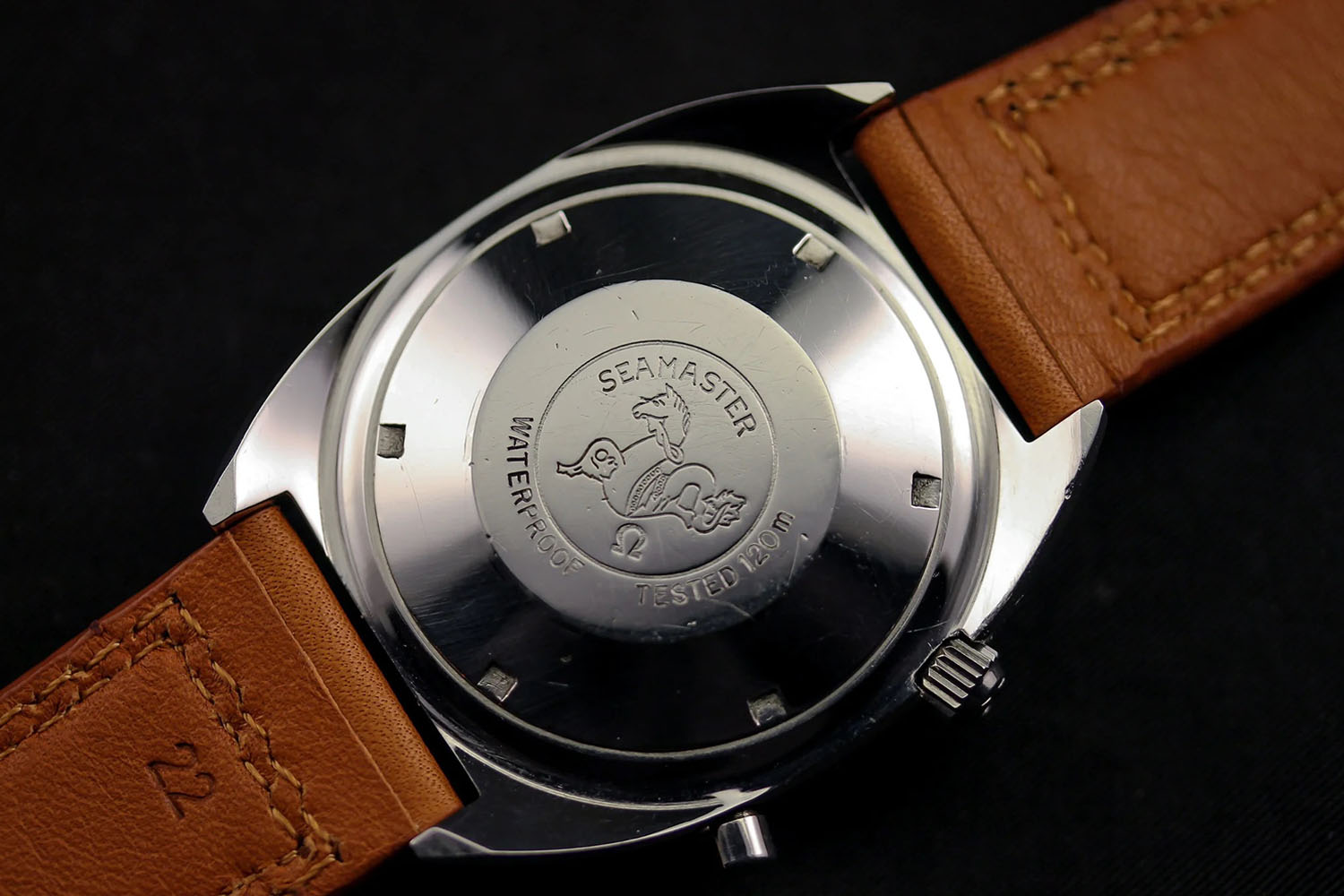
Two other Chronostop references (145.007 and 145.008) were housed within the Seamaster collection and oriented vertically in C-shaped cases with 120m of water resistance. The first featured a fixed inner bezel with one of four scales — what Omega referred to in the 1960s as the “tachoproductometer” (“tachymeter”), pulsometer, decimal or telemeter. The dial on this reference was black in a stepped configuration with the outer section featuring the aforementioned scale in white printing; a central section in white featuring a 1/5th-seconds scale in black printing; and an inner black section featuring applied dial furniture with a luminous 12 o’clock marker and a luminous sword handset with an orange seconds hand.
The reference 145.008 is perhaps the most compelling Chronostop iteration for tool watch enthusiasts. Likewise housed in a C-shaped stainless steel case, it featured an additional crown at 10 o’clock to control an inner rotating bezel. This bezel held either a standard dive (“count-up”) insert for elapsed time calculation; a countdown insert for calculating the time remaining until a fixed starting point; or a combination 12/24 hour bezel for tracking a secondary time zone. The dials were otherwise the same as those on the reference 145.007. Both watches were sold on either a leather strap or a stainless steel multi-link bracelet ref. 118/123.
Collecting the Omega Chronostop
While it’s probably unwise to comment on specific pricing — which changes as rapidly as the weather and is largely inflationary in the long run — it’s safe to say the Chronostop is an overlooked model within the greater Omega catalog. While most focus on the triple-register Speedmaster (which is admittedly much more useful for timing longer intervals) and the Seamaster diver references, they ignore the funkier late-1960s/early-1970s output that gave birth to collections such as the Chronostop. Still, Omega is a watchmaking powerhouse, long capable of outputting tens (or hundreds) of thousands of any given reference during a short period of time. These factors combine to mean that the market is full of interesting (and comparatively affordable) watches.
Well-sized and produced in a variety of funky configurations and highly eye-catching dial colors, the Chronostop is emblematic of the brand’s daring mid-century watchmaking. Outfitted with an in-house caliber based on an old Lemania movement and designed with particular use cases in mind, it stems from an age when watches were still genuine tools designed to do a specific job. In the 2020s — as color, design and smaller case shapes are making a comeback — they just may be the perfect modern tool watch again.

More Like This
The world of men’s style, from the streets of NYC to the showrooms of Milan, run down weekly by writer and photographer Christopher Fenimore.