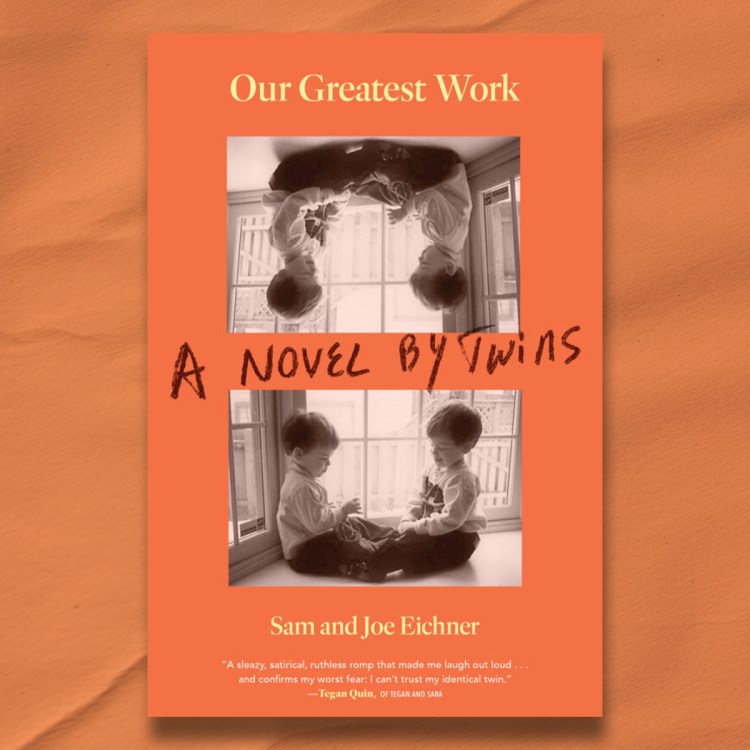
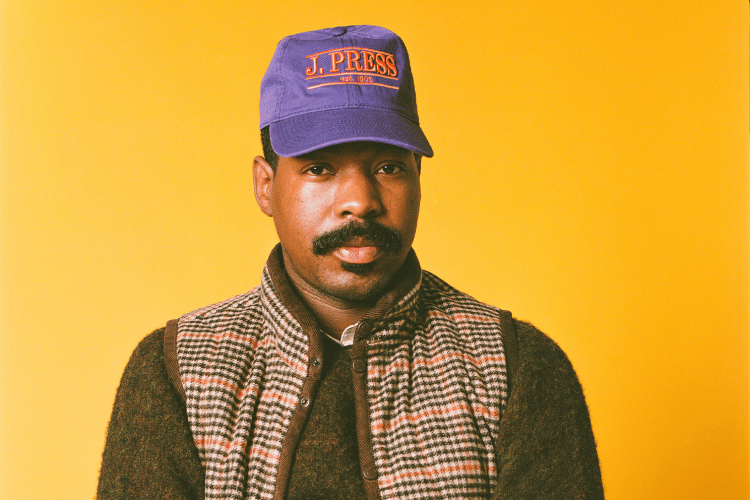
Any fiction writer is familiar with the solitude the craft requires. While there are friends, agents and editors available to read drafts, the ideating is all mental, and the creation is all on your own. It’s one of the reasons I was particularly drawn to Joe and Sam Eichner’s debut novel Our Greatest Work, out Nov. 10 via Akashic Books. How do you co-write a novel without getting in your own head about whether the words on the page are truly yours or someone else’s?
The book is set in the present day, following fictionalized versions of Sam and Joe on the way to their 10-year high school reunion. Told in alternating chapters from each of their perspectives, they recount the history of their relationship and what led to their current estrangement, and as they near the reunion, many strange, silly twists follow. While there is plenty of ruminative melancholy that’s the stuff of literature told in the first person, there’s also plenty of distinctly cinematic tropes pulled straight from American coming-of-age comedies — Eurotrips with precocious young adults, a squabble that turns into a stabbing and never letting go of what happened in high school. This, plus a significant cameo from Anthony Rapp, the lead from the original production of Rent, makes this screwball novel a lot of fun, with plenty of profundity between the pages.
In keeping up with the spirit of the novel, I spoke with the twins separately, asking them the same set of questions to see how their answers would differ, and I tasked myself with piecing together an interview that flowed between their perspectives while trying to tell a fuller story about how they view their work and what the fiction project allowed them to do.
Minh Tran: Whose idea was it to co-write a book?
Joseph Eichner: It was Sam’s idea. He’ll own it. We had started over the pandemic, when we were both stalled out on our own projects and had never really written together. We had an idea for a screenplay and then we did this Substack together that had this back and forth. And at one point Sam was like, “Should we just try this in book form?”
Sam Eichner: It was definitely mine. We had written a script together over COVID and then we had written this incredibly niche Substack about topics that nobody cared about.
MT: Could you give me some examples?
SE: We wrote one about the Halloween episode of Boy Meets World. And then we had one about Axe body spray at summer camp, which was super specific. There was one I really liked about the STDs in Whit Stillman’s The Last Days of Disco, which I actually think was somewhat of a co-analysis of that movie in time, which I love. But it was essentially a dialogue between us that we would edit down. And at one point I was like, should we just try doing this with fiction because we both wrote fiction.
MT: Did your guys’ interest in becoming writers emerge around the same time?
JE: I think we were both interested in writing from a really early age. Our dad is a huge reader. He collects pulp noir, old books, old paperbacks, and we would go with him to different bookstores growing up. I went to college and majored in English and was doing creative writing and Sam did journalism because he thought it would be better for a career, which, as you know, sort of went haywire.
SE: I think I got into it first. I remember in high school — this is where I actually think my memory of high school might be blending with the book — Joe did theater for a little bit, and I was definitely more interested in writing fiction and remember writing a short story junior or senior year of high school. But then he pursued it more seriously than I did in our 20s.
JE: I was more committed to fiction than Sam was in our 20s. And then as his journalism jobs dried up and he wasn’t writing as much for a living, Sam went back to writing fiction. And this was around the time that we conceived of this project.
MT: What was the writing process like?
SE: In the beginning it was really fun. We wrote the first draft extremely quickly, over three or four months. Joe would have an idea for one chapter from his perspective, and then I would have an idea for a chapter that would maybe come after that and then we would swap pages and meet to discuss where it would go next. We probably traded a chapter every week or two, which was a really fun way to write a book. That draft is completely different from what we have now, but it was a good way to get to the end of something.
JE: It moved really quickly because you’re just getting feedback immediately from someone you trust who’s co-creating this thing with you, which was a really awesome way to do it because fiction is so solitary.
MT: Did anyone end up waiting on the other for pages more often than not?
JE: Me. I’m always waiting for Sam.
SE: It would certainly have been Joe waiting for me because I’m slower at writing. Joe is sometimes intimidatingly prolific. He is not scared by the blank page at all.
JE: I’m so much more used to getting words down on the page and moving on from there because it’s what I do for my job, and he hadn’t been doing that for a while.
SE: But as the process got further along, more of my chapters stayed the same and he had to rewrite things based on where we had decided the story would go.
JE: Sam is useful in that regard because I can be really quick and want to be like, “Let’s send it to our agent,” but he’s more patient and that’s very valuable.
Loose Tooth Press Subverts the Age-Old Literary Model
If a recent standing-room-only reading in Brooklyn is any indication, Maggie Kennedy and August Lamm’s experiment is workingMT: You guys are both co-writers but also each other’s editors and first readers. Can you speak about what you gain from co-writing and undertaking an endeavor which is usually quite solitary? Do you lose anything in the process?
JE: The gaining part is easy to answer because as a fiction writer, you constantly feel the need for a draft to be perfect because you only want to ask XYZ friend to read 200 pages one time. I want it to be in good shape. So, it’s helpful to have someone who you can bounce things off of and show a rough cut to and not feel insecure about it.
SE: There was something incredibly freeing that we could just show it to someone right away and not be judged, understanding that we’re working on it and working on it together. I would say the potential pitfall of that, and probably why it took us so long to finish the final draft, was that Joe and I have super similar tastes. You can get into an echo chamber, which usually when you’re giving feedback or when you’re soliciting feedback, it’s from someone who’s not part of the project.
JE: We mind-melded on the [novel], but I do think that there are aspects of my individuality, of who I am as a person and a writer, that get hampered by that and what Sam’s aesthetic vision is. For instance, I can be a lot more academic-minded or want to bring in research and outside texts. And Sam is like, if it’s not related to the twins plot, we got to cut it. He’s very focused on clarifying the story, which is super helpful.
SE: Joe tends to write too much and I tend to write too little. And so, I feel like we’re generally very good editors for each other. And before this and since then, I’m always his first read and he’s always mine.
MT: The jacket copy posits this book as being inspired by the work of Elena Ferrante. I’m wondering if you find the phrase “Ferrante for Boys” to be an accurate designation of your novel?
JE: I would be happy for you to popularize that phrase around this book. But I almost wonder if the new Chad Harbach book or something would be more Ferrante for the boys because we’re not really operating in the same register as she is. It’s less realistic. It’s much goofier and more absurd.
SE: I think we used that as sort of a lodestar, especially during the editing process. When I’m reading a book, I can sort of get how this was constructed, you could sort of see the seams a little bit. In her books, it’s really hard to see the seams of how we’re suddenly in the past and then the present. But what makes those books work to me was that the relationship between the two friends is always central and they’re always coming back to it, pulling everything from the narrative into it.
MT: So much of this book involves writing or thinking about “the other,” which is already so layered and complex when trying to do this about anyone, let alone someone who you have known your entire life, who you were born within minutes of. I’m wondering if you can talk about whether that experience illuminated your understanding of your relationship to your brother.
JE: I think in some ways we avoided writing about each other for a long time. We didn’t want to be grouped together as twins through high school, and we went to different colleges and lived apart for a lot of our 20s. It’s as if we were avoiding going into some of the dynamics between us that were complicated or problematic because we’ve always been twins. I think the big example is, I’m the bad twin and Sam’s the good twin, a dynamic that was set into motion by my mom, as in the book, before we were out of the womb. She said, “I’m the bad one because I was heavier when I was born and I ate the nutrients that Sam needed,” and so that narrative was part of our upbringing, and you start playing the roles that you’re assigned. Sam was the quieter and good one and I was the more outgoing, wild, maybe at times argumentative one. And I think we hit this point where we thought those narratives don’t really feel true to us anymore. And this was an interesting way to exhume that, almost like an exorcism.
SE: I’m super curious to see how Joe answers this because he tends to be more introspective about things than I am. But I think this was one part where the fictional aspect really helped because we’ve thought about each other a lot and I don’t know that I would have had as much to say about Joe if it was less fictionalized. Because [the twins] relationship, something I’ve realized after we had finished the book was in conflict. They’re estranged, but obviously Joe and I are collaborating and we’re working together. And in some ways those relationships, a conflict and a collaboration, are kind of similar — when you’re in a conflict you’re collaborating. But I think the one thing that we built that dynamic on was this notion in high school that I legitimately and generally did feel was Joe is the performer and I’m the audience. I’m the critic, he’s going to be the one who’s very out there, and I’m going to be the one who’s leading from behind.
MT: Last question: Would you do this again?
JE: If there was demand for us to do it again, which is a big ask, I would love to do it again. We had an idea for a sequel, where they go to L.A. and they get involved in some Hollywood noir thing.
SE: If people are clamoring for a sequel, I would be happy to do it again. And I know that Joe and I are interested in collaborating on other things, but in general, he already wrote a novel, which I’m jealous of. It’s really incredible. And people are going to realize how much smarter he is than me.

More Like This
This article appeared in an InsideHook newsletter. Sign up for free to get more on travel, wellness, style, drinking, and culture..