
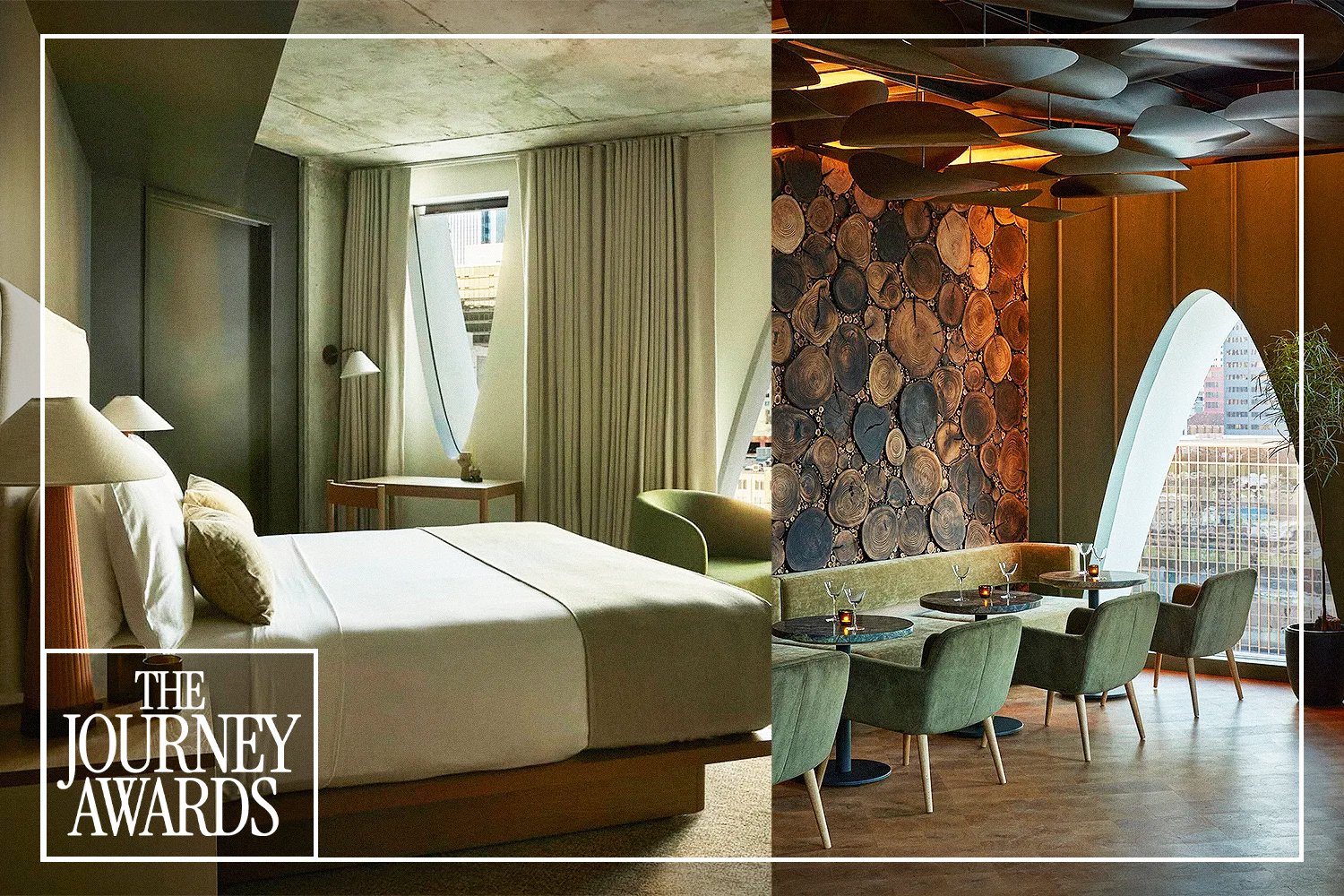
This story is part of The Journey Awards 2026, covering the best in hotels, airlines, destinations and travel products. Find the full awards here.
- A Definitive Ranking of the Best of the Worst Airlines
- The Best Major Airport Lounges, Ranked
- Which Airline Rewards Program Is Right for You?
- “A Room Should Satisfy All the Senses”: The NYC Hotels Raising the Design Bar
- The Best City to Visit Solo Is Also Seriously Misunderstood
As you walk or drive up to Populus Denver, you won’t be the first person who does a double take. The triangular building has a facade designed to look like a dense aspen tree forest, with rows of white columns featuring irregular-shaped windows evoking the knotty eyes of tree trunks. The hotel has a touch of the natural curves of Gaudí, without the over-the-top flash. There’s substance behind the form, with the property’s architectural manifestation representing its under-the-hood dedication to sustainability.
“Sustainability isn’t an afterthought or a feature, but the foundation of everything we do,” says Jon Buerge, the CEO of developer Urban Villages. “Every decision, from the materials we select and the energy we use to the design and daily operations, was made with one goal in mind: to ensure Populus serves as a regenerative force for both its community and the planet.”
The 265-room hotel is LEED Gold certified and sources 100% renewable energy from Colorado wind farms via Xcel Energy. And then they go further: The property, which opened in October 2024, is said to be the first carbon-positive hotel in the U.S., with its efforts continuously tracked via Lotus Engineering & Sustainability to ensure the accountability and accuracy of that claim while gaining insight into yet more ways to tweak and optimize. Suddenly, carbon neutrality sounds like settling.
The numbers and impact can be staggering. Urban Villages acquired 7,000 tons of certified carbon credits with partners including Grassroots Carbon, OneTreePlanted and Terrapass to offset its footprint. In addition, Populus has already planted over 70,000 trees in Gunnison County, Colorado. The hotel operates with a zero-waste principle, using landfill diversion efforts and an on-site biodigester to compost 26 tons of organics via BioGreen 360 Food Cycling, avoiding the equivalent of over 300,000 miles of car emissions. The hotel has created enough compost to fertilize 175 acres of farmland.
Guests can even bring that eco-friendly mentality home, too, as key card holders are studded with wildflower seeds that can be planted in your home garden. And matching the outdoor-centric, adventure vibes of the Rockies, guests receive a promo code to use for a free month of AllTrails+ access.
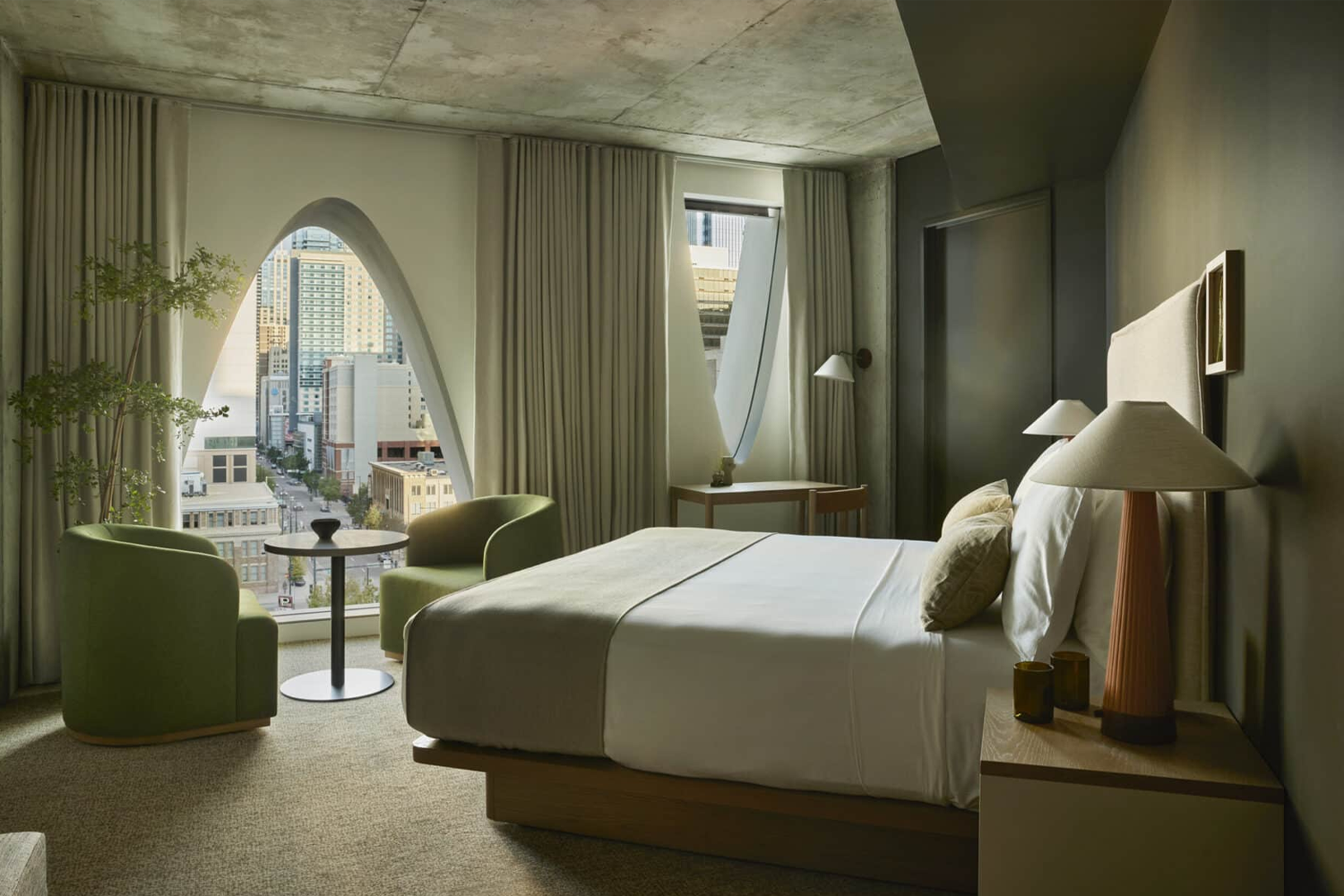
It would all be for naught if nobody wanted to stay at the property, of course. The good news, then, is that Populus Denver delivers a comfortable boutique experience with cozy and well-curated rooms featuring thoughtful amenities throughout, buoyed by several excellent on-site food and beverage venues.

The location is walkable to some of Denver’s sites, such as the Colorado State Capitol, U.S. Mint and Civic Center Park, the latter of which features vibrant garden beds fertilized by the hotel’s compost. “It’s really special to see the tangible impact we’re having not only on Colorado farms but in our immediate backyard, all while eliminating waste,” Buerge says. The neighborhood is also loaded with museums, including the Denver Art Museum, while guests receive free access to the nearby Clyfford Still Museum.
The forest feel continues across the property, with large wooden slab furniture, artwork and recorded bird song providing elevator backdrop audio. The hotel ground floor is said to represent the forest floor, with restaurant Pasque named for the flower that’s the first to bloom in Colorado after winter. A large hanging sculpture overhead is made with Reishi, a mushroom-based leather alternative. Food is seasonal and regional, with local purveyors providing the ingredients for dishes such as a rye tagliatelle with Colorado lamb ragu. Plant-based dishes abound, of course, and don’t skip the savory beignets.
Rooftop restaurant Stellar Jay, representing the forest canopy, makes use of an indoor-outdoor space to serve up open-flame cooking and an agave-centric drinks lineup. Grilled and charred produce plays a starring role, with hearty dishes that make it easy to skip meat without viewing it as a trade-off.
“Whether guests initially booked a stay for its sustainability ethos or for its striking design or exceptional restaurants, the overwhelming response is that they leave feeling more connected to nature and their environment, and that means we’ve accomplished our larger goal,” Buerge says.

Another Deserving Entrant to Know: 1 Hotels
Looking at the scale of a growing brand with almost 20 worldwide locations, 1 Hotels is another innovative leader in the eco-friendly hotel space. Sustainability is built into the brand’s entire concept, and stays at their properties are filled with smart and environmentally friendly amenities.
From one location to another, hotels showcase lush green exteriors and coinciding interior spaces filled with plants and greenery, along with décor made from wood and natural fibers. Look closely at your room, and you’ll start to notice even more.
For instance, at the 1 Hotel Central Park, you’ll find a small hourglass that functions as a three-minute timer. “Because we’re focused on sustainability, we want to give awareness to our guests about how long they spend in the shower so they might use less water,” a staffer told me. It’s included as a small touch and friendly nudge across their properties.
Also seen at the Central Park location was a “1 Less Thing” placard, informing guests they can leave an extra item of clothing from their bag to donate. Other in-room signage encourages you to reuse your towels because “most of our guests do. Sometimes it’s OK to be a follower.”


The Journey by InsideHook
Join over 100K travelers seeking trip ideas, the latest travel news, and all the inspiration you need for your next vacation.
There are dedicated water bottle filling stations, including specialized in-room dispensers in some locations, with filtered water throughout the hotel so guests can feel comfortable filling up a provided recycled glass pitcher at their sink, too. 1 Hotels also has a partnership with Audi to serve as their official electric vehicle, giving guests the opportunity for a test drive, but more importantly, offering complimentary house car services within the immediate proximity. A ride in style for a couple of miles across Manhattan is no small thing in terms of convenience.
The hotel’s Mission Membership takes the idea of a loyalty program into a fresh direction as well. It’s less about accumulating points and more about fostering a deeper connection and a more positive travel experience. For instance, 1% of every qualifying stay is donated to your choice of three environmental nonprofits, and for every new member, the brand plants a tree via Arbor Day Foundation, working on a pledge to support the growth of 100,000 trees in California.
Populus offers several similar initiatives. The hotel has a One Night, One Tree program, planting a tree with the National Forest Foundation for every stay, and awards 1% of revenue to environmentally-focused projects via its Populus Stewardship Grant. A further 1% of restaurant sales is committed towards regenerative farming, a figure matched by Wolfe’s Neck Center for Agriculture and the Environment.
It’s easy to get lost in the minutiae and terminology of sustainable materials and the long names of partner NGOs. But such intensive efforts have paid incredible dividends. “Building a truly carbon-positive hotel required rethinking every traditional process — from sourcing to energy systems to long-term operations — but that challenge is also what makes the project so meaningful,” Buerge says. “It’s driven us to prove that environmental leadership and exceptional hospitality can, and should, coexist.”
Imagine if more hotels made these kinds of commitments, and the way this type of impact could compound to offer sweeping changes. But it’s also up to us, as travelers and consumers, to make our voices heard with our wallets and to support brands who are doing things the right way.
“Today’s travelers expect more from a hotel stay. They’re seeking experiences that reflect their values and contribute to a greater purpose,” Buerge says. “Sustainability has become a defining factor in that decision-making process, particularly among younger generations who view responsible travel as an essential standard.”
More Like This




This article appeared in an InsideHook newsletter. Sign up for free to get more on travel, wellness, style, drinking, and culture..